Poetic Rendering

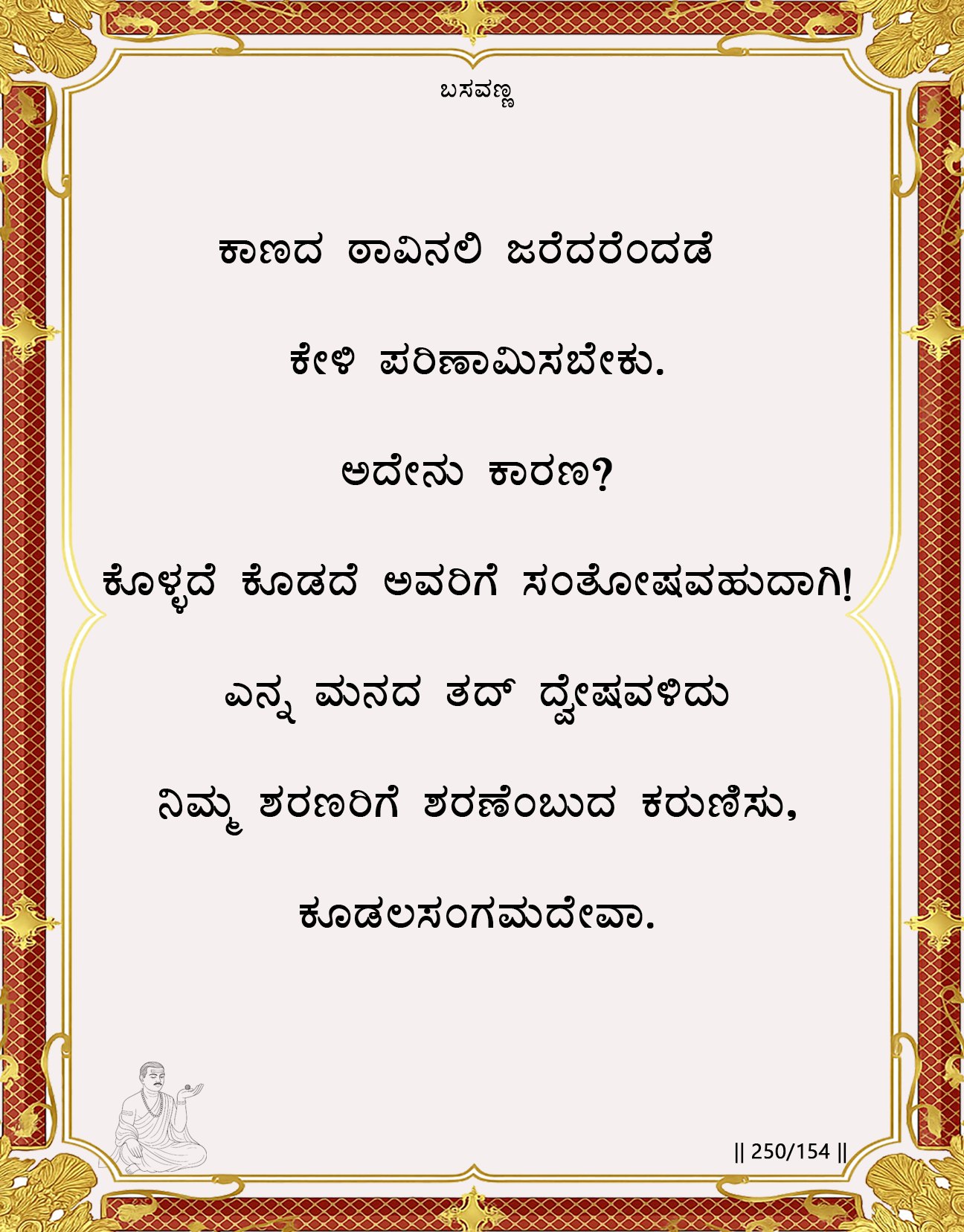
In places unseen and unknown,
if they call us dull or foolish,
let us look within and askwhy?
They beckon us with no offering of worth,
yet rejoice in belittling us.
Let that be the moment
we turn our gaze inward.
For when we search our own hearts,
we see the root that makes us
treat another as an enemy.
And the one who stirs this self-inquiry
even through insult
becomes my teacher, my sharana.
For he awakens the purification within me,
O Kudalasangamadeva.
This vachana teaches radical inner reflection. When others insult or underestimate us, instead of reacting outwardly, Basavanna urges us to turn inward. The pain or agitation we feel is actually a divine trigger, a mirror revealing our own impurities or ego. Thus, even someone who insults us becomes unknowinglya sharana, because they spark our self-purification. Their words are instruments of the Divine’s grace. The core message: Every encounter even hurtful one scan become a doorway to inner growth when viewed through the lens of self-inquiry and devotion.
Spiritual Context
Core Spiritual Principle: The external world is a mirror for the mind. Any negative reaction to an insult is not caused by the other person, but by an unresolved impurity (vasana) within oneself. Therefore, every critic is an agent of grace, revealing where inner work is needed.
Cosmic Reality Perspective: In the non-dual view of Shivayoga, the Linga is the only true reality and actor. If the Linga uses a person to deliver an insult, it is a divine act meant for the recipient’s purification. To react with anger is to mis-identify the source of the action and to reject the medicine offered by the Divine Physician.
Historical Reality (Anubhava Mantapa Context): This Vachana provided a powerful psychological and spiritual tool for a community facing social persecution and ridicule for breaking caste norms. It transformed their victimhood into a position of spiritual power. Instead of feeling oppressed by insults, they could use them as fuel for their own inner purification, disarming their oppressors and accelerating their own path.
Interpretation
“If they call us dull or foolish, let us look within and askwhy?”: This is the pivotal shift from external blame to internal responsibility. The question “why?” is not about the other’s motive, but about the internal trigger the sore spot within one’s own ego that was struck.
“When we search our own hearts, we see the root that makes us treat another as an enemy.”: The “root” is the ego’s sense of separate self, which feels threatened and creates the categories of “friend” and “enemy.” The insult merely illuminates this pre-existing structure of separation.
“The one who stirs this self-inquiry… becomes my teacher, my sharana.”: This is the ultimate alchemy. A “sharana” is a realized being who guides others to God. Basavanna declares that anyone who provokes this profound self-inquiry has performed the function of a Sharana, regardless of their intention. They have become a conduit for grace.
Practical Implications: The seeker is instructed to practice “spiritual judo,” using the force of an insult to throw the mind inward into contemplation. The practice is to welcome criticism as a gift and to immediately use the resulting emotional charge for self-inquiry, rather than for retaliation.
The Cosmic Reality
Anga (Human Dimension): The seeker who possesses the capacity for self-reflection. This Anga is being refined by using the friction of the world as a polishing tool.
Linga (Divine Principle): Koodalasangamadeva as the ultimate truth and the source of all interactions, who orchestrates every event for the soul’s evolution.
Jangama (Dynamic Interaction): The dynamic is the entire process: the insult, the turning inward, the self-inquiry, and the resulting purification. The insulter is an unwitting part of this sacred Jangama movement.
Shatsthala
Primary Sthala: Maheshwara. This Vachana is a perfect expression of the Maheshwara stage, which is defined by intense inner purification (antah-shuddhi). The practice of using insults for self-inquiry is a powerful purificatory fire.
Supporting Sthala: Sharana. The ability to see the insulter as a “sharana” reflects the consciousness of the Sharana stage, where one perceives the divine play (leela) in all circumstances and sees every being as an instrument of God.
Practical Integration
Arivu (Awareness Practices): When feeling hurt or offended, immediately pause and ask: “What in me is feeling threatened? What belief about myself is being challenged?” Do not analyze the other person; analyze the reaction within.
Achara (Personal Discipline): Cultivate a vow of non-reactivity. Make it a discipline to thank someone inwardly for their criticism, seeing it as a mirror they are holding up for you, even if their intention was harmful.
Kayaka (Sacred Action): In your workplace or daily duties, see conflicts and criticisms as your most valuable feedback for inner growth. Let your work relationships be the fire that forges your patience and humility.
Dasoha (Communal Offering): Create a community culture where constructive feedback is valued, and where individuals support each other in using difficult interactions for self-improvement rather than for creating factions.
Modern Application
“Cancel culture,” online trolling, extreme sensitivity to perceived slights, and the inability to handle criticism without crumbling or retaliating. A victim mentality that externalizes all blame.
This Vachana is a master key for psychological resilience and emotional freedom in the modern world. It transforms social media trolls and workplace critics into free personal growth coaches. It empowers the individual by making them the sole author of their emotional state, rendering them immune to insult and converting all conflict into fuel for enlightenment.
Essence
The barb that stings, the mocking word,
A mirror to the self unheard.
The one who throws it, though unkind,
Becomes the guru of the mind.
The Deeper Pattern (The Subtle Body): This Vachana describes a Feedback Loop for Consciousness Evolution. An insult is an external perturbationa disruptive energy input. An unawakened system (ego) responds by amplifying the disruption outward as anger (positive feedback), creating chaos. An awakened system uses the perturbation as a catalyst for internal recalibration. The pain of the insult acts as a forcing function that reveals the system’s unstable parameters (the “root” of enmity). The act of self-inquiry is the system consciously rewriting its own code to achieve a higher state of equilibrium. The insulter is the random mutation in the environment that, by triggering this rewrite, drives the evolution of consciousness.
In Simple Terms (The Gross Body): A wound hurts when you touch it. The problem is not the finger that touches it, but the infection within the wound. The wise person thanks the finger for showing them where the hidden infection is, so they can clean and heal it. The fool curses the finger and lets the infection fester. Basavanna says: be the wise healer of your own soul.
The Human Truth (The Causal Body): No one can insult you without your active collaboration. Your peace of mind is an inside job. The people who challenge you the most are your greatest teachers, for they show you exactly where you are not yet free. To blame them is to miss the lesson. True strength is not the absence of critics, but the ability to use their energy to build a more resilient and compassionate self.

Views: 18