Poetic Rendering

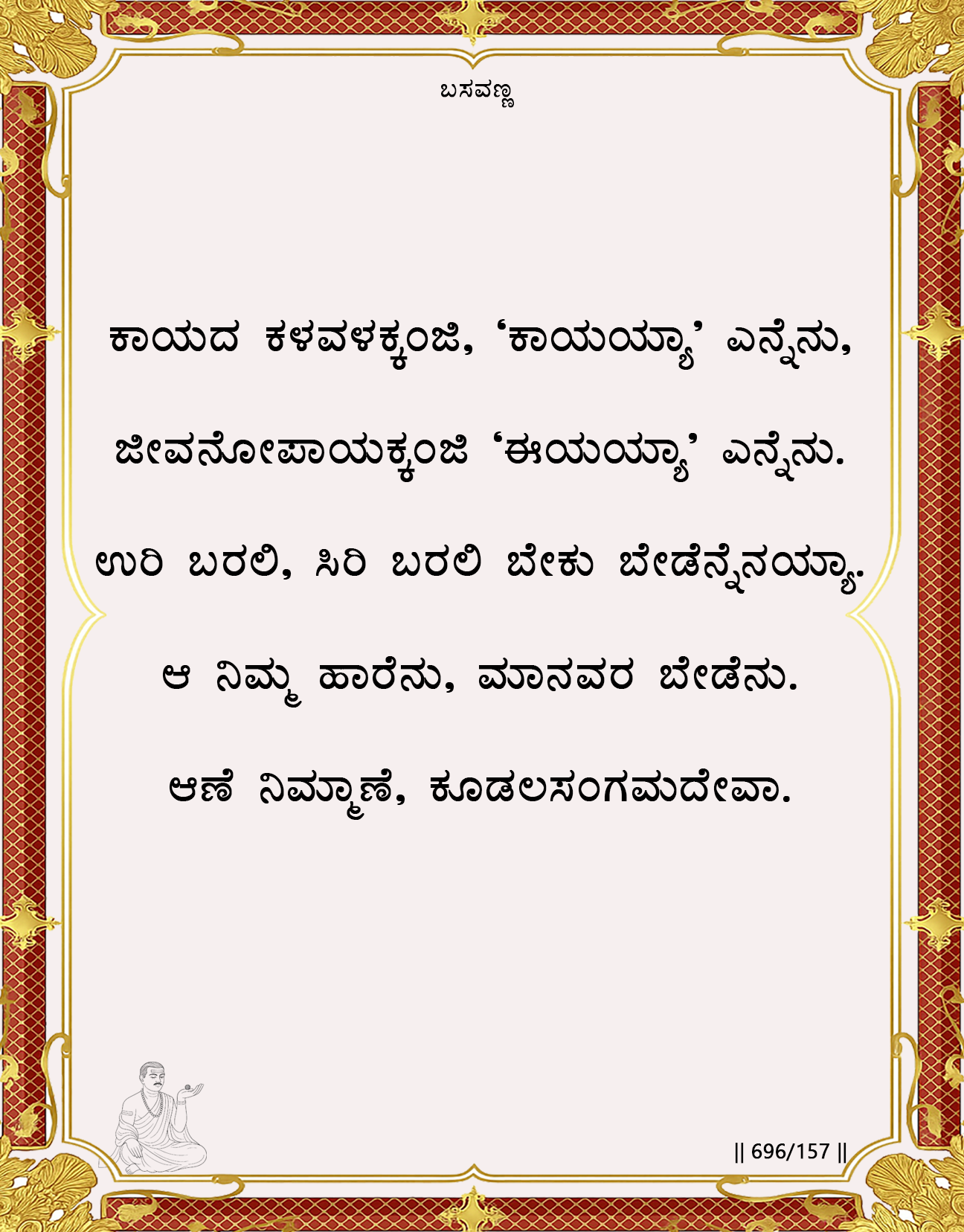
For this body’s needs,
grant me just enough to live by
only by Your grace, O Lord.
For the ways of the world
and its daily dealings,
let Your compassion sustain me.
Whether youth or age,
whether illness or fortune comes,
let them pass as they will
I shall neither cling to them
nor reject them.
I will ask nothing of anyone else,
I will seek nothing from any other.
This is my vow,
O Kudalasangamadeva.
In this vachana, Basavanna makes a complete surrender to the Divine. He asks for only what is necessary for living and for the grace to navigate worldly duties. All other conditionsyouth, old age, sickness, or wealthhe accepts without attachment. His final declaration is absolute: he will ask nothing from any human or any other power except God. The vachana represents the highest form of sharana-dharma: total trust, total surrender, and total dependence on Koodalasangamadeva alone.
Spiritual Context
Core Spiritual Principle: Absolute, non-transactional surrender (Sharanagati). This is the dissolution of the egoic will into the Divine Will, where the seeker relinquishes all personal agency and becomes a perfect instrument of the Divine.
Cosmic Reality Perspective: This vachana embodies the final stage of non-dual Shiva-Shakti dynamics. The individual Shakti (the seeker’s energy and will) ceases all independent movement and completely merges with the foundational consciousness of Shiva (Koodalasangamadeva). The world is not rejected but is re-contextualized as a play of the Divine, to be experienced without ownership or aversion.
Historical Reality (Anubhava Mantapa Context): In a society rigidly structured by caste-based duties and dependencies, Basavanna’s vow is a radical act of social and spiritual emancipation. To “ask nothing of anyone else” dismantles the hierarchies of patronage and obligation, establishing a direct, personal, and sovereign relationship with the Divine as the only true source of sustenance. This creates a community of spiritually autonomous individuals united by this shared principle of divine dependence.
Interpretation
“For this body’s needs… only by Your grace, O Lord.” The body (Anga) is acknowledged not as a self, but as a temporary vessel. Its sustenance is not a right but a grace (Linga’s prasada), establishing the correct relationship between the human and the Divine from the outset.
“For the ways of the world… let Your compassion sustain me.” Worldly action (Karma) is not abandoned but sanctified. The seeker does not act from personal desire but navigates life as a channel for divine compassion, transforming all action into Kayaka.
“Whether youth or age… I shall neither cling to them nor reject them.” This is the core of equanimity. The dualities of life (sukha/dukha, honor/dishonor) are seen as transient waves on the ocean of consciousness. The self, identified with the Linga, remains unmoved, witnessing but not claiming them.
“I will ask nothing of anyone else… This is my vow.” This is the final severing of all secondary dependencies. The seeker recognizes that all other beings and powers are merely reflections of the One. To seek from them is to be trapped in illusion. True independence is found in total dependence on God.
Practical Implications: The practitioner cultivates a mindset of radical acceptance and trust. In daily life, one performs duties with excellence but is detached from outcomes. One meets every situation from prosperity to poverty, health to sickness as a direct manifestation of Divine Will, thereby dissolving anxiety, complaint, and entitlement.
The Cosmic Reality
Anga (Human Dimension): The human is redefined as an empty, receptive vessel. Its needs are minimal, its actions are grace-led, and its experiences are witnessed without egoic entanglement. The Anga is purified by its complete orientation towards the Linga.
Linga (Divine Principle): Koodalasangamadeva is the sole Actor, Sustainer, and Grace-Giver. The Linga is no longer an external object of worship but the inner source from which all life flows. It is the ultimate security.
Jangama (Dynamic Interaction): The Jangama is the continuous, moment-to-moment flow of surrender. It is the active process of offering up every need, every action, and every experience. In this state, the distinction between the one who surrenders and the act of surrendering collapses into the One to whom all is surrendered.
Shatsthala
Primary Sthala: Aikya (Union) The vachana’s concluding vow and its entire mood are not of a seeker on the path, but of one who has arrived. The absolute refusal to seek any other source signifies a state of established union, where the Linga is experienced as the only reality.
Supporting Sthala: Sharana (Total Refuge) The means to reach Aikya is the unwavering stance of the Sharanataking total refuge. The entire vachana is a perfect articulation of this stage, where every aspect of life is placed at the feet of the Divine.
Practical Integration
Arivu (Awareness Practices): Maintain the constant inner mantra: “Not my will, but Thine.” Use every experience, pleasant or unpleasant, as a trigger to remember, “This too is from Koodalasangamadeva.”
Achara (Personal Discipline): Practice contentment (santosha) with what is provided. Consciously refrain from complaining or boasting. Simplify life to reduce dependencies on external, non-essential sources of validation or comfort.
Kayaka (Sacred Action): Perform all work as an offering, without desire for personal profit or recognition. The outcome of the work, whether success or failure, is received with the same equanimity, as it is part of the “daily dealings” sustained by divine compassion.
Dasoha (Communal Offering): Share the fruits of one’s Kayaka from a place of abundance that comes from trusting the Divine source. One gives not as a giver, but as a conduit, embodying the principle that since one “asks nothing,” one also possesses nothing to hoard.
Modern Application
The contemporary world is defined by hyper-agency, anxiety, and a relentless pursuit of security through wealth, relationships, and social status. This leads to burnout, existential fear, and a fragile sense of self that is shattered when these external supports fail.
This vachana offers the antidote: profound psychological freedom through surrender. It teaches how to be fully engaged in the world while being inwardly free from it. By transferring the burden of security from the fallible self to the infinite Divine, one achieves a fearless and unshakeable peace, turning a life of stress into a life of sacred trust.
Essence
A bowl held out for daily bread,
A heart that takes what grace has led.
Sun and storm may have their way,
I neither grasp nor push away.
All other doors are sealed shut now,
One Light, one Vow, one Bow.
The Deeper Pattern: This vachana maps the quantum collapse of the wave-function of individual possibility into the singular reality of the Divine Observer. The myriad potentialities of “my life” (youth/age, health/sickness) are not denied, but they are no longer perceived as personal properties. They are superseded by the one, non-dual state of conscious surrender, where the observer (sharana), the act of observation (surrender), and the observed (life itself) are all resolved into the Linga.
In Simple Terms: It is like a river finally surrendering to the ocean. The river no longer claims its fish, its currents, or its path as its own. It lets go, loses its separate name and form, and becomes the ocean itselfvast, boundless, and complete.
The Human Truth: The universal human struggle is the exhausting effort to control an uncontrollable life. The timeless truth revealed here is that ultimate control is found in the release of control; true power is discovered in acknowledged dependence; and real freedom is achieved not by commanding the world, but by trusting the Source of the world completely.

Views: 4