Poetic Rendering

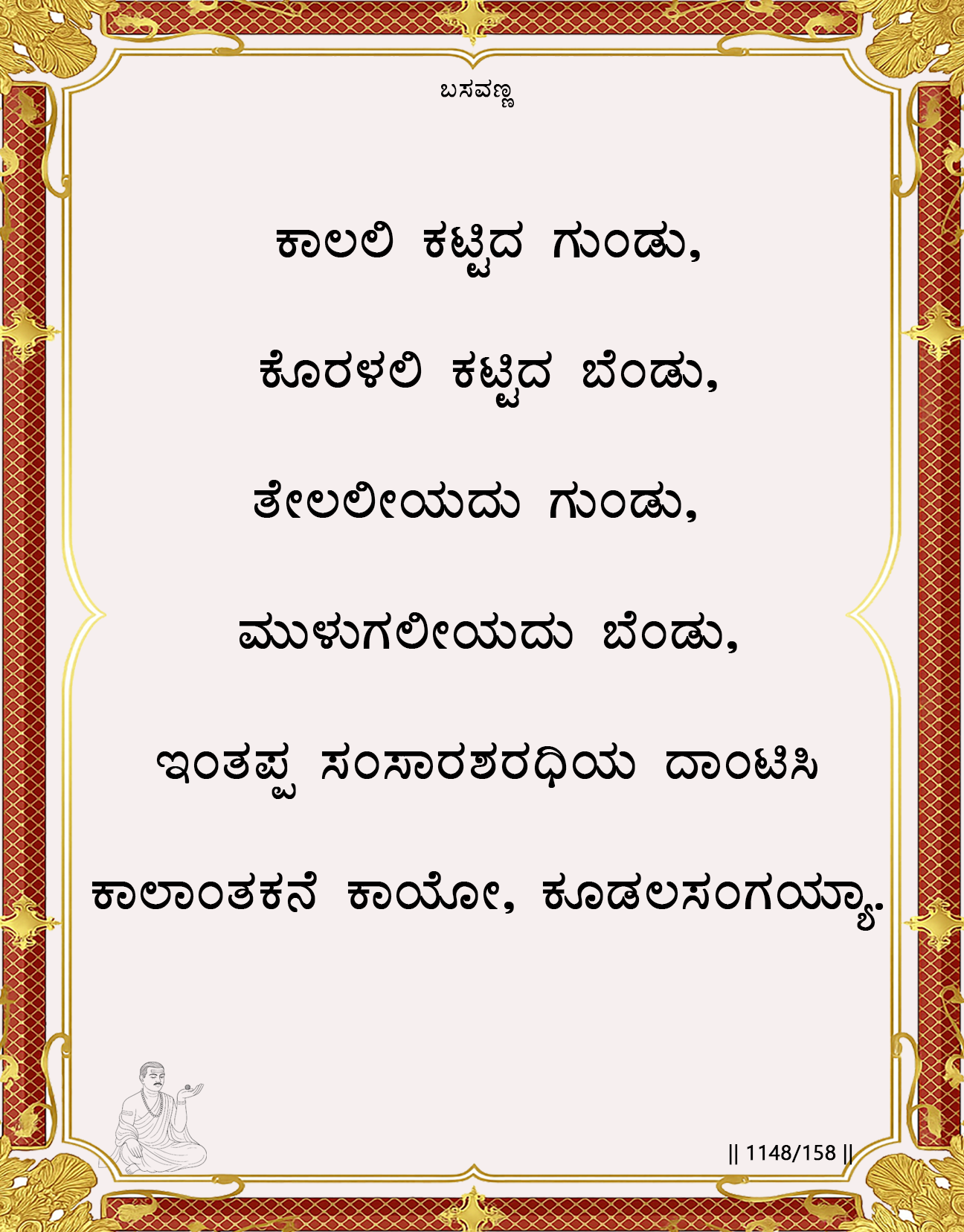
A stone tied to the foot
pulls a man down into the depths;
but the Linga tied around my neck
keeps me from sinking.
The stone drags downward,
the Linga lifts upward
and caught between these two pulls
I must cross this swirling world.
O Eternal One,
hold me steady as I walk;
be my true companion,
Kudalasangamadeva.
Basavanna contrasts the weight of worldly attachments with the uplifting power of devotion. Just as a heavy stone sinks while a buoyant object rises, the world pulls the devotee downward, while the Linga (divine consciousness) lifts him upward. Human life is lived between these two opposing forces. Basavanna therefore prays for divine companionship and support, asking Koodalasangama to keep him steady and guide him safely across samsara.
Spiritual Context
Core Spiritual Principle: The physics of grace in a dualistic world. While the ultimate reality is non-dual, the human experience is one of dualityspirit versus matter, ascent versus descent. Spiritual practice is the conscious application of divine force (Linga) to overcome the inertial force of worldly bondage (stone).
Cosmic Reality Perspective: This vachana illustrates the Shiva-Shakti dynamic from the perspective of the bound soul. The inert, material world (Shakti as maya) exerts a gravitational pull, while the conscious, liberating principle (Shiva as Linga) provides buoyancy. The goal is not to deny the world but to use the upward force to traverse it without being submerged by it.
Historical Reality (Anubhava Mantapa Context): Basavanna speaks to every householder grappling with the demands of the world. The “stone” represents the burdens of caste duty, familial obligation, and material desire that keep one entrenched in societal norms. The “Linga” offers a revolutionary counter-forcea personal, direct connection to the Divine that empowers one to live in the world without being of it, transforming a life of social burden into a sacred journey.
Interpretation
“A stone tied to the foot… the Linga lifts upward” The “stone” is a metaphor for ahamkara (ego) and vasanas (latent impressions) that bind the soul (Anga) to the cycle of birth and death. Its placement on the “foot” signifies base, instinctual attachments. The “Linga around the neck” signifies its proximity to the heart and mind, representing a conscious, chosen devotion that elevates awareness.
“and caught between these two pulls I must cross this swirling world.” This acknowledges the reality of the human condition. Liberation is not an escape from the battlefield but a successful crossing of it. The “swirling world” is the samsara sagara, the ocean of becoming, characterized by constant change and emotional turbulence.
“O Eternal One, hold me steady as I walk; be my true companion…” This is the climax: a plea for grace. “Steadiness” is the state of equanimity (sama-drishti), and “companionship” signifies the intimate, guiding presence of the Divine (Linga) in the Jangama dynamic of daily life.
Practical Implications: The practitioner is encouraged to consciously identify the “stones” in their own lifehabits, attachments, fearsthat create a downward pull. Simultaneously, one must actively engage with the “Linga” through constant remembrance (Linga Dharane) and ethical action (Kayaka), using it as a spiritual anchor to maintain balance and direction.
The Cosmic Reality
Anga (Human Dimension): The human is a nexus of forces, a field where a spiritual tug-of-war takes place. The Anga is not inherently sinful but is subject to gravity. Its purpose is to serve as the vessel for this journey, learning to align with the uplifting force.
Linga (Divine Principle): The Linga is the supreme anchor and the liberating force. It is not a passive symbol but an active, energetic reality that counteracts the entropy of worldly existence. It is the source of stability and the true friend on the path.
Jangama (Dynamic Interaction): The Jangama is the continuous, moment-to-moment act of choosing the Linga. It is the practice of re-orienting one’s focus from the sinking weight of problems to the uplifting power of grace. Every conscious breath of remembrance is a step in “crossing the swirling world.”
Shatsthala
Primary Sthala: Prasadi (Recipient of Grace) The entire vachana is a plea for and a recognition of the necessity of grace. The devotee understands that their own effort is insufficient against the powerful pull of the world; steadiness must be given by Koodalasangamadeva. This defines the stage of Prasadi.
Supporting Sthala: Bhakta (Devotee) The stance of the speaker is that of a devotee who recognizes the two forces and actively turns to the Divine for help. The relationship is one of reliance and devotion, the hallmark of the Bhakta stage.
Practical Integration
Arivu (Awareness Practices): Cultivate the awareness of these two “pulls” throughout the day. When feeling stressed, heavy, or attached, recognize this as the “stone.” Consciously invoke the presence of the Linga through mantra or breath to experience the “uplift.”
Achara (Personal Discipline): Practice non-attachment (vairagya) by voluntarily simplifying life and letting go of one “stone” at a timebe it a possession, a grudge, or a compulsive habit.
Kayaka (Sacred Action): Perform duties in such a way that they become part of the “crossing” rather than adding weight. Let work be an offering that strengthens your connection to the Linga, making it a buoyant force.
Dasoha (Communal Offering): Help others lighten their load. By offering support, compassion, and shared resources, you act as an instrument of the Linga’s uplifting force in the lives of your fellow travelers.
Modern Application
Contemporary life is defined by overwhelming “downward pulls”: the weight of information overload, the pressure of social media comparison, the anxiety of economic instability, and the gravitational force of consumerism. This leads to burnout, depression, and a profound sense of being adrift.
This vachana provides a powerful framework for mental and spiritual resilience. It teaches that one need not eliminate life’s pressures but can develop a “divine counter-force”a centering practice of meditation, ethical living, or devotional remembrance. This becomes the inner anchor that provides stability, purpose, and the strength to navigate modern life without sinking.
Essence
One weight drags to the deep,
One force lifts the soul from sleep.
Between the drown and the divine,
This turbulent river is mine.
Be my pole, my steady guide,
Walk with me, O Grace, inside.
The Deeper Pattern: This vachana describes the metaphysical state of a system under two opposing force vectors. The “stone” represents the entropic force leading to disorder and bondage (increasing maya). The “Linga” represents the negentropic force leading to order and liberation (increasing consciousness). The human being is the system where these forces interact, and spiritual practice is the conscious work of amplifying the Linga’s vector to achieve a resultant force that moves the system toward liberation.
In Simple Terms: It is like a hot air balloon. The “stone” is the weight of the basket (worldly attachments). The “Linga” is the hot air (divine grace). For the balloon to rise and journey across the landscape (samsara), the burner must be consistently fired (spiritual practice) to generate enough lift to overcome the weight. The pilot’s prayer is for a steady flame.
The Human Truth: The universal human experience is one of being torn between our base instincts and our highest aspirations, between our limitations and our potential. The timeless truth here is that we are not powerless in this struggle; we have access to a force that can lift us. The path is not about removing the weight, but about securing ourselves to a power greater than it.

Views: 14