Poetic Rendering

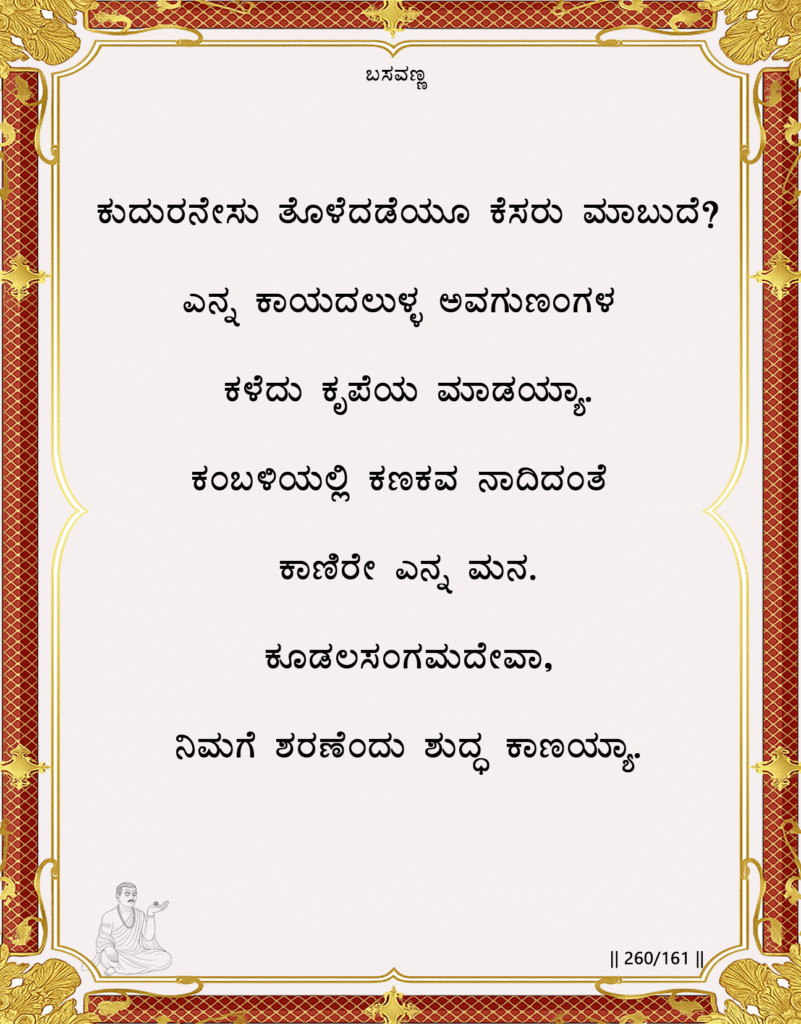
A horse washed clean
still rolls in dust
so does this body return to its stains.
This mind, thick like wool,
holds fast the dirt it would cast away.
Only when You breathe through it
does light begin to flow.
Not water,
not ritual cleansing
only Your fire purifies.
Forge me, Koodalasangamadeva,
and let me shine like tested gold.
This vachana teaches that purity is not achieved through external means, such as bathing, rituals, or bodily discipline. The body naturally accumulates impurity just as a washed horse returns to dust. The real obstacle is the mind, which dense and tangled like wool clings to habits, desires, and impressions even when they are unwanted. True transformation happens only when divine grace “breathes” into this mind, softening and opening it. Basavanna emphasizes inner alchemy, not outward ritual: only Shiva’s grace, received through surrender, devotion, and the company of sharanas, can burn away impurity and forge the seeker into pure gold. The message: Cleansing the soul requires inner fire, not outer water. Only the divine touch makes one radiant, free, and true.
Spiritual Context
Core Spiritual Principle: Alchemical transformation through grace. Purity is an internal state of consciousness, not an external condition of the body. It cannot be achieved by mechanical ritual (kriya) but only through the catalytic fire of divine grace (prasada), which transmutes the base metal of the egoic mind into the gold of the divine self.
Spiritual & Metaphysical Essence: This vachana articulates the core of the path of Basavanna: a non-dual alchemy where the seeker and the Divine are not separate, but are the raw material and the transforming fire in a single, unified process. The “impurities” are the illusion of a separate self. The fire of grace does not create a new self but incinerates the illusion, revealing the soul’s eternal, luminous nature (Lingatva), which was always present. This is the light of Basavaa spirituality of transformative fire, not cosmetic water.
Cosmic Reality Perspective: This vachana distinguishes between Shakti as bound energy (the dense, tangled mind) and Shakti as liberating grace (the divine breath). The bound energy is inert and cyclical, perpetually returning to its patterns. Only when the supreme Shiva (consciousness) activates this bound energy with its “fire” does it become free, luminous, and capable of union.
Historical Reality (Anubhava Mantapa Context): This is a direct critique of Brahminical ritual purity centered on physical cleanliness, bathing in sacred rivers, and adherence to caste-based pollution rules. Basavanna declares these efforts futile. The true revolution happens within, through a direct relationship with the Divine, making spiritual liberation accessible to all, regardless of their external social or physical condition.
Interpretation
“A horse washed clean still rolls in dust” This symbolizes the futility of trying to purify the body and senses through force. The very nature of embodied existence (Anga) in the world of duality (maya) is to be subject to recurring impressions and attachments.
“This mind, thick like wool, holds fast the dirt it would cast away.” The “wool” represents the antahkarana (inner instrument) in a state of tamas (inertia) and rajas (activity). It is dense with vasanas (latent impressions) and samskaras (mental grooves) that actively resist mere intellectual or behavioral cleansing.
“Only when You breathe through it does light begin to flow.” The “breath” is the active descent of grace (shakti-pata). It is the catalytic force that softens the hardened mind, loosens the grip of the vasanas, and initiates an inner illumination (Arivu) from within.
“Forge me… let me shine like tested gold.” This is the ultimate goal: not just cleanliness, but a fundamental transformation. The self is not “cleaned” but is reborn through a process of spiritual ordeal, emerging with a new, divine nature (Linga-nature).
Practical Implications: The practitioner must shift their effort from external purification to internal receptivity. Instead of striving to be “good,” one must cultivate surrender, prayer, and the company of the enlightened (satsang) to become a vessel for the transformative descent of grace.
The Cosmic Reality
Anga (Human Dimension): The Anga is the raw material the base metal or the unspun wool. In its current state, it is prone to recurring defilement and possesses an innate density that traps impurities. Its role is to be the recipient of the transformative process.
Linga (Divine Principle): The Linga is the divine Alchemist and the purifying Fire itself. It is the active, conscious principle whose grace alone has the power to penetrate the density of the mind and effect a fundamental change in its very substance.
Jangama (Dynamic Interaction): The Jangama is the act of being “forged.” It is the dynamic, often challenging, process where the heat of spiritual practice and grace meets the resistance of the ego. It is the surrender that allows the divine breath to flow through, creating not a static purity but a dynamic, living luminosity.
Shatsthala
Primary Sthala: Prasadi (Recipient of Grace) The entire vachana is a plea from one who understands the absolute necessity of grace. The devotee recognizes the utter futility of their own efforts to purify the “woolly” mind and explicitly asks for the divine fire, positioning themselves perfectly in the Prasadi stage.
Supporting Sthala: Bhakta (Devotee) The stance is that of a humble devotee (Bhakta) who acknowledges their own limitations and turns with devotion and trust to the source of all transformation. The relationship is one of a supplicant to the all-powerful Lord.
Practical Integration
Arivu (Awareness Practices): Practice witnessing the mind’s “thickness”its recurring thoughts, habits, and resistances without judgment or the futile attempt to “wash” them away. Simply observe them as the “wool,” and use that recognition as a trigger to invoke the “divine breath” through mantra or silent surrender.
Achara (Personal Discipline): Shift your discipline from rigid self-control to conscious self-offering. Let your practices (prayer, meditation) be about creating the inner conditions for grace to enter, rather than about achieving personal purity through willpower.
Kayaka (Sacred Action): Engage in work as a means to be “forged.” Allow the challenges and pressures of your labor to reveal your inner impurities (impatience, pride, aversion) and consciously offer those very moments to the divine fire for transformation.
Dasoha (Communal Offering): Share your journey of transformation. In community, offer not a facade of purity, but honest companionship in the struggle, helping others to also trust in the alchemical process of grace over the mechanical process of self-improvement.
Modern Application
We are obsessed with external “cleansing”detox diets, digital detoxes, self-help techniques, and curated online personas. This leads to a cycle of temporary fixes and deeper frustration, as the core patterns of the mind (anxiety, dissatisfaction, fear) remain untouched and persistently return, like the horse to the dust.
This vachana liberates us from the exhausting treadmill of self-improvement. It offers the profound relief of surrender. Instead of trying to fix ourselves, we learn to offer our broken, “impure” selves to a higher transformative power. This shifts the paradigm from one of stress and failure to one of trust and profound, lasting inner change.
Essence
Wash the horse, it finds the dust.
The mind’s thick wool clings to its lust.
No river’s flow, no rite’s command,
Can burn the dross where I stand.
Breathe Your fire, make my mold,
Forge this lead into gold.
The Deeper Pattern: This vachana describes a phase transition in consciousness. The mind in its “woolly” state is like a soliddense, with particles (thoughts) tightly bound. External efforts are like trying to clean the solid by scrubbing its surface. Divine grace acts as the critical application of heat (fire) that causes a phase transition, turning the solid into a liquid (the “flow” of light), allowing for a reconstitution of the substance into a new, purified, and radiant form (gold).
In Simple Terms: It is the difference between cleaning a stained piece of iron and forging it into steel. Washing the iron only temporarily removes surface dirt; the inherent softness and tendency to rust remain. To forge steel, the iron must be subjected to intense fire, which changes its very molecular structure, making it stronger, sharper, and more resilient. Grace is that transformative fire.
The Human Truth: The universal human experience is the frustration of knowing our weaknesses and repeatedly failing to overcome them by willpower alone. The timeless truth here is that our deepest flaws and patterns are not surface stains but structural imperfections. They require not our condemnation and scrubbing, but a fundamental restructuring that can only be catalyzed by a power greater than our own ego. True freedom is found not in self-cleaning, but in being forged by the Divine.

Views: 7