Poetic Rendering

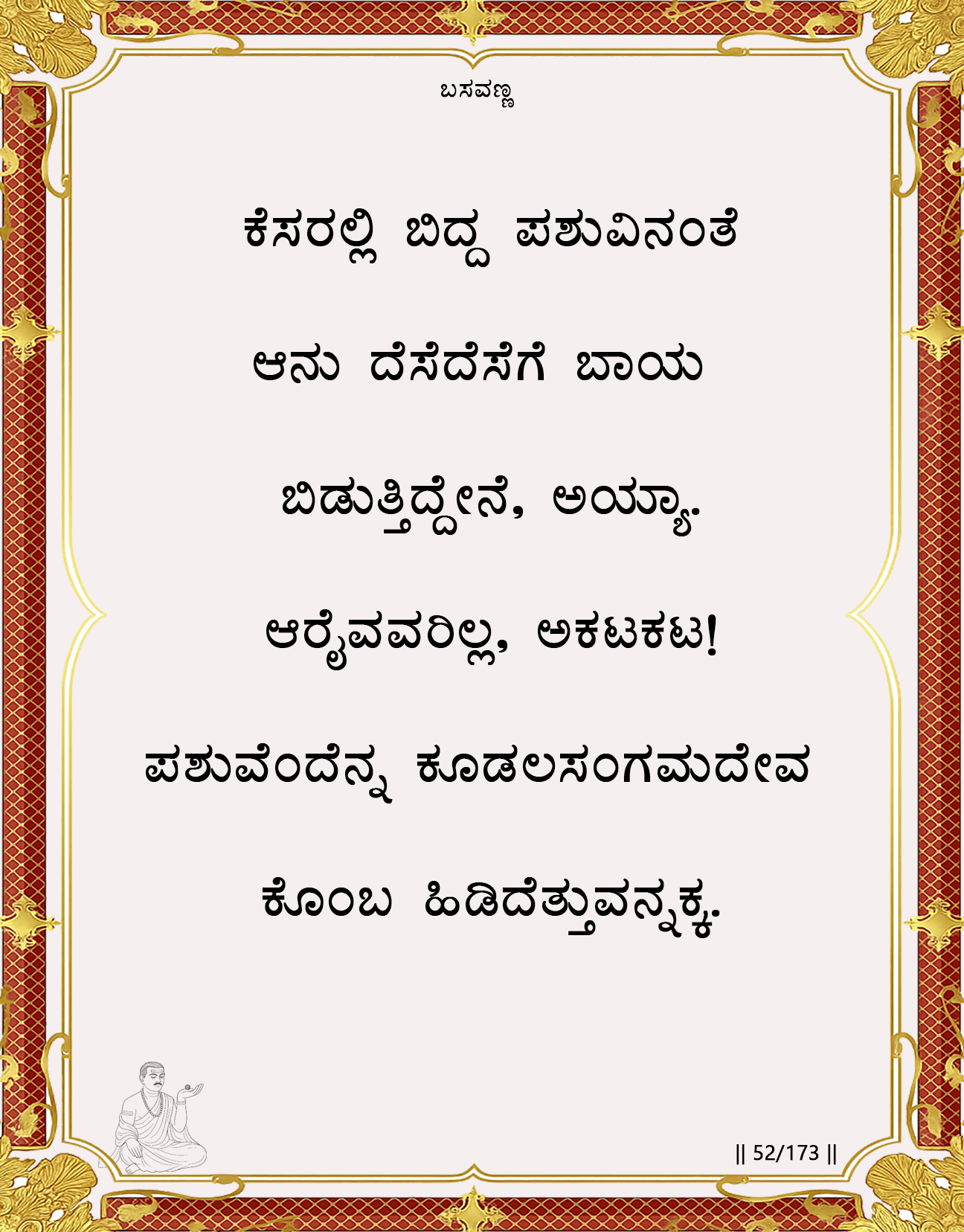
Like a bull sunk deep in slush,
I try to hold my gaze upon You
but these eyes, like restless horns,
swerve toward every sound and sight.
I push, I strain,
yet this body-mind, thick with habit,
keeps me stuck in the same mire.
Only You, Kudalasangamadeva,
can turn these very senses that bind me
into wings that carry me to You.
In this vachana, Basavanna reveals the helplessness of the seeker who strives to fix the mind on the Divine but is continually dragged outward by the senses and bodily instincts. Human effort alone cannot overcome the deep-rooted tendencies of the body-mind, which behaves like a trapped animal struggling yet unable to escape. The very faculties meant for perception become instruments of distraction. Basavanna therefore shifts from self-reliance to surrender, acknowledging that only divine grace can transform the senses from sources of bondage into channels of liberation, drawing the seeker toward Kudalasangamadeva.
Spiritual Context
Core Spiritual Principle: The necessity of grace (prasada) after the exhaustion of self-effort. The vachana maps the critical transition on the path where the ego’s resources are fully spent. It is only when one truly acknowledges the incapacity of the personal will (ahamkara) that the door opens for divine intervention to transmute the very structure of the psyche.
Cosmic Reality Perspective: This vachana illustrates the bound state of Shakti. The bull represents individual Shakti powerful and full of potential but trapped in the inertia (tamas) of its own latent impressions and the active distractions (rajas) of the senses. Shiva (as Linga) is the conscious principle that, when invoked through surrender, can “pull” this stuck Shakti free, not by opposing its nature, but by redirecting its energy upward.
Historical Reality (Anubhava Mantapa Context): This vachana provides a deeply human and relatable spiritual psychology for the Lingayoga community. It prevents the path from becoming a source of egoistic striving or guilt. By openly confessing his own struggle, Basavanna normalizes the challenges of practice and points the community toward the essential, humbling role of grace, fostering a spirituality based on trust rather than perfect performance.
Interpretation
“Like a bull sunk deep in slush…” The “slush” is a powerful metaphor for samsara the world of sensory experience and mental habits that is sticky, entrapping, and energy-draining. The more one struggles with egoic will, the deeper one sinks.
“I try to hold my gaze upon You but these eyes, like restless horns, swerve…” The “gaze” represents dharana (concentration) and bhakti (loving attention). The “restless horns” symbolize the untamed, outward-turning senses (indriyas) that actively sabotage one-pointed focus.
“I push, I strain, yet this body-mind, thick with habit, keeps me stuck…” This acknowledges the limits of personal sadhana (effort) against the force of samskaras (latent impressions). The “thickness” is the density of the egoic mind.
“Only You… can turn these very senses that bind me into wings that carry me to You.” This is the pivotal insight. The solution is not to destroy the senses but to have their energy transformed and reversed (paravritti). Grace does not negate human nature; it sanctifies and repurposes it.
Practical Implications: The practitioner is guided to recognize the point of diminishing returns in struggle. When effort leads to frustration, it is time to shift to surrender. The practice becomes one of offering the struggle itself to the Divine, trusting that grace will accomplish what willpower cannot.
The Cosmic Reality
Anga (Human Dimension): The Anga is the trapped bulla creature of immense power and potential, but currently incapacitated by its environment and its own nature. Its struggle is part of its path, leading to the realization of its need for help.
Linga (Divine Principle): The Linga is the solid ground, the rescuer, and the alchemist. It is the stable reality that is not stuck in the slush. Its grace is the force that can extract the bull and, crucially, teach it to walk on solid ground.
Jangama (Dynamic Interaction): The Jangama is the cry for help and the subsequent rescue. It is the dynamic process where the relationship shifts from one of struggle to one of reception. The transformation of “horns” (instruments of defense and aggression) into “wings” (instruments of ascent) is the ultimate Jangama miracle.
Shata Sthala
Primary Sthala: Prasadi (Recipient of Grace) The entire vachana is the archetypal prayer of the Prasadi. It is the stage where the devotee has done all they can and now stands empty-handed, fully acknowledging their dependence on a power beyond themselves to achieve the final breakthrough.
Supporting Sthala: Bhakta (Devotee) The intense, struggling effort to “hold the gaze” is the mark of a sincere Bhakta. This stage of fervent, if frustrated, devotion is a necessary prelude to the humble surrender of the Prasadi.
Practical Integration
Arivu (Awareness Practices): Practice witnessing the “bull” without identifying with it. Observe the impulses of the senses and the mind’s restlessness as phenomena, and with each observation, mentally offer that impulse to Koodalasangamadeva to be transformed.
Achara (Personal Discipline): Let your discipline include the practice of surrender. At the end of your meditation or prayer, consciously offer the entire sessionits successes and failuresto the Divine, acknowledging that the real work of transformation is done by grace.
Kayaka (Sacred Action): When you feel “stuck” in your work or responsibilities, consciously shift from striving to offering. Say, “I am the bull in the slush. I offer this struggle to You. Use my efforts as You will.”
Dasoha (Communal Offering): Share your struggles authentically within the community. By being open about our shared human frailty, we reduce shame and build a culture where relying on grace is seen as a strength, not a weakness.
Modern Application
We live in a culture of hyper-agency and self-optimization, where struggle, failure, and distraction are seen as personal moral failings. This leads to burnout, anxiety, and a deep sense of inadequacy when we cannot “fix” our minds or control our lives through willpower alone.
This vachana offers profound psychological relief. It validates our experience of struggle and frees us from the tyranny of self-help. It introduces the concept of a “grace-based” life, where we do our part but ultimately trust in a higher intelligence to transform our limitations into strengths. It is the antidote to perfectionism and a gateway to authentic peace.
Essence
The bull is stuck, the slush holds fast,
The gaze that sought You could not last.
I’ve pushed and strained with all my might,
And found in effort, only night.
So take these horns, these senses keen,
And forge of them, wings, unseen.
The Deeper Pattern: This vachana describes a phase transition that cannot be achieved by incremental change within the old system. The bull (the egoic system) is in a local energy minimum (the slush). Its own struggles only reinforce its trapped state. Grace acts as the external energy input required to push the system over the activation barrier into a new, more stable state of freedom (the bull liberated and flying). The system’s own components (senses) are reconfigured into a new functional structure (wings).
In Simple Terms: It is like a caterpillar trapped in its own body, struggling to be a butterfly. It cannot, through an act of caterpillar-will, grow wings. It must enter the chrysalis (surrender its old form) and allow a mysterious, transformative process (grace) to dismantle and reconfigure its very substance into a new being capable of flight.
The Human Truth: The universal human experience is the frustration of being trapped by our own nature our habits, our fears, our desires. We try to think or discipline our way out, only to find ourselves back in the same patterns. The timeless truth here is that we cannot lift ourselves out of the quicksand by our own hair. Liberation requires a power that is not of the ego. The moment we stop struggling and call for help is the moment that true transformation becomes possible.

Views: 7