Poetic Rendering

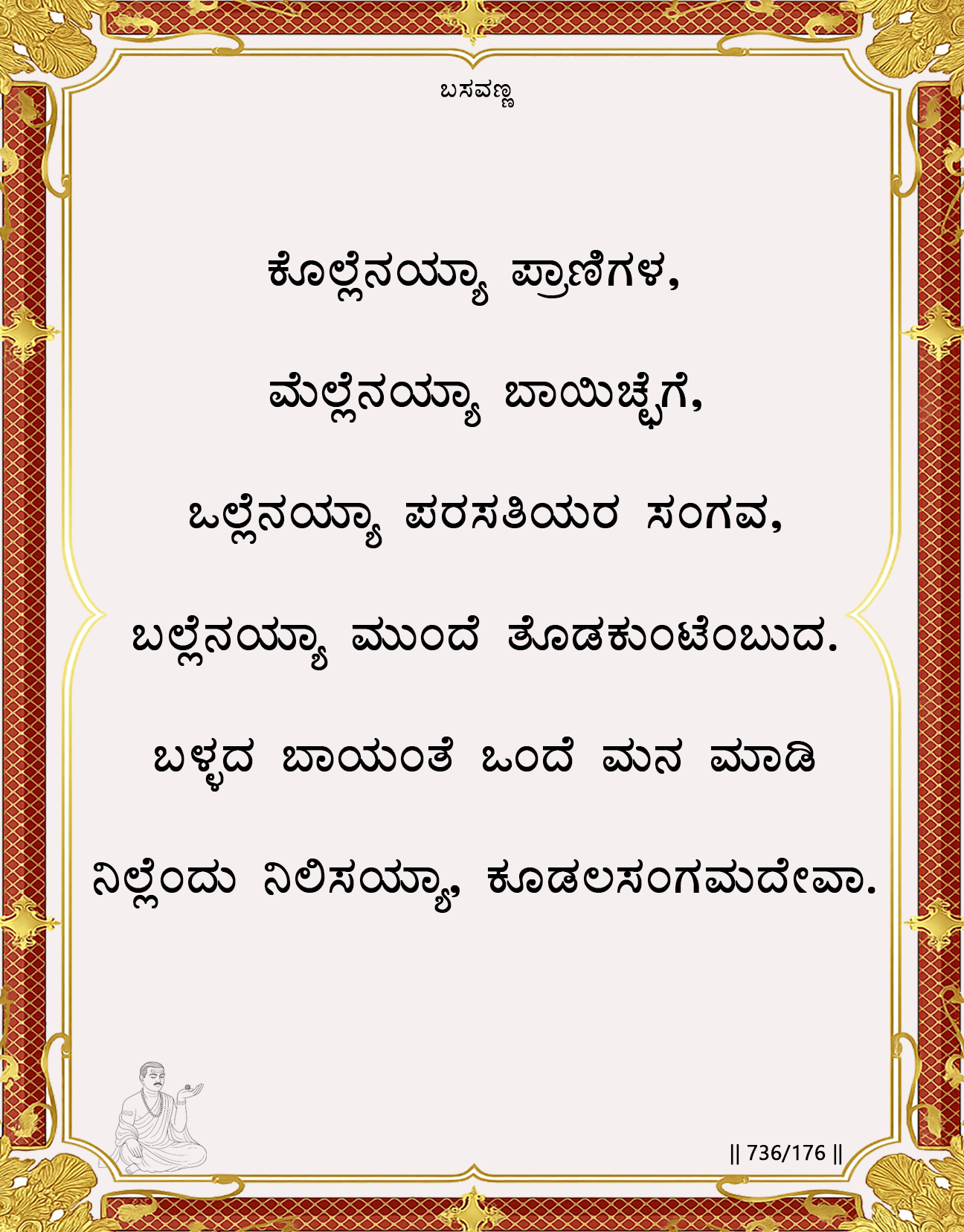
I will not harm any living being,
I will not surrender to the greed of the tongue,
nor touch another’s spouse.
These are traps laid upon the pathI see them clearly.
Let my mind become like a bamboo:
hollow of ego, straight in purpose,
measured and steady in every breath.
Still these restless wanderings,
anchor me in single-pointed devotion,
O Kudalasangamadeva.
In this vachana, Basavanna recognizes that mere personal discipline cannot steady the mind or sustain true devotion. Though he vows to avoid violence, craving, and misplaced desire, he sees that the mind still sways and that human effort alone cannot create inner stillness. Like a bamboo hollow, straight, and receptive he longs to become an open vessel for the Divine. Thus, Basavanna turns to Kudalasangamadeva, seeking not just strength but grace itself to stabilize his wandering consciousness and establish unwavering, single-pointed devotion. True steadiness, he realizes, is a gift granted by the Lord, not an achievement of the ego.
Spiritual Context
Core Spiritual Principle: The limits of willpower and the primacy of grace for inner transformation. While ethical discipline (yama-niyama) is the essential foundation, it can only create the outer conditions for spirituality; it cannot by itself quiet the mind. The final leap to one-pointed devotion (ekagrata) requires the mind’s very substance to be altered by a power beyond itself.
Cosmic Reality Perspective: This vachana illustrates the relationship between Shakti (the mind’s energy) and Shiva (still consciousness). The vows are an attempt to regulate Shakti from the level of Shakti itself, which can only go so far. For Shakti to become perfectly still and reflective like a calm lake, it must be stabilized by its source, Shiva. The “hollow bamboo” is Shakti that has been emptied of its egoic content, allowing it to be perfectly filled and guided by Shiva’s conscious presence.
Historical Reality (Anubhava Mantapa Context): This vachana provides a sophisticated spiritual psychology for the Lingayoga community. It prevents practitioners from falling into the trap of moral perfectionism or becoming discouraged by their mental restlessness. It teaches that after one has done their part through ethical living, the next step is not more striving, but sincere surrender to the transformative power of the Ishta-Linga.
Interpretation
“I will not harm… I will not surrender to greed… nor touch another’s spouse.” This represents the practice of Yama (ethical restraints). It is the necessary clearing of the ground, removing gross obstacles that would otherwise dominate consciousness.
“These are traps laid upon the pathI see them clearly.” This shows discernment (viveka). The devotee is not naive; they understand the nature of worldly temptations and the importance of avoiding them.
“Let my mind become like a bamboo: hollow of ego, straight in purpose, measured and steady…” The “bamboo” is a profound metaphor. Its hollowness represents the emptying of ego (nirahara). Its straightness represents unwavering focus on the Divine. Its steadiness represents equanimity (sama). This is a description of a mind ready for grace.
“Still these restless wanderings, anchor me… O Kudalasangamadeva.” This is the critical turn from self-effort to surrender. The practitioner acknowledges that the final stillness is a gift to be received, not a skill to be mastered.
Practical Implications: The practitioner must first establish a strong ethical foundation. Then, when the mind is still restless, the practice shifts to a prayerful surrender, actively inviting grace to accomplish the inner work that willpower cannot.
The Cosmic Reality
Anga (Human Dimension): The Anga is the unsteady bamboo, swaying in the winds of desire and distraction. It possesses the right form (the vows) but lacks the inner stability. Its role is to recognize its own limitation and open itself to be filled.
Linga (Divine Principle): The Linga is the unwavering core around which the bamboo can grow straight. It is the divine consciousness whose grace acts as a stabilizing force, filling the hollow mind with presence and purpose.
Jangama (Dynamic Interaction): The Jangama is the process of the bamboo being steadied by the gardener. It is the dynamic relationship of surrender and grace, where the human effort of holding the vows meets the divine action of instilling stillness, resulting in a mind that is both disciplined and divinely tranquil.
Shata Sthala
Primary Sthala: Prasadi (Recipient of Grace) The entire vachana is a prayer from the Prasadi stage. The devotee has done the preparatory work and now stands at the threshold, understanding that the final transformationthe achievement of steady devotioncan only be received as a divine gift.
Supporting Sthala: Bhakta (Devotee) The initial vows and the clear seeing of the “traps” on the path are the work of a sincere Bhakta. This stage of purification and discernment is the essential preparation that makes one a worthy vessel for the grace sought in the Prasadi stage.
Practical Integration
Arivu (Awareness Practices): Practice observing the mind as “bamboo.” Notice when it is swaying (distracted) and when it is steady (focused). Without judgment, use each observation of restlessness as a trigger to silently invoke the stabilizing presence of Koodalasangamadeva.
Achara (Personal Discipline): Uphold your ethical vows diligently, but do so with an attitude of offering. Say, “I hold these vows as best I can, and I offer the resulting mental space to You to fill with Your presence.”
Kayaka (Sacred Action): Use your work as a practice in “steadiness.” When you feel distracted or rushed, pause and remember the image of the straight, steady bamboo. Ask for the grace to perform your duty with single-pointed focus.
Dasoha (Communal Offering): Share this understanding within the community. Support fellow practitioners who are struggling with restlessness by reminding them of the role of grace, helping to alleviate the burden of thinking they must achieve perfect focus through sheer willpower alone.
Modern Application
We live in an age of unprecedented distraction and fragmented attention. We set goals and make resolutions (our “vows”), but our minds are constantly pulled in different directions by digital notifications, multitasking, and information overload. This leads to anxiety, a lack of deep focus, and the feeling that we are failing at self-mastery.
This vachana offers a profound solution. It teaches us to do our part by creating boundaries (digital fasts, focused work blocks) but then to surrender the obsession with a perfectly quiet mind. It introduces the concept of receiving focus as a gift. This relieves the performance anxiety of meditation and mindfulness, making the spiritual path a relationship of trust rather than a test of will.
Essence
I’ll harm no being, curb my taste,
And walk the righteous path in haste.
But traps I see, and still I sway,
My mind will wander from the Way.
So make me like the bamboo, true,
Hollow and straight, held firm by You.
The Deeper Pattern: This vachana describes the transition from classical to quantum change in consciousness. Classical change is the incremental effort of the ego to modify its own behavior (the vows). Quantum change is a discontinuous leap to a new state of being (a steady mind), which cannot be achieved by the system’s own internal rules. This requires an external “measurement” or intervention in this case, the collapse of the wave function of a distracted mind into the particle-like state of one-pointedness by the “observer,” which is divine grace.
In Simple Terms: It is the difference between trying to smooth out turbulent water by skimming the surface with your hand, and pouring a vessel of water into a still, deep well. Your hand (willpower) can only create a temporary calm. Pouring it into the well (surrender to grace) allows it to naturally become still, becoming one with the deep, calm water already there.
The Human Truth: The universal struggle is with our own restless nature. We believe that with enough discipline and effort, we can finally “fix” ourselves. The timeless truth here is that the ego cannot quiet the ego. Lasting peace and focus come when we stop trying to be the sculptor of our own mind and instead become the hollow flute, allowing the Divine to play the music of stillness through us.

Views: 16