Poetic Rendering

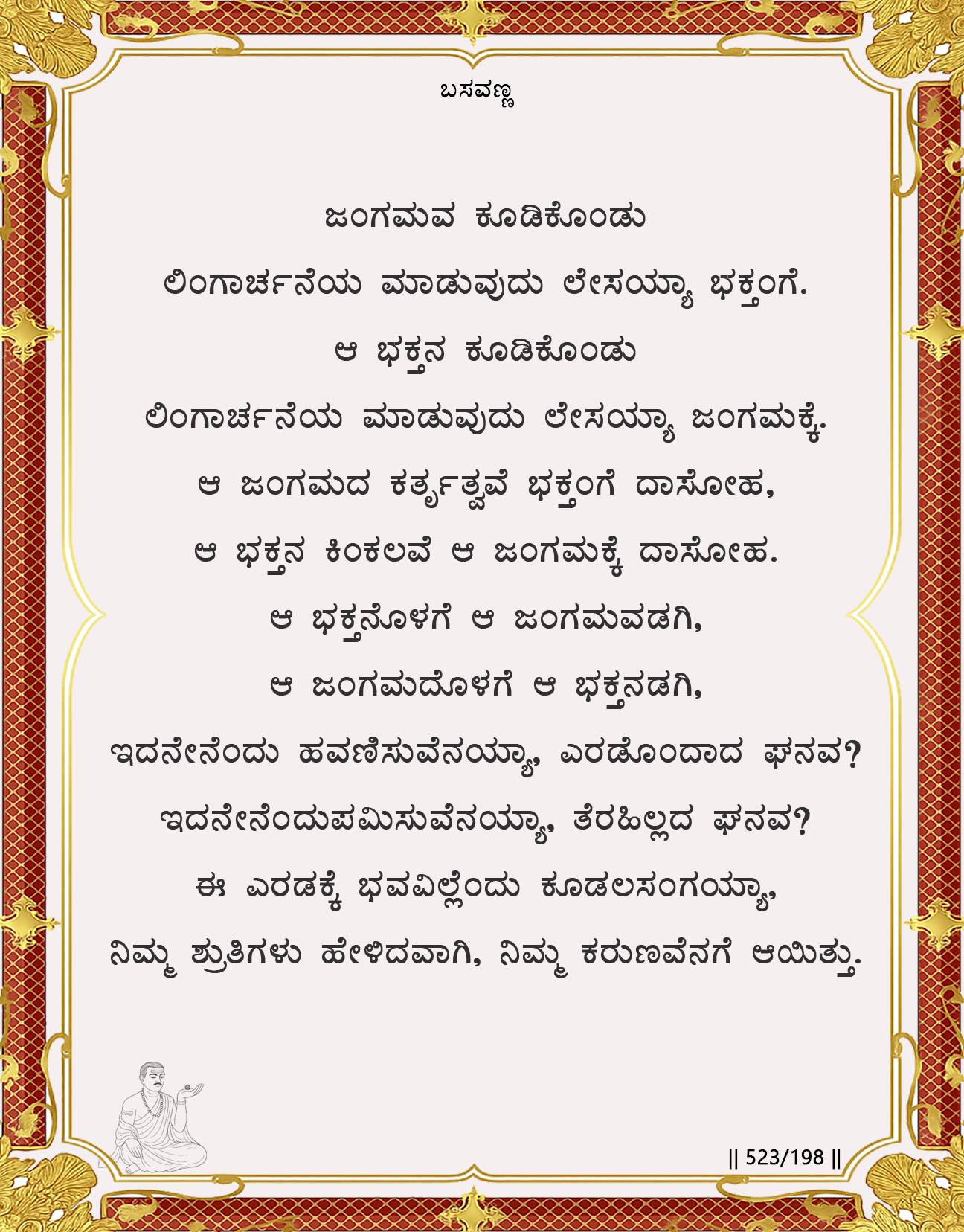
When the Jangama guides the bhakta,
and the bhakta practices the path of the Linga
this harmony itself becomes sacred.
When the bhakta walks with the Jangama,
and the Jangama performs the work of the Linga
that too is pure dāsoha.
For in the bhakta, the Jangama is hidden;
and in the Jangama, the bhakta lies concealed.
What wonder is this
this mirror of devotion within devotion,
this radiance folding into itself?
What can words reveal
of the known shining through the unknown,
of two infinities meeting without boundary?
O Kudalasangamadeva,
your mystery is immeasurable;
your grace has enclosed me
on every side.
Basavanna describes the reciprocal sanctity between the bhakta and the Jangama. Their mutual guidance, service, and practice of Lingayoga become acts of dāsoha offerings that nourish each other spiritually. Because the seeker and the divine teacher are inward reflections of one another, Basavanna marvels at this boundless magnificence, where devotion mirrors divinity. He concludes by acknowledging the vastness of Kudalasangama’s grace, which surrounds and sustains him completely.
Spiritual Context
Core Spiritual Principle: The Guru-disciple relationship as a non-dual circle of grace. The relationship is not hierarchical but holographic. Each party is a mirror and a container for the other, and their sacred interaction (satsang) is the very activity of the Divine realizing itself through relationship. The path is not linear but a mutually sustaining ecosystem of grace.
Cosmic Reality Perspective: This vachana illustrates the perfect, dynamic equilibrium of Shiva and Shakti. The Jangama represents Shiva (the guiding consciousness), and the bhakta represents Shakti (the receptive energy). However, in their deepest reality, Shiva is not separate from Shakti, and Shakti is not separate from Shiva. The “Jangama hidden in the bhakta” is Shiva consciousness latent in every soul. The “bhakta concealed in the Jangama” is the devotional energy that animates the enlightened being. Their interaction is the cosmic dance of unity.
Historical Reality (Anubhava Mantapa Context): This vachana defines the ideal relational dynamics within the Lingayoga community. It prevents the relationship between wandering mystics (Jangamas) and householder devotees (sharanas) from becoming a mere hierarchy. It teaches that the Jangama is served not as a superior, but as the divine within the community, and that in serving, the devotee serves their own highest self. This fostered a culture of profound mutual respect and interdependence.
Interpretation
“When the Jangama guides the bhakta… this harmony itself becomes sacred.” The guidance is not a one-way transmission of information but a co-creative act that generates a sacred field. The relationship itself becomes a temple.
“When the bhakta walks with the Jangama… that too is pure dāsoha.” Service (dasoha) is redefined. It is not just giving material things but the act of companionship and shared journey. Walking together on the path is the highest offering.
“For in the bhakta, the Jangama is hidden; and in the Jangama, the bhakta lies concealed.” This is the core mystical insight. It expresses the holographic principle: the whole is contained in every part. The potential for enlightenment (Jangama) is in the seeker, and the essence of seeking (bhakta) remains in the enlightened one as compassionate activity.
“this mirror of devotion within devotion, this radiance folding into itself?” The relationship is a hall of mirrors where devotion reflects devotion, and consciousness recognizes itself. It is a “radiance folding into itself,” a perfect, self-aware loop of divine love.
“your grace has enclosed me on every side.” The speaker realizes that he is not outside this circle looking in; he is encompassed by it. Grace is not a line from A to B but the very space in which he exists.
Practical Implications: The practitioner must approach spiritual relationships with this non-dual understanding. When serving a teacher, serve the divine within them and recognize it as the same divinity within yourself. When receiving guidance, receive it as your own higher consciousness speaking to you.
The Cosmic Reality
Anga (Human Dimension): The Anga (bhakta) is a microcosm containing the entire cosmos, including the Jangama. Its journey is one of uncovering what is already hidden within.
Linga (Divine Principle): The Linga is the singular reality that is both the source and the substance of both the bhakta and the Jangama. It is the “radiance” itself.
Jangama (Dynamic Interaction): The Jangama is this entire, inseparable, dynamic circuit of giving, receiving, guiding, and serving. It is the relationship itself, recognized as divine.
Shata Sthala
Primary Sthala: Aikya (Union) The perception of the bhakta and Jangama as mutually indwelling and inseparable is the perception of Aikya. The vachana is spoken from this unified state where all distinctions are seen as expressions of one reality.
Supporting Sthala: Sharana (Total Refuge) To fully engage in this sacred circleto be both guide and guided, server and servedis the lived experience of the Sharana who has taken total refuge in the divine play (lila).
Practical Integration
Arivu (Awareness Practices): In your spiritual relationships, practice seeing the other as your own Self. See the teacher in the student and the student in the teacher. Contemplate the ways you are both a bhakta and a Jangama to others in different contexts.
Achara (Personal Discipline): Let your discipline include conscious participation in community. Engage in satsang not as a consumer but as a co-creator of the sacred field. Practice both humble receptivity and compassionate guidance as the situation demands.
Kayaka (Sacred Action): See all collaborative work as this “circle of grace.” In any partnership, recognize the mutual gift being exchanged and see the divine presence in your collaborator.
Dasoha (Communal Offering): Understand Dasoha as this reciprocal flow. The community thrives when every member is both a giver and a receiver, a guide and a student, in a continuous, sanctifying exchange.
Modern Application
Spiritual relationships are often transactional, hierarchical, or dysfunctional marked by guru-worship, dependency, or rebellion. We fail to see the sacredness in mutual relationships and the divine potential in every interaction.
This vachana liberates us from unhealthy spiritual dynamics. It empowers us to see every relationship as a potential field for mutual awakening. It teaches that we are all, simultaneously, containers of divine potential (Jangama) and seekers on the path (bhakta). This understanding fosters spiritual partnerships based on mutual respect and recognition, rather than blind devotion or cynical independence.
Essence
The guide and seeker, hand in hand,
A sacred circle on the land.
Each in the other finds their soul,
And makes the broken fragment whole.
O Lord, this mystery so deep,
A grace in which I wake and sleep.
The Deeper Pattern: This vachana describes a perfectly coherent, resonant systema spiritual superconductor. In a superconductor, electrons form Cooper pairs and move without resistance. Here, the bhakta and Jangama form a “divine pair.” Their interaction encounters no resistance of ego or separation because they recognize their fundamental identity. The “current” of grace flows without any loss of energy. The system’s state is such that the internal boundaries have dissolved, creating a unified field where the properties of one part are instantly reflected in the other.
In Simple Terms: It is like two mirrors facing each other, reflecting reflections into infinity. Which is the original image? The question becomes meaningless. There is only one reflection, one light, appearing in an endless, mutually generating dance. The bhakta and the Jangama are these two mirrors, and the light they are reflecting is Koodalasangamadeva.
The Human Truth: We crave connection but often create separation. We see teachers as “other” and ourselves as lacking. The timeless truth here is that the most profound connection occurs when we see the same consciousness in another that we seek within ourselves. In that recognition, the circle is closed, the seeker vanishes, and only the sacred dance of unity remains. We are not just seeking God; we are the very relationship in which God seeks to know itself.

Views: 10