

Summary
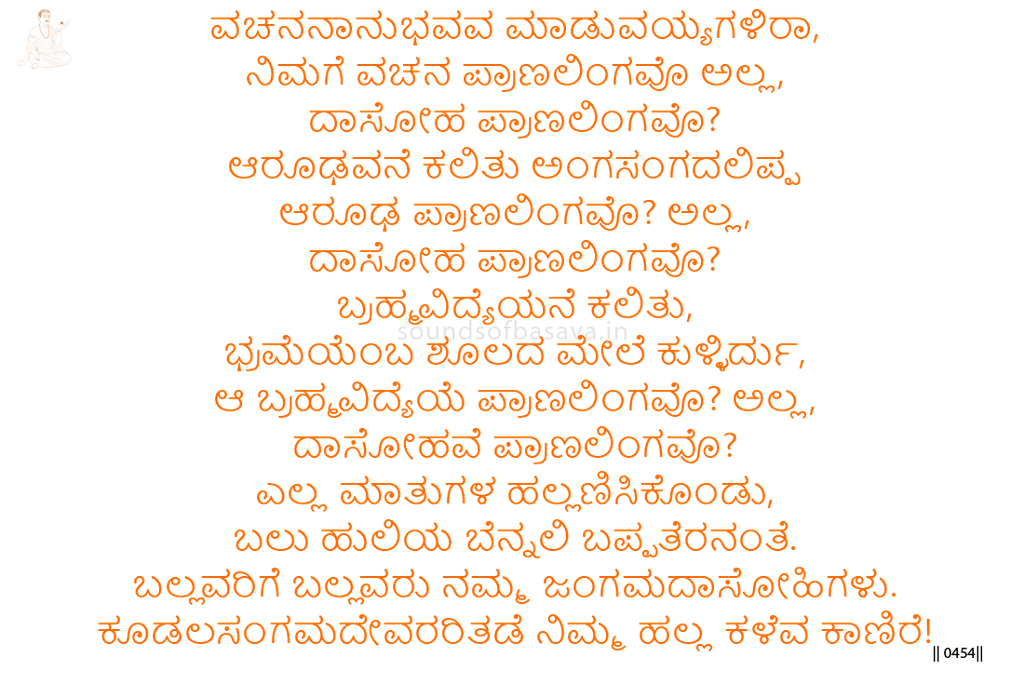
In this vachana, Basavanna questions those who speak from Vachana-anubhava.
He asks whether Vachana itself is Prana-Linga, or whether Dasoha is Prana-Linga. He then tests learned attainment and Brahmavidya in the same way. If attainment still remains in Anga-sanga, bodily attachment, or if Brahmavidya still sits upon the thorn of delusion, can that be called Prana-Linga?
The question is not against Vachana, attainment, or Brahmavidya. Basavanna is asking whether they have become living truth. His answer points toward Dasoha.
Words may be made sweet and impressive, but living the truth is like mounting the back of a fierce tiger. Those who truly know are the Jangama-Dasohis.
The teaching is direct: Prana-Linga is not proved by speech, learning, or spiritual claim alone. It is known when realization becomes Dasoha in the living field of Jangama.
Imagery & Symbolic Relevance
Vachana-anubhava is the first tested image. Basavanna does not reject sacred speech, but asks whether it has become living Prana-Linga.
The second image is attainment joined to Anga-sanga. A person may have learned the path of ascent, yet remain bound to bodily attachment. Such attainment is incomplete.
The third image is Brahmavidya upon the thorn of delusion. Brahma means the expanding or vast principle; Vidya means knowledge. Yet even high knowledge does not become Prana-Linga if delusion still pierces the one who holds it.
Dasoha is the correcting image. It is not ordinary charity. It is the lived offering through which knowledge, speech, and realization become active in Jangama.
The tiger’s back shows the danger of actual practice. Words may be sweet, but Dasoha is demanding. One cannot enter it casually and remain unchanged.
The Jangama-Dasohis are the final measure. They know because they do not hold realization as speech or learning alone. They live it as service to Jangama.
Lingayoga
In Lingayoga, Prana-Linga must become living conduct.
Vachana, attainment, and Brahmavidya have value, but they are incomplete if they remain as words, learning, or inner claim. They must become Dasoha.
For Prasadi Sthala, the point is precise: what is received as grace must not stop as knowledge. It must move outward as Jangama-Dasoha, free from self-claim.
Editorial Commentary
“Dasoha” should remain central. Here it is the test of whether realization has become living Prana-Linga.
“Anga-sanga” should be retained because Basavanna is testing attainment that still remains bound to bodily identification.
The tiger image should not be softened. It shows that Dasoha is not easy verbal sweetness, but a difficult and living discipline.
Related Vachana
Supporting Vachana
Maheshwara Sthala Vachana 292 — The Distance Between Knowledge and Realization
Maheshwara Vachana 292 supports this vachana by showing that sacred nearness and Linga-speech are not the same as realization.
In Vachana 1350, Basavanna asks whether Vachana, attainment, or Brahmavidya is truly Prana-Linga unless it becomes Dasoha. Both vachanas test sacred speech by lived realization.
Advancing Vachana
Pranalingi Sthala Vachana 961 — The Descent of Linga into Prana
Pranalingi Vachana 961 advances this teaching by showing that Linga must become joined with prana and that realization must pass through Dasoha and Jangama-Mukhalinga.
In Vachana 1350, Basavanna asks whether Dasoha is Prana-Linga. In Vachana 961, this becomes Pranalingi discipline: realization is not held as inward knowledge alone, but moves through Dasoha and the living face of Jangama before Kudalasangama Deva.
