

Summary
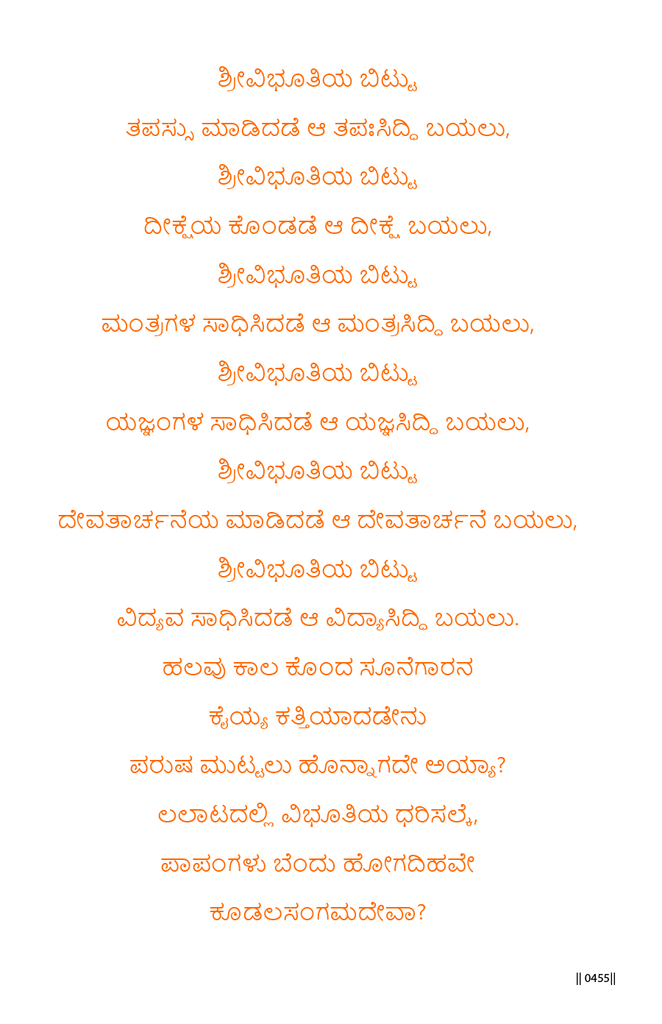
In this vachana, Basavanna says that austerity, initiation, mantra, sacrifice, divine worship, and learning become empty when they are done without Shri Vibhuti.
He does not reject these practices. He shows that they remain incomplete when they lack the purifying mark and meaning of Vibhuti.
He then gives the image of a butcher’s knife. Though it has long remained in the butcher’s hand, it becomes gold when touched by parasu. What appears stained by prior association can still be transformed by sacred contact.
Basavanna closes with a question: when Vibhuti is worn on the forehead, will sins not be burned away before Kudalasangama Deva?
The teaching is direct: practice alone is not enough. It must pass through purification, transformation, and the burning away of impurity.
Imagery & Symbolic Relevance
The repeated phrase “without Shri Vibhuti” gives the vachana its structure. Basavanna applies it to tapas, diksha, mantra, yajna, worship, and vidya. Each practice may appear complete outwardly, but without Vibhuti it becomes bayalu — empty or without spiritual substance.
The butcher’s knife is the decisive image. Its past association is harsh, yet the touch of parasu changes it into gold. Basavanna uses this to show that transformation is stronger than prior impurity.
The forehead mark completes the movement. Vibhuti is not shown as ornament. It is the visible sign of the fire that burns away sin and places the seeker before Kudalasangama Deva in a purified state.
Lingayoga
In Lingayoga, this vachana teaches that practice must become purified life.
Tapas, diksha, mantra, yajna, worship, and learning cannot remain as external achievement. They must be joined to the inward meaning of Vibhuti: the burning away of impurity and self-claim.
For Prasadi Sthala, the point is precise. The seeker does not claim worth through practice alone. He receives transformation through the grace symbolized by Vibhuti and offers even past impurity into the purifying presence of Kudalasangama Deva.
Editorial Commentary
“Shri Vibhuti” should be retained because it governs the whole vachana.
Vibhuti occupies a unique place in the Shaiva and Veerashaiva traditions. Sacred ash is what remains after fire has completed its work. Spiritually, it represents the state that remains after ignorance, pride, attachment, and ego have been offered into the fire of realization.
“Bayalu” here should be read as emptiness or lack of spiritual substance. Basavanna is not praising emptiness in this context; he is warning that practice without Vibhuti becomes hollow.
The butcher’s knife and parasu image should remain central. It shows that even what appears impure through prior use can be transformed through sacred contact.
Related Vachana
Supporting Vachana
Maheshwara Sthala Vachana 94 — The Iron Heart
Maheshwara Vachana 94 supports this vachana through the image of iron touched by parasu. It asks whether true change has reached the inner nature.
In Vachana 1369, the butcher’s knife becomes gold through transforming touch. Maheshwara Vachana 94 keeps the same principle clear: sacred transformation must not remain external.
Advancing Vachana
Pranalingi Sthala Vachana 1260 — The Sacred Vibhuti Born of the Fivefold Brahman
Pranalingi Vachana 1260 advances this teaching by deepening the meaning of Vibhuti itself. There, Vibhuti is shown as sacred ash formed through purification, burning, consecration, and reduction into essence.
In Vachana 1369, Basavanna says that practice without Vibhuti is empty and that Vibhuti burns away sin. In Vachana 1260, this advances into Pranalingi understanding: Vibhuti is not merely worn, but understood as purified essence before Kudalasangama Deva.
