

Summary
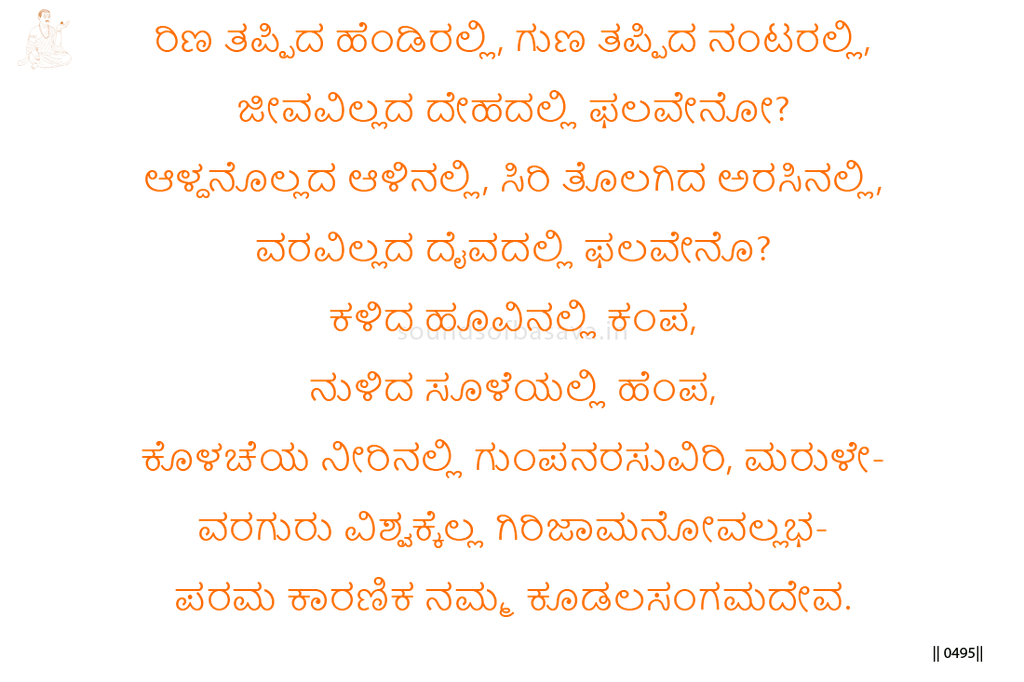
In this vachana, Basavanna tests every form by its essential quality. What use is a relationship without fidelity, a friend without virtue, or a body without life? The outward form may remain, but without its living truth it becomes empty.
He then extends the same test to service, prosperity, and worship. What use is service without loyalty, a ruler without sustaining fortune, or a deity without grace? The question is not whether the form exists, but whether its essential power is present.
Basavanna then turns to natural and sensory images: fragrance in a withered flower, charm in what has lost its freshness, and coolness in foul water. He addresses the deluded mind and points it toward Kudalasangama Deva, the true Guru of all, beloved of Girija (Parvati, the daughter of the mountain and consort of Shiva), and the Supreme Cause. The teaching is that forms without essence are hollow, while Kudalasangama Deva alone is the living source of fullness.
Imagery & Symbolic Relevance
The first image is the woman or spouse without fidelity. Basavanna uses this as an image of relationship emptied of its essential truth. The form of relation remains, but its grounding quality is absent.
The second image is the friend without virtue. Friendship is not complete by name alone. If virtue is absent, the word “friend” becomes hollow.
The third image is the body without life. This is the clearest image. The body may still have form, but without jiva it has no living value.
The fourth image is service without loyalty. Service is not merely standing in a role. Without inner loyalty or right relation, the form of service does not bear fruit.
The fifth image is the ruler or condition from which prosperity has departed. Status without sustaining power becomes empty. Basavanna again distinguishes title from substance.
The sixth image is the deity without grace or boon. A god that gives no grace cannot be the true refuge. Worship must be measured by living response, not by name alone.
The withered flower and fragrance form the next image. A flower without fragrance shows beauty after its essence has faded. The form remains, but its inner quality is gone.
The image of lost charm continues the same teaching. What has lost its living freshness cannot be made whole by name or appearance.
The foul water and coolness form the final natural image. Water should refresh, but polluted water cannot give true coolness. Its purpose has failed because its purity is lost.
The final address to the deluded mind gathers all the images. Basavanna asks the mind not to seek value in hollow forms. Kudalasangama Deva alone is named as Varaguru, Girija’s beloved, and the Supreme Cause.
Lingayoga
In Lingayoga, this vachana teaches discernment of essence. The seeker must not be satisfied with name, role, form, or appearance when the living truth is absent.
For Pranalingi Sthala, the teaching is inwardly sharp. The relation to Linga must not become an empty form. It must carry life, fidelity, virtue, grace, and living awareness.
The practice-point is direct: test every form by its essence. If devotion, service, worship, speech, and identity do not carry living truth, they remain hollow. The seeker must turn from hollow appearance to Kudalasangama Deva, the Supreme Cause.
Editorial Commentary
The repeated question “what use?” should be preserved. It is Basavanna’s method of stripping form away from essence.
The social images function as examples of form without its essential quality.
The natural images—withered flower, lost charm, and foul water—make the teaching concrete. Fragrance, freshness, and coolness cannot be supplied by appearance alone. In the same way, spiritual form cannot replace living truth.
Related Vachana
Supporting Vachana
Prasadi Sthala Vachana 900 — Divine Paradox
Prasadi Vachana 900 supports this vachana by showing that sacred-looking action becomes empty when living understanding is absent. There, flowers are taken from a tree and offered back to the tree, river water is taken and poured back into the river, and milk is taken while the calf cries and the mother grieves.
Vachana 563 tests forms by their essence. A body without life, a flower without fragrance, foul water without coolness, and a deity without grace are all hollow. Vachana 900 supports this by showing that worship itself becomes hollow when it lacks awareness, compassion, and right relation before Kudalasangama Deva.
Advancing Vachana
Sharana Sthala Vachana 1337 — Show Me the Difference Between Prana and Prana-Linga
Sharana Vachana 1337 advances this teaching by carrying the problem of hollow form into the heart of worship. In Vachana 563, Basavanna asks what use any form has when its living essence is absent. In Vachana 1337, the seeker admits that he did not understand the intimate relation between Prana and Linga, and that by making a hollow form and worshipping outwardly, his days passed in vain.
Thus the Pranalingi discernment of hollow and full advances into Sharana Sthala as the prayer to know the living relation between Prana and Prana-Linga. The seeker must not remain with form alone. He must know the life within the form before Kudalasangama Deva.
