

Summary
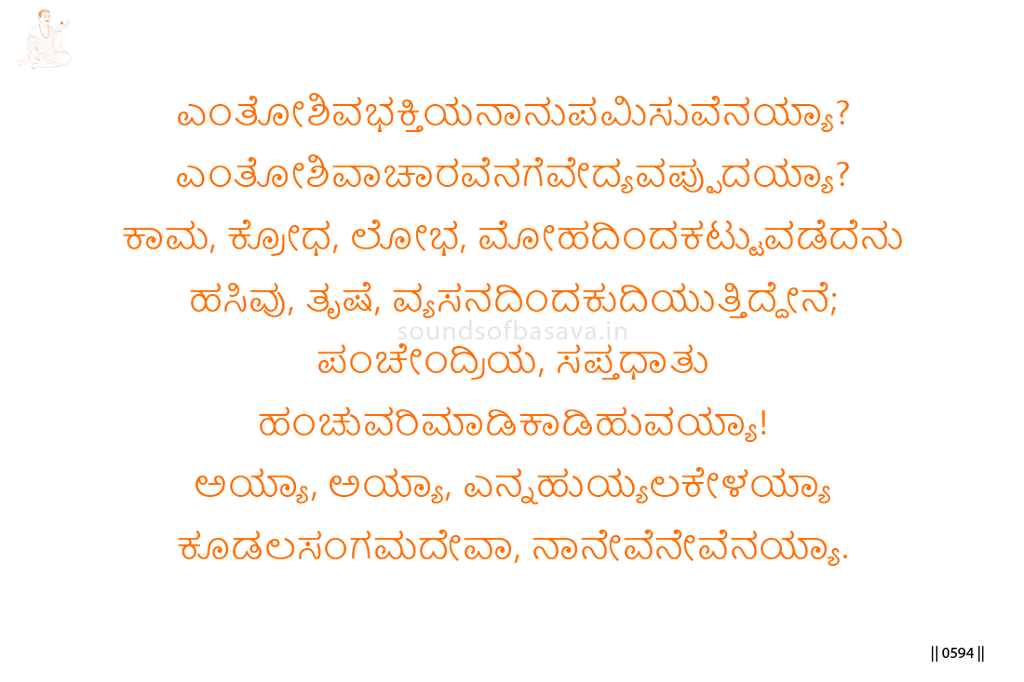
Basavanna asks how he can speak of devotion to Shiva (Shiva-bhakti) and how the disciplined way of living in accordance with Shiva (Shiva-achara) can become known to him. He then names the condition that prevents steadiness: desire, anger, greed, delusion, pride, and jealousy have bound him.
The disturbance is not only inward. Hunger, thirst, and habit burn within him. The five senses and the seven bodily elements trouble him and tear his steadiness apart. Having seen this, Basavanna does not claim capacity. He cries to Kudalasangama Deva: “Ayya, Ayya, hear my cry. What shall I do?”
Imagery & Symbolic Relevance
The opening questions give the vachana its force. Basavanna does not deny Shiva-bhakti or Shiva-achara. He questions his own capacity to speak of them or live them while bound by disturbance.
The six inner forces form the first field of bondage: desire, anger, greed, delusion, pride, and jealousy. They are named plainly as what binds the seeker.
Hunger, thirst, and habit form the next field. Basavanna shows that the seeker is also pressed by bodily need and repeated tendency.
The five senses and seven bodily elements form the final field of trouble. They do not remain quiet; they disturb and pull the seeker apart.
The repeated cry, “Ayya, Ayya,” completes the movement. The vachana moves from incapacity, to bondage, to burning, to disturbance, and finally to helpless appeal before Kudalasangama Deva.
Lingayoga
In Lingayoga, the relevance of this vachana lies in the movement given by the source: the seeker sees that he cannot speak of Shiva-bhakti or live Shiva-achara while bound by inner forces, bodily pressure, senses, and bodily elements.
The practice-point is direct: when the seeker sees his helplessness clearly, he must cry to Kudalasangama Deva without concealment.
Editorial Commentary
This vachana should be read as an honest confession, not as a doctrine of defeat. Basavanna names the forces that bind him and does not soften the condition. The final question, “What shall I do?” is not a request for abstract explanation; it is the cry of one who has reached the limit of self-confidence before Kudalasangama Deva.
Related Vachana
Supporting Vachana
Pranalingi Sthala Vachana 635 — The Weaver Bird and the Restless Monkey
Pranalingi Vachana 635 supports this vachana by questioning whether bhakti is rooted in knowing or only in unstable relief-seeking. There, Basavanna warns that devotion must not remain restless, formal, verbal, or comfort-seeking. Sharana Vachana 47 carries this concern into a more urgent confession: the seeker asks how he can speak of Shiva-bhakti and Shiva-achara while bound by desire, anger, greed, delusion, pride, jealousy, bodily need, habit, senses, and bodily elements. The support is direct: devotion must become true steadiness, not merely a name spoken from helpless disturbance.
Advancing Vachana
Aikya Sthala Vachana 1022 — The Vigilance of Complete Offering
Aikya Vachana 1022 advances this teaching by showing the state in which the six inner enemies no longer have ground. In Sharana Vachana 47, Basavanna is bound by desire, anger, greed, delusion, pride, and jealousy, and is troubled by the senses and bodily elements. In Aikya Vachana 1022, the six enemies cannot enter, the elements become Prasada, and the senses are gathered and fulfilled. Thus the Sharana-stage cry of helplessness advances into Aikya as freedom from the very forces that had bound and disturbed the seeker before Kudalasangama Deva.
