

Summary
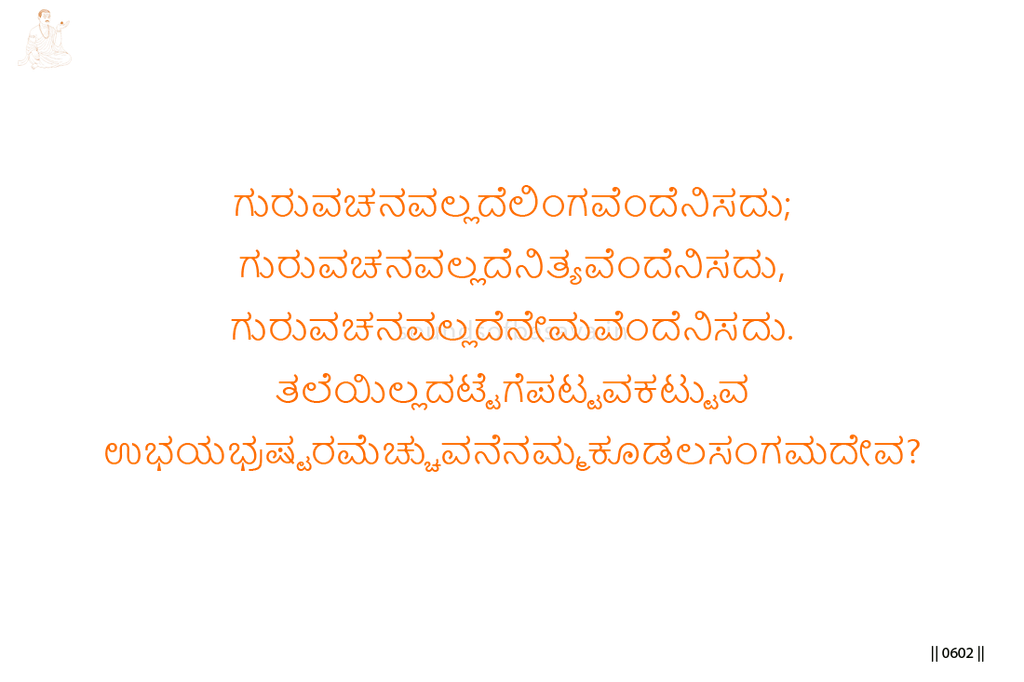
Basavanna says that without the living word of the Guru (Guru-vachana), it cannot be called Linga, the realized presence of the Divine. Without Guru-vachana, it cannot be called Jangama. Without Guru-vachana, it cannot be called Nitya, the eternal and unchanging truth. Without Guru-vachana, it cannot be called Nema, the disciplined observance or sacred practice that governs conduct.
The vachana then turns to a severe image. One who is headless — that is, one without knowledge of the eternal truth — cannot rightly be crowned. If such a one is crowned by crooked persons who create unrest, would Kudalasangama Deva approve it? The teaching is direct: sacred names, observances, and authority do not become valid by outer declaration. They must be grounded in Guru-vachana.
Imagery & Symbolic Relevance
Guru-vachana is the repeated governing term. Basavanna places it before Linga, Jangama, Nitya, and Nema. The repetition shows that these cannot be claimed apart from the Guru’s word.
Linga is the first to be tested. Without Guru-vachana, it is not truly Linga.
Jangama is the second to be tested. Without Guru-vachana, it is not truly Jangama.
Nitya and Nema are then tested in the same way. What is called eternal and what is called observance cannot stand apart from Guru-vachana.
The image of the headless one gives the vachana its force. “Headless” here refers to one without knowing the eternal truth. Such a person may be outwardly honored, but the essential knowing is absent.
The crowning by crooked persons who create unrest sharpens the warning. Basavanna is not merely criticizing lack of knowledge; he is questioning false recognition given by those who themselves are distorted. The final question asks whether Kudalasangama Deva would approve such crowning.
Lingayoga
In Lingayoga, the relevance of this vachana lies in the movement given by the source: Linga, Jangama, Nitya, and Nema are not to be claimed apart from Guru-vachana.
The practice-point is direct: sacred form, sacred movement, eternal truth, and observance must remain grounded in the Guru’s word. Without that grounding, even recognition or honor becomes invalid.
Editorial Commentary
This vachana should be read as a warning against false spiritual recognition. Basavanna does not reject Linga, Jangama, Nitya, or Nema. He rejects calling them true when they are separated from Guru-vachana. The closing image makes the warning sharper: one without knowledge of eternal truth cannot be made valid by being crowned by crooked persons who create unrest.
Related Vachana
Supporting Vachana
Pranalingi Sthala Vachana 648 — The Body as the Sacred Field
Pranalingi Vachana 648 supports this vachana by showing Guru-vachana as one of the essential supports of worship. There, Linga is held in the palm, Guru-vachana is placed on the tongue, and nitya-nema is joined to walking in truth. Sharana Vachana 72 makes the same principle sharper: without Guru-vachana, Linga, Jangama, Nitya, and Nema cannot truly be called so. The support is direct: Pranalingi integrates Guru-vachana into worship and conduct; Sharana makes Guru-vachana the test of sacred validity.
Advancing Vachana
Aikya Sthala Vachana 1087 — Guru and Disciple in the Light of Grace
Aikya Vachana 1087 advances this teaching by carrying the Guru principle into direct recognition of Kudalasangama Deva as Guru. In Sharana Vachana 72, Basavanna says that Linga, Jangama, Nitya, and Nema cannot stand apart from Guru-vachana. In Aikya Vachana 1087, the relation deepens: Kudalasangama Deva Himself is recognized as the Guru, and the speaker stands as disciple. Thus the Sharana-stage dependence on Guru-vachana advances into Aikya as the direct recognition of the Lord as Guru.
