

Summary
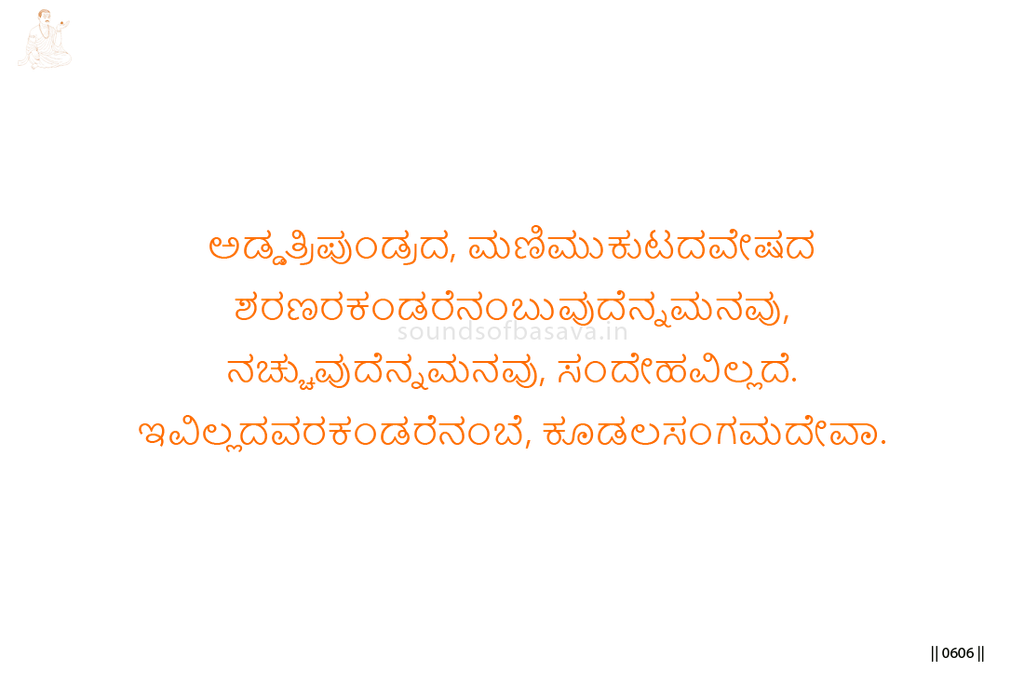
Basavanna says that when he sees the Sharana bearing the three lines of Vibhuti and the Rudraksha upon the head, his mind trusts. His mind is pleased and does not doubt.
He then asks how he can trust those in whom these are absent. The teaching is direct: the sight of the Sharana bearing these marks brings trust and removes doubt before Kudalasangama Deva.
Imagery & Symbolic Relevance
The Sharana is the central figure of the vachana. Basavanna does not speak here of a general person, but specifically of the Sharana.
The three lines of Vibhuti form the first visible mark. The vachana does not require additional symbolic expansion beyond this: the Sharana bears the sacred ash in three lines.
The Rudraksha upon the head forms the second visible mark. Together with the three lines of Vibhuti, it becomes part of the Sharana’s recognizable bearing.
The response of Basavanna’s mind is important. He says his mind trusts; it is pleased; it does not doubt. Trust is not argued into existence here. It arises when the Sharana is seen with these marks.
The closing question gives the warning. Where these are absent, Basavanna asks how trust can arise. The force of the vachana lies in this contrast: presence of the marks on the Sharana brings trust; absence raises doubt.
Lingayoga
In Lingayoga, the relevance of this vachana lies in the movement given by the source: the seeker sees the Sharana bearing the three lines of Vibhuti and Rudraksha, and the mind trusts without doubt.
The practice-point is direct: the seeker must learn to recognize the Sharana through the signs named by Basavanna.
Editorial Commentary
This vachana should be read as a teaching on recognition. Basavanna does not reduce the three lines of Vibhuti and Rudraksha to mere decoration, nor does he expand them into unsupported symbolic systems. He states their effect plainly: when seen on the Sharana, the mind trusts, is pleased, and does not doubt.
Related Vachana
Supporting Vachana
Pranalingi Sthala Vachana 613 — The Borrowed Word and the Lived Radiance
Pranalingi Vachana 613 supports this vachana by warning that Vibhuti and sacred signs must not remain outer marks when inward allegiance is divided. Sharana Vachana 88 shows the corresponding positive recognition: when the Sharana bears the three lines of Vibhuti and Rudraksha, Basavanna’s mind trusts and does not doubt. The support is direct: Pranalingi tests sacred signs against inner truth; Sharana shows those signs as trustworthy when borne by the Sharana.
Advancing Vachana
Aikya Sthala Vachana 1214 — The Radiance of the Tenfold Padodaka
Aikya Vachana 1214 advances this teaching by carrying Vibhuti and Rudrakshi into an integrated Aikya field. In Sharana Vachana 88, the three lines of Vibhuti and Rudraksha on the Sharana awaken trust and remove doubt. In Aikya Vachana 1214, Vibhuti and Rudrakshi stand together with Guru, Linga, Jangama, Padodaka, Prasada, Panchakshari, Gana-vrata, Nema, Achara, and Shila as part of sacred wholeness. Thus the Sharana-stage recognition of these marks advances into Aikya as integrated completeness before Kudalasangama Deva.
