

Summary
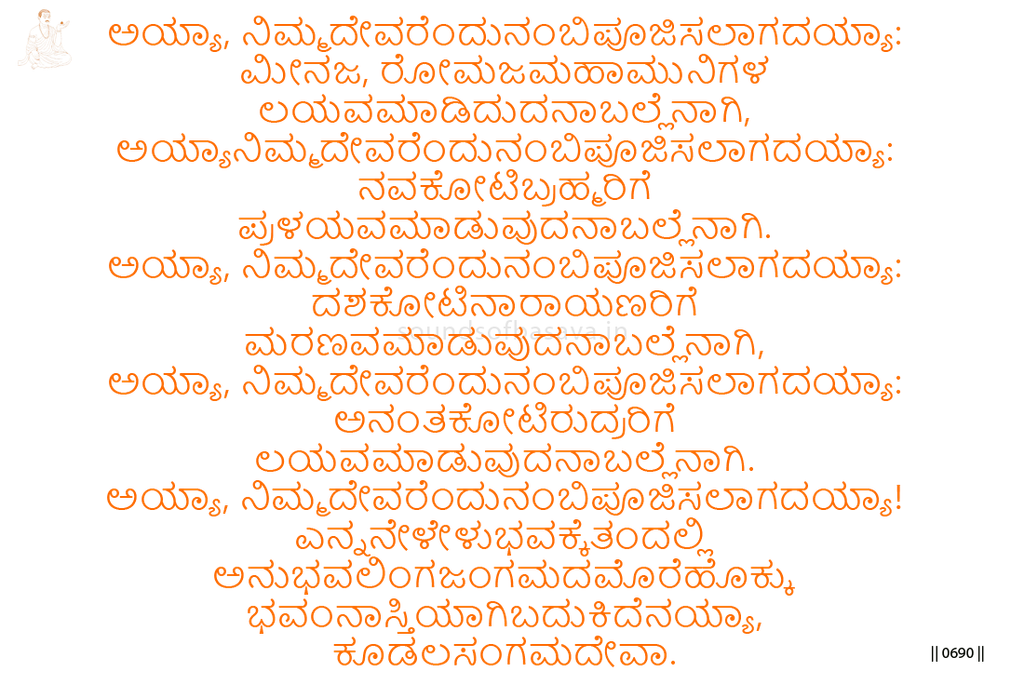
In this vachana, Basavanna repeatedly says that he cannot claim to worship Kudalasangama Deva as God by any power of his own.
He cannot dissolve the great sages, the nine crore Brahmas, the ten crore Narayanas, or the endless crore Rudras. He does not stand as one who possesses cosmic power, spiritual authority, or devotional greatness.
Thrown into sevenfold becoming, he enters the refuge of Anubhaya Linga-Jangama. This means that the culmination of realization is converted into service of Jangama, the living society through whom Kudalasangama Deva is served.
Through that refuge and service, his becoming becomes no more, becomes void, and thus he lives before Kudalasangama Deva.
Imagery & Symbolic Relevance
The repeated statement “How can I worship You as God?” is the first movement. Basavanna is not denying devotion; he is refusing devotional self-claim.
Mīnaja, Rōmaja, and the great sages form the first measure of scale. Basavanna does not claim the power to dissolve such beings.
The nine crore Brahmas, ten crore Narayanas, and endless crore Rudras enlarge the same point. Creation, preservation, and dissolution themselves are placed beyond his personal power.
This vast enumeration brings humility. Basavanna does not stand before Kudalasangama Deva as one who controls cosmic process or claims spiritual greatness.
The sevenfold becoming names the condition into which he has been brought. He is not master of becoming.
Anubhaya Linga-Jangama is the decisive refuge. It is not merely private inward realization. Linga-realization must become Jangama-service; at-one-ment must flow into service of the living society through whom Kudalasangama Deva is served.
The final image is becoming made void. Basavanna lives because bhava no longer holds him; it is emptied through refuge in Linga-Jangama and through service to Jangama.
Lingayoga
In Lingayoga, this vachana teaches that realization must not remain as self-claim, cosmic imagination, or inward attainment alone.
The practice-point is direct: do not claim power, worship, or realization as personal possession. Let Linga-realization become service to Jangama, the living field through whom Kudalasangama Deva is served.
For Sharana Sthala, this is surrender in which bhava becomes void through Anubhaya Linga-Jangama.
Editorial Commentary
The final phrase is decisive. Basavanna does not merely say that he survives within becoming. He says that, after entering the refuge of Anubhaya Linga-Jangama, becoming became no more and thus he lived. Here Anubhaya Linga-Jangama should be read as realized Linga-awareness converted into Jangama-service, not as an abstract twofold idea.
Related Vachana
Supporting Vachana
Pranalingi Sthala Vachana 1046 — The Jangama: Guru of the Guru
Pranalingi Vachana 1046 supports this teaching by naming Linga as Ādi and Jangama as Anādi, and by declaring service to Jangama as Paramananda Sukha. Vachana 392 moves from inability to claim cosmic power into refuge in Anubhaya Linga-Jangama, where realization becomes service to Jangama. Vachana 1046 prepares this by showing that the living Jangama is the beginningless movement through which Linga is served and known.
Advancing Vachana
Aikya Sthala Vachana 1192 — Jangama Seva Is the Eternal Path
Aikya Vachana 1192 advances this teaching by declaring that Jangama Seva is Guru-puja, Linga-puja, sustenance, true nature, the Self, and the Eternal State. Vachana 392 says that Basavanna entered the refuge of Anubhaya Linga-Jangama, and that his becoming became void. Aikya Vachana 1192 carries this into full Aikya: realization is not held privately, but becomes service to Jangama, the living society through whom Kudalasangama Deva is served.
