

Summary
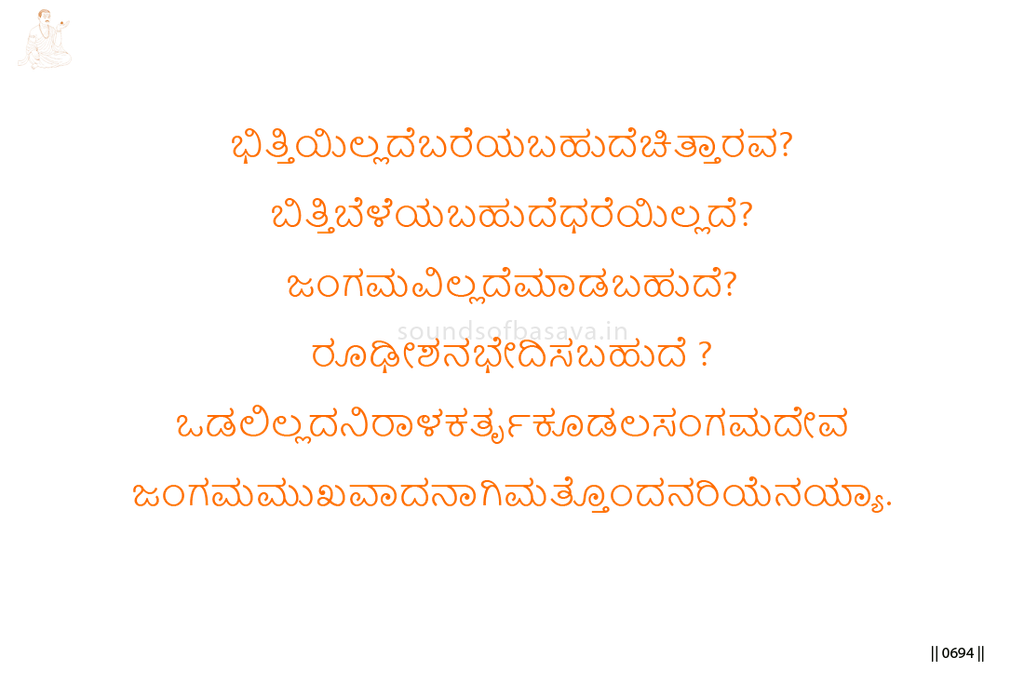
In this vachana, Basavanna asks whether a painting can be made without a supporting surface, whether seed can grow without earth, and whether Linga-archane can be performed without Jangama.
Each question points to the same teaching: what is hidden, subtle, or sacred requires a proper field through which it becomes manifest. A painting needs a surface. Seed needs earth. Linga-worship needs Jangama.
Basavanna then asks whether Rudreshwara can be known without the body. The body is not treated as final reality, but as the field through which recognition, worship, and encounter become possible.
Kudalasangama Deva, though formless and subtle, becomes knowable through Jangama-mukha, the living face of Jangama. Beyond this way, Basavanna says he knows no other.
Imagery & Symbolic Relevance
The painting and its surface form the first image. A painting cannot appear without something on which it is drawn. The image shows that revelation requires a medium.
The seed and earth form the second image. Seed contains life, but without earth it cannot sprout, grow, or become visible. Hidden possibility needs a living ground.
Linga-archane without Jangama is the central spiritual question. Basavanna continues the teaching of the previous vachana: Linga worship becomes incomplete when separated from Jangama.
The question about Rudreshwara and the body gives the vachana its embodied force. The body is the field where worship, recognition, service, and transformation occur. Basavanna does not make the body the goal; he shows that the body cannot be dismissed as irrelevant.
Jangama-mukha is the final image. Kudalasangama Deva, though formless, becomes knowable through the living face of Jangama. The formless is not denied; it is encountered through living presence.
Lingayoga
In Lingayoga, this vachana teaches that the inward and the living must not be divided. Linga is not complete for the seeker when treated only as an isolated object of worship. Jangama is the living field through which Linga becomes relationally known.
The practice-point is direct: do not seek the formless by rejecting the embodied field. Let Linga-archane be joined to Jangama-recognition, and let the body become the place where worship, seeing, and service are made real.
For Sharana Sthala, this vachana shows Bhakti maturing into living recognition. The Sharana does not separate the subtle Kudalasangama Deva from Jangama-mukha.
Editorial Commentary
The governing images are surface and painting, earth and seed, Linga and Jangama, Rudreshwara and body. They should remain simple and direct. Basavanna is not reducing the formless Divine to physical form; he is showing that the formless becomes knowable to the seeker through embodied Jangama-presence.
Related Vachana
Supporting Vachana
Pranalingi Sthala Vachana 961 — The Descent of Linga into Prana
Pranalingi Vachana 961 supports this teaching by showing that Linga placed only upon the body and worshipped outwardly does not by itself end bhava. Linga must become inwardly joined with prana, and the realization must pass through Dasoha and Jangama as Mukhalinga. Vachana 399 gives the Sharana form of this same movement: Linga-archane cannot be separated from Jangama, and Kudalasangama Deva becomes knowable through Jangama-mukha.
Advancing Vachana
Aikya Sthala Vachana 941 — See the Sahaja Sharana
Aikya Vachana 941 advances this teaching by showing the mature Sharana in whom form and formlessness are no longer opposed. The Sahaja Sharana does not reject the body, nor does he create another self beyond it. Vachana 399 says that the formless Kudalasangama Deva becomes knowable through Jangama-mukha; Aikya Vachana 941 carries this into Aikya, where form and formlessness are seen together in the living Sharana of Kudalasangama.
