

Summary
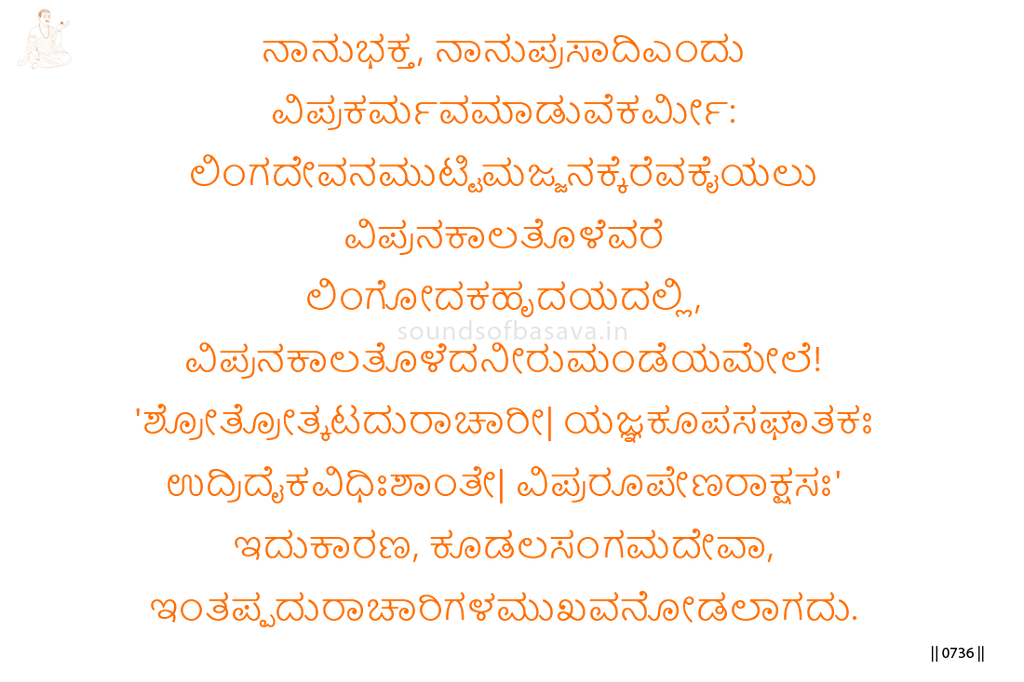
In this vachana, Basavanna exposes divided devotion.
He describes a ritual-minded person who says, “I am a Bhakta, I am a Prasadi,” but whose conduct contradicts the claim. For the reader, Bhakta means devotee. Prasadi means one who receives and lives by Prasada, the grace-filled offering returned from Linga. Karmi here means one who performs religious action mechanically.
The person touches and bathes the Linga with his hands, but those same hands wash the feet of a Vipra. Vipra here refers to a Brahmin or one treated as ritually superior by inherited religious status. The issue is not humility before a realized Sharana. The issue is misplaced reverence before social hierarchy.
Basavanna then gives the decisive contrast: Linga-water is not held in the heart, while the water that washed the Vipra’s feet is placed upon the head. The heart should hold the Linga’s grace, but the head gives highest honor to another source.
Basavanna says he cannot bear to see the face of such bad-conducted people. The teaching is direct: devotion cannot be divided. One cannot claim Linga-bhakti while giving greater inward authority to caste-based or worldly sacred status.
Imagery & Symbolic Relevance
The claim “I am a Bhakta, I am a Prasadi” is the first image. Basavanna begins with religious self-description. The person speaks the right words, but the later images test whether the words are true.
The hand touching and bathing the Linga is the second image. The hand represents action and worship. Outwardly, the person performs Linga-archane.
The same hand washing the Vipra’s feet creates the contradiction. The problem is not the physical act of washing. The problem is that reverence has become divided: the Linga is ritually handled, but inherited social authority is inwardly honored.
Linga-water is the sacred water of Linga worship. It should enter the heart as grace, remembrance, and inward transformation.
The water from the Vipra’s feet placed on the head is the sharper image. The head is the place of honor. Basavanna shows that the person’s highest reverence has gone elsewhere.
The face of the bad-conducted person is the final image. Basavanna does not merely criticize an error in ritual sequence. He rejects a whole pattern of conduct where speech, hand, heart, and head do not agree.
The movement of the vachana is clear: devotional claim, ritual action, social submission, inward displacement, and final rejection of divided conduct.
Lingayoga
In Lingayoga, this vachana teaches unity of worship, inner reception, and conduct.
The practice-point is direct: do not let Linga worship remain in the hand while the heart and head bow elsewhere. Let Linga-water become inward remembrance, not merely ritual contact.
For Sharana Sthala, this is a test of allegiance. The Sharana must not claim Prasada while continuing to enthrone caste-status, inherited hierarchy, or worldly religious authority above Linga. True Sharana conduct requires the hand, heart, and head to be aligned before Kudalasangama Deva.
Editorial Commentary
This vachana should be written carefully. Basavanna is not rejecting reverence, service, or humility. He is rejecting divided priority. When the Linga is bathed outwardly but caste-based foot-water is honored above Linga-water, devotion has become false. The final word “durachari” should remain strong: this is not a minor ritual mistake, but bad conduct born of divided consciousness.
Related Vachana
Supporting Vachana
Pranalingi Sthala Vachana 966 — The Integrity of the One Linga Path
Pranalingi Vachana 966 supports this teaching by insisting that after receiving Ekalinga, the One Linga, the seeker must become firm in Linga-niṣṭhe. The mind must not wander into other external sacred dependencies after the Anga-Linga relation has been received. It also places this steadiness within the integrated path of Guru, Linga, Jangama, Pādodaka, Prasada, and Sadbhakti.
This supports Vachana 593 directly. Vachana 593 shows a person who touches and bathes the Linga, but whose reverence remains divided by social hierarchy. Vachana 966 gives the supporting principle: once Linga-relation is received, worship must become steady, undivided, and properly integrated before Kudalasangama Deva.
Advancing Vachana
Aikya Sthala Vachana 1126 — When All Offering Becomes One Offering
Aikya Vachana 1126 advances this teaching by carrying divided worship into the deeper Aikya correction. There, offering is tested through Linga-mukha and Jangama-mukha, and the seeker recognizes that what stands upon the Anga is Linga and that all is Sangamanatha. The veil covering Shiva-bhakti is lifted when offering, remembrance, and Dasoha are no longer divided.
Vachana 593 rejects the person whose hand serves Linga outwardly while heart and head honor another authority. Aikya Vachana 1126 carries this into fulfillment: offering no longer moves between competing centers. Linga, Jangama, Anga, and Dasoha become one field of recognition before Kudalasangama Deva.
