

Summary
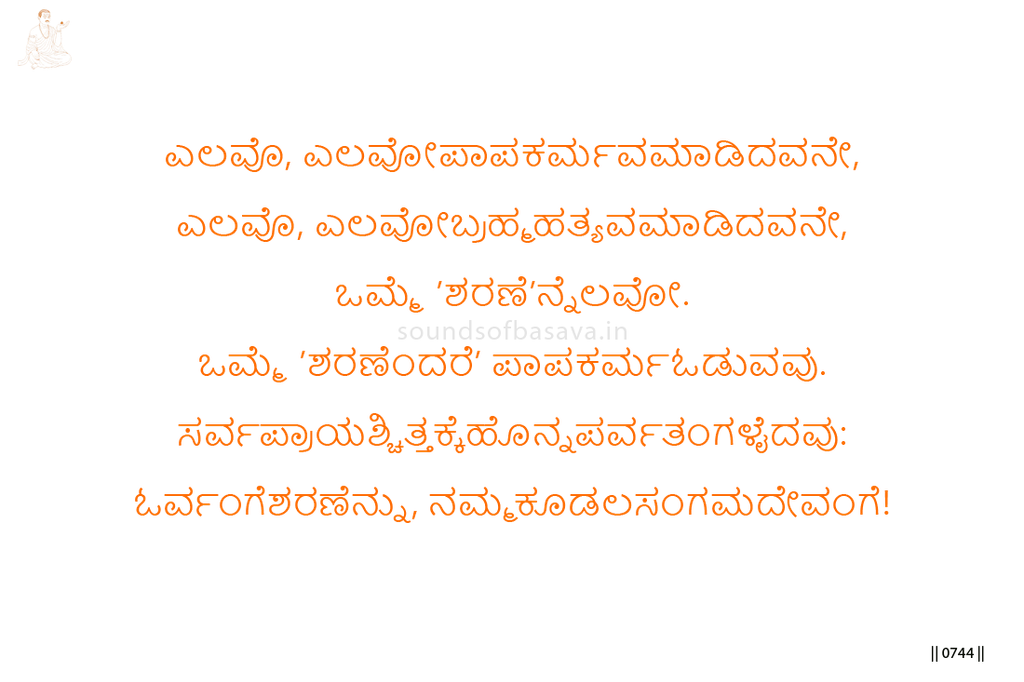
In this vachana, Basavanna addresses the one who has committed sinful action and wandered in delusion. He does not leave such a person imprisoned in the past. His instruction is direct: become a Sharana even once.
A Sharana is one who has taken refuge in Kudalasangama Deva. Śaraṇāgati means surrender or refuge-taking: the inward turning by which the seeker no longer stands apart in self-will, fear, or accumulated fault.
Basavanna says that when one becomes a Sharana in this true sense, sinful action runs away. The past is not denied, but it loses its power to define the seeker. The decisive force is not external payment, ritual compensation, or social restoration, but the turning of the whole person toward Kudalasangama Deva.
The image of mountains of gold offered for all expiation is central. Prāyaścitta means expiation or atonement, the attempt to correct fault through penance, offering, or prescribed acts. Basavanna says that even vast wealth given for such correction cannot equal one true surrender.
The teaching is therefore compassionate and severe at once: past fault is real, but not final; ritual compensation has limits; total refuge in Kudalasangama Deva transforms the seeker at the root.
Imagery & Symbolic Relevance
The first image is the one who has done pāpa-karma, sinful or harmful action. Basavanna begins with the burdened person, not with the already pure. This makes the vachana an invitation into transformation, not a praise of spiritual achievement.
The second image is wandering in delusion. The problem is not only bad action, but wrong seeing. When the mind is confused, action follows that confusion. The person is not merely guilty; he is misdirected.
The phrase “become a Sharana once” gives the turning point. “Once” should not be read as a casual moment or a light ritual gesture. It means one true act of inward reversal. The person who was scattered, burdened, and confused now takes refuge wholly in Kudalasangama Deva.
The running away of sinful action gives the image of release. Sin is not treated as an eternal stain. When the center of life changes, what bound the person no longer holds the same authority.
The mountains of gold form the strongest contrast. Gold represents great external value. Mountains of gold represent the greatest imaginable offering. Basavanna places this vast image beside one true surrender and declares the surrender greater. The force is clear: quantity cannot replace sincerity; external payment cannot replace inward transformation.
The final call is not to perform more calculations of merit and fault, but to become the Sharana of Kudalasangama Deva. The vachana moves from burden to refuge, from wandering to turning, from expiation to transformation.
Lingayoga
In Lingayoga, this vachana teaches the power of decisive refuge.
The practice-point is direct: do not remain trapped in self-condemnation, and do not imagine that external compensation alone can purify the root. Turn wholly toward Kudalasangama Deva.
Achara, right conduct, begins again from this turning. Kayaka, sacred work, must no longer continue the old pattern of harmful action. Dasoha, offering, becomes the giving of the whole self, not merely the giving of wealth or objects.
For Sharana Sthala, this is essential. The Sharana is not one who has no past. The Sharana is one whose past no longer stands as master because refuge has become total.
Editorial Commentary
This vachana should be written as a teaching on sincere transformation, not as permission to continue wrongdoing. Basavanna’s compassion is not casual forgiveness. He calls the one who has erred into a complete change of center. The “once” is powerful because true surrender is powerful. The mountains of gold show the limit of external expiation; the becoming of a Sharana shows the force of living refuge.
Related Vachana
Supporting Vachana
Pranalingi Sthala Vachana 991 — Transformed Through the Touch of Grace
Pranalingi Vachana 991 supports this teaching by showing transformation through Kudalasangama Deva’s muttida guṇa, the transforming quality or grace of Divine touch. There, the seeker is changed by the Lord’s touch: restored to the ancient path of conduct, made steady like Vṛṣabha, given a transformed identity, and reborn within the living Sharana-field.
This supports Vachana 620 because both vachanas place transformation beyond self-manufacture. In Vachana 620, past sin is overcome through true refuge in Kudalasangama Deva, not through mountains of gold. In Vachana 991, the seeker is transformed through the Lord’s touch, not by self-invention. Together, they show that grace does not merely cover fault; it changes the condition of the seeker.
Advancing Vachana
Aikya Sthala Vachana 1354 — A Bond Beyond All Measure
Aikya Vachana 1354 advances this teaching by showing the mature fulfillment of Sharana-belonging. It declares that worldly achievements, heroic powers, ritual grandeur, scriptural attainment, yogic accomplishment, heavenly status, and even exalted spiritual powers remain external when compared with the living bond between the Sharana and Kudalasangama Deva.
Vachana 620 opens the way through one true turning: become a Sharana, and the burden of past sin loses its hold. Aikya Vachana 1354 shows where that turning matures. The Sharana’s relationship with Kudalasangama Deva becomes beyond measure. It is no longer a transaction for removing sin, but a living communion rooted in surrender and direct realization.
