

Summary
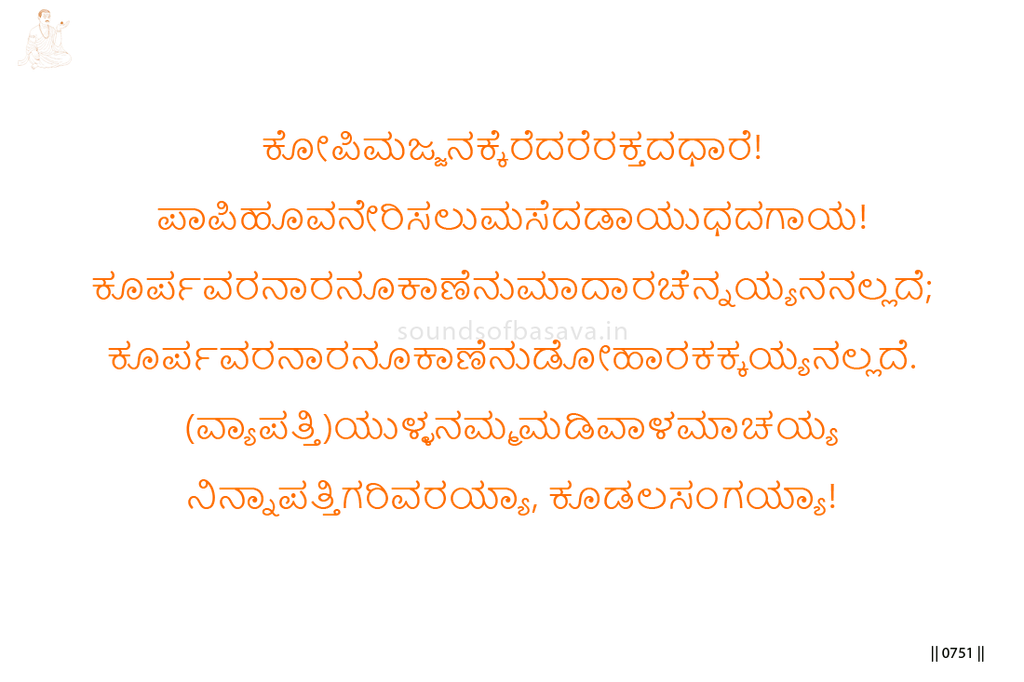
In this vachana, Basavanna tests worship by the state of the one who offers.
If an angry person pours water for the Linga’s bathing, the act becomes like a stream of blood. If a wrongdoer offers a flower, the offering becomes like the wound of a sharpened weapon. Water and flower are normally sacred substances, but anger and wrongdoing alter the quality of the act.
Basavanna is not rejecting Linga-worship. He is saying that worship cannot be separated from the inward condition of the worshipper. An angry heart cannot make the water pure by pouring it. A life steeped in wrongdoing cannot make the flower harmless by placing it before the Linga.
The vachana then turns to the living counter-example. Basavanna says he sees no true conqueror of anger except Madara Chennayya. He sees no such one except Dohara Kakkayya. He then names Madiwala Machayya as one of expansive presence.
These names are not decorative. Chennayya, Kakkayya, and Machayya stand as realized Sharanas whose lives show the purification that worship requires. The teaching is direct: true offering is not the substance alone; it is the purified life from which the offering arises.
Imagery & Symbolic Relevance
The angry person pouring water is the first image. Water used for Linga-bathing should cleanse and honor. But when it comes from anger, Basavanna says it becomes like blood. The sacred act is turned into an image of violence.
The wrongdoer offering a flower is the second image. A flower usually suggests fragrance, softness, and reverence. But when offered by one whose life remains corrupt, it becomes like a wound made by a weapon. The flower no longer carries tenderness; it carries injury.
The two images work together. Water becomes blood. Flower becomes wound. Basavanna shows that outwardly sacred materials do not overcome inward disorder by themselves.
The named Sharanas form the positive image. Madara Chennayya and Dohara Kakkayya are presented as conquerors of anger. Basavanna’s measure is not caste-status, ritual rank, or public reputation, but conquered inner violence.
Madiwala Machayya completes the group. He is described as one with expansive presence. In this context, that means a life no longer narrowed by anger, wrongdoing, or self-centered agitation.
The final movement places these Sharanas before Kudalasangayya as those who know the distress and need of the Lord’s field. Their greatness is not formal purity, but inward transformation joined to living care.
Lingayoga
In Lingayoga, this vachana teaches fitness in offering.
The seeker should not approach the Linga with anger, harm, or unresolved wrongdoing and imagine that water or flowers will hide that state. The first purification must be the one who offers.
For Sharana Sthala, the practice-point is clear: worship must arise from a life being purified. The company of Chennayya, Kakkayya, and Machayya shows the field in which worship becomes truthful, because the worshipper’s conduct and inward state have been transformed.
Editorial Commentary
The images of blood and wound should remain central. Basavanna’s warning is severe because he is protecting worship from hypocrisy. The issue is not the ritual substance but the condition carried into the act.
The three Sharanas should also remain central. They are not examples added from outside the vachana; Basavanna himself names them as the measure of anger conquered and life made fit before Kudalasangayya.
Related Vachana
Supporting Vachana
Pranalingi Sthala Vachana 963 — Body, Mind, and Being as the Vessels of Linga
Pranalingi Vachana 963 supports this teaching by saying that body, mind, and bhava each become vessels for Linga at their proper level. Bhava means inward feeling or inner condition. The vachana also says that for sacred receiving before Prabhudeva, Basavanna sees no vessel other than Bhakti-pariyāṇa, the path or movement of devotion.
This supports Vachana 650 directly. Vachana 650 shows what happens when the vessel is unfit: water becomes blood, and flower becomes wound. Vachana 963 gives the positive rule: the vessel must be rightly formed. Body, mind, bhava, and devotion must become fit to hold and offer before Linga.
Advancing Vachana
Aikya Sthala Vachana 935 — Beyond Truth and Untruth: The Primordial Silence of Aikya
Aikya Vachana 935 advances this teaching through the idea of satya-shuddha, truth-purity. It says that where truth and purity are still held as separate things to be possessed, practiced, displayed, or ritualized, the seeker has not yet reached the silence of Aikya. True purity is no longer an outer condition or ceremonial state; it is the disappearance of separation before Kudalasangama Deva.
Vachana 650 warns that water poured by an angry person becomes like blood, and a flower offered by a wrongdoer becomes like a weapon-wound. The fault lies not in water or flower, but in the state of the one who offers. Aikya Vachana 935 carries this further: even truth, purity, worship, and sacred discipline cannot remain as outer claims. They must dissolve into realized truth-purity.
Thus Vachana 650 exposes unfit offering. Aikya Vachana 935 shows the fulfilled state where worship is no longer divided from being. The one who is truly pure does not make purity into a display; such a one abides in the natural stillness of Kudalasangama Deva.
