

Summary
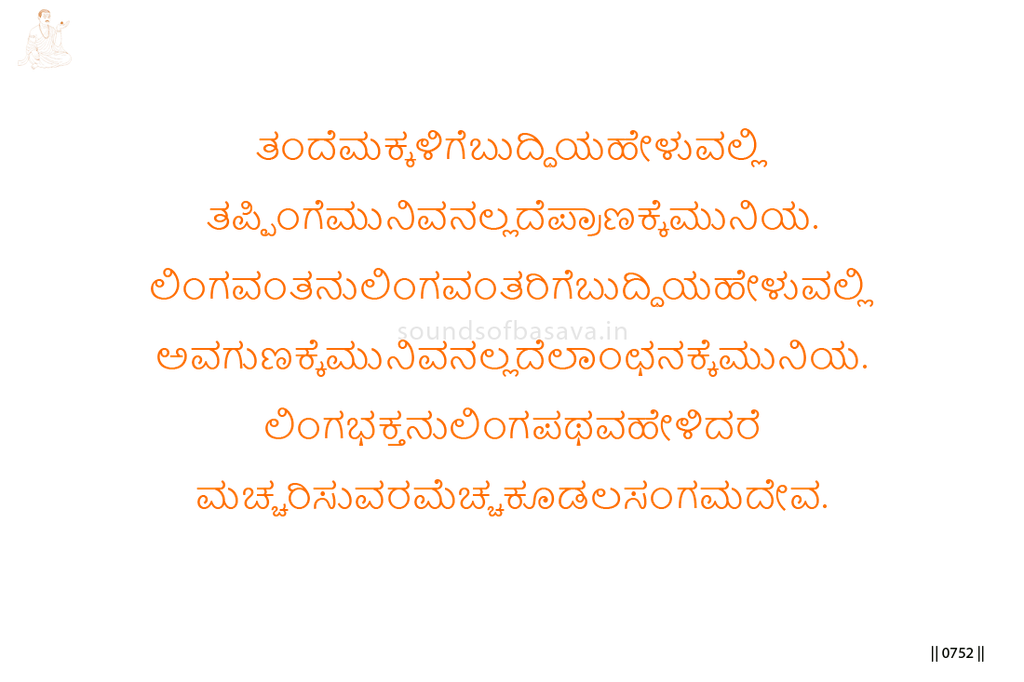
In this vachana, Basavanna teaches how correction should be understood on the Linga-path.
He begins with the image of a father advising his children. When the father becomes stern, he is not angry at the child’s life. He is angry at the fault. The child is not rejected; the misstep is corrected.
Basavanna then applies this to the Lingavanta. A Lingavanta is one who bears the Linga and belongs to the Linga-path. When one Lingavanta gives guidance to another, the anger is not toward the lanchana, the sacred mark or sign. It is toward the avaguna, the defect or wrong quality.
The final line gives the warning. When a Linga-Bhakta shows the Linga-path, those who become resentful or jealous are not pleasing to Kudalasangama Deva.
The teaching is precise: true correction is not hatred. It does not attack life, being, or sacred belonging. It addresses the fault that obstructs the path. The seeker should not turn correction into insult, nor should the one correcting confuse the person with the defect.
Imagery & Symbolic Relevance
The father and child form the first image. A father’s correction arises within relationship. The father does not wish to destroy the child’s life; he wants the child to leave the wrong step.
The distinction between life and fault is the heart of the image. Prana, life, is not the target. Tappu, fault or error, is the target. This keeps correction from becoming cruelty.
The Lingavanta gives the second image. The setting has now moved from household instruction to spiritual instruction. A person on the Linga-path may still carry defects that need correction.
The distinction between lanchana and avaguna is important. Lanchana means mark or sign, here the sacred sign of Linga-belonging. Avaguna means defect, wrong quality, or flaw. Basavanna says the correction is not against the sacred mark. It is against the defect that dishonors the path.
The Linga-Bhakta showing the Linga-path gives the final image. This is not general advice. It is guidance concerning the way of Linga. To resent such guidance is to resist the path itself.
The final warning before Kudalasangama Deva is simple: resentment toward rightful correction is not acceptable. The one who is corrected must receive the instruction without jealousy or hardness.
The movement of the vachana is clear: father corrects child, Lingavanta corrects Lingavanta, Linga-Bhakta shows the path, and resentment is rejected before Kudalasangama Deva.
Lingayoga
In Lingayoga, this vachana teaches the right reception of correction.
The seeker must learn to distinguish between the self and the fault. Correction does not mean that life is rejected. It means that what obstructs the Linga-path must be shown and removed.
For Sharana Sthala, this is a necessary humility. One who bears the Linga should not resent the guidance of one who shows the path. To receive correction rightly is to protect the sacred mark from being contradicted by defect.
Editorial Commentary
This vachana should remain close to its Kannada distinctions. The father is angry at the fault, not at the child’s life. The Lingavanta is angry at the defect, not at the lanchana.
The final line should not be softened into vague advice. Basavanna warns that resentment toward one who shows the Linga-path does not please Kudalasangama Deva.
Related Vachana
Supporting Vachana
Pranalingi Sthala Vachana 1117 — Teach My Mind, Not Merely My Speech
Pranalingi Vachana 1117 supports this teaching by distinguishing outward instruction from inward correction. There, Basavanna says that people taught him how to speak to others, but did not teach him how to speak to his own mind. They rebuked him for wealth, but Madivala Machayya corrected him for the sake of the mind.
This supports Vachana 653 closely. Vachana 653 says that true correction is directed at fault and defect, not at life or sacred belonging. Vachana 1117 shows the same principle inwardly: the deepest guidance is not social polishing, but correction of the mind.
Together, they teach that real instruction reaches the root.
Advancing Vachana
Aikya Sthala Vachana 1154 — The Revelation of Linga-Aikya
Aikya Vachana 1154 advances this teaching by showing the fulfilled form of guidance. Chennabasavanna is praised as the one who established the Fivefold Achara, made firm the Shatsthala path, revealed the mystery of Prana-Linga and Linga-Prana, removed the veil of delusion, and showed Linga-Aikya.
Vachana 653 teaches the seeker not to resent correction when the Linga-path is shown. Aikya Vachana 1154 shows why such guidance matters: the revealer does not merely criticize faults; he removes delusion and makes the path visible.
Thus Vachana 653’s discipline of receiving correction advances into Aikya as revelation. What begins as correction of fault becomes the removal of the veil before Kudalasangama Deva.
