

Summary
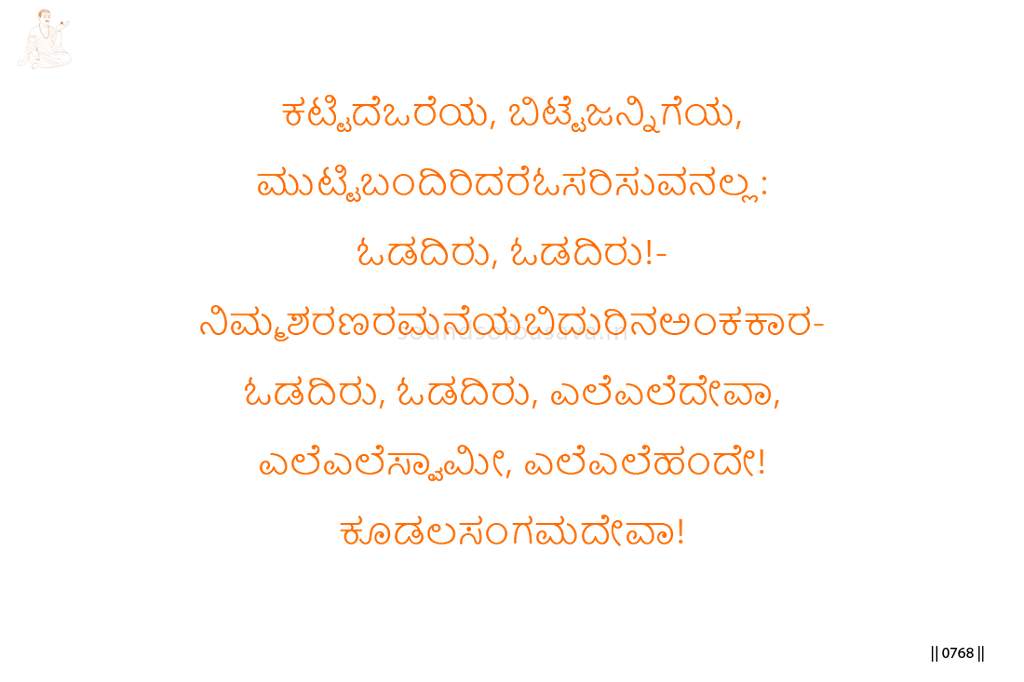
In this vachana, Basavanna warns against turning spiritual life into possession and account.
He speaks first of what is tied and what is offered. What has been bound, held, or taken up should not become possessive claim. What has been offered should not be counted back as one’s own achievement.
He then says that even if things come rushing against him, he will not be struck by them. The Sharana is not formed by being untouched by all movement, but by not being overcome when movement presses upon him.
The repeated command is “Do not run, do not run.” This is the heart of the vachana. The mind must not scatter outward, even in the name of seeking the Divine.
Basavanna then gives the measure of the Sharana’s warriorhood. The warrior of the Sharana is not made through counting. Strength on the path is not built by tallying offerings, practices, cries, or achievements.
The final invocation — “O Deva, O Swami, O Kudalasangama Deva” — should be read with care. Basavanna is not rejecting devotion or invocation. He is warning against restless running that hides itself under sacred calling.
The teaching is direct: the Sharana does not possess what is tied, does not count what is offered, does not run when pressed, and does not turn devotion into restless spiritual accounting before Kudalasangama Deva.
Imagery & Symbolic Relevance
What is tied is the first image. It may refer to what the seeker has taken up, bound himself to, or held within practice. Basavanna warns that even what is rightly taken up can become bondage if it is possessed as “mine.”
What is offered is the second image. Offering should release ownership. If the offering is counted, remembered, and claimed, the act has not fully left the giver.
The rushing movement is the third image. It shows pressure, disturbance, or inward movement that comes toward the seeker. Basavanna does not say that such movement will never arise. He says he will not be struck by it.
“Do not run” is repeated because the danger is restlessness. Running may appear as fear, escape, seeking, comparison, or moving from one support to another. The repetition halts the movement.
The warrior is the central human image. This warrior is not defined by outer battle or display. He is defined by steadiness that does not depend on counting.
Counting is the subtle danger. It turns practice into measure, offering into merit, devotion into achievement, and movement into self-importance. Basavanna rejects this accounting mind.
The cries “O Deva” and “O Swami” show that even sacred speech can become scattered when the mind runs outward through it. The problem is not the Divine Name, but the running mind that uses the Name without steadiness.
The movement of the vachana is therefore from possession to offering, from pressure to non-disturbance, from running to stillness, and from counting to true Sharana-steadiness before Kudalasangama Deva.
Lingayoga
In Lingayoga, this vachana teaches non-possession within practice.
The seeker should examine the inner ledger: “What have I given? What have I practiced? What have I endured? What have I gained?” Basavanna cuts through this accounting. What is offered should not return as self-claim.
For Sharana Sthala, the practice-point is clear: do not run when movements press upon the mind, and do not use devotion as another form of restless seeking. Stand before Kudalasangama Deva without counting.
Editorial Commentary
The brevity and repetition of the vachana should be preserved. Its force lies in the paired warnings: do not possess what is tied, do not count what is offered, do not run. The final invocation should not be expanded into a doctrine of divine play. It should remain a warning that even sacred calling must not become restless movement away from steadiness.
Related Vachana
Supporting Vachana
Pranalingi Sthala Vachana 437 — The Arrow That Has Already Flown
Pranalingi Vachana 437 supports this teaching by showing movements of noise, force, display, and prowess arising before the seeker. Basavanna says he has seen them, but he does not make them his own; once the arrow has already flown, desire need not continue. This supports Vachana 701 directly. Vachana 701 says that what rushes toward the seeker should not strike him, and that what is offered should not be counted. Vachana 437 gives the supporting ground: what arises may be seen, but it need not be possessed, repeated, or pursued again before Kudalasangama Deva.
Advancing Vachana
Aikya Sthala Vachana 735 — The Sufficiency of One Seeing
Aikya Vachana 735 advances this teaching by rejecting the accumulation of many arts, disciplines, and methods when one direct seeing is sufficient. It asks whether a single blade is not enough to strike the enemy, and whether one seeing is not enough for realizing the Linga. This is the natural advancement from Vachana 701. Vachana 701 rejects counting within Sharana Sthala; Aikya Vachana 735 carries that rejection into fulfilled sufficiency, where multiplicity of methods and measures gives way to one clear seeing before Kudalasangama Deva.
