

Summary
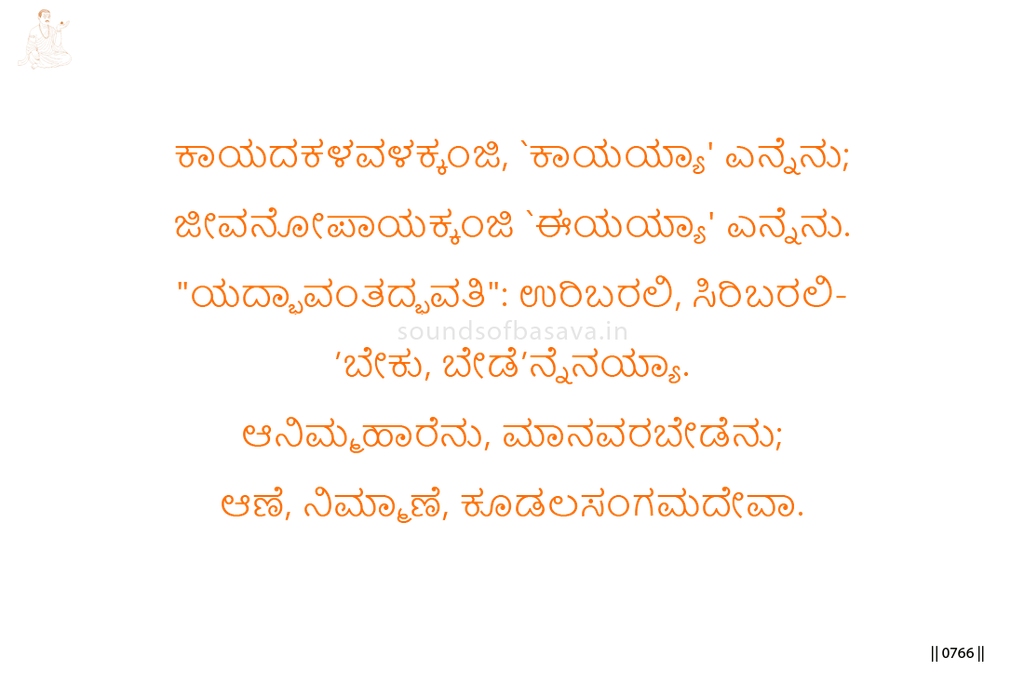
In this vachana, Basavanna makes a vow of freedom from fear-driven need.
He says that, out of fear for the body, he will not say, “I need this body.” Out of fear for livelihood, he will not say, “I need sustenance.” The issue is not neglect of body or life. The issue is dependence that arises from fear.
He then names two opposite conditions: let fire come, let prosperity come. Whether hardship comes or gain comes, he will not say, “I want this” or “I do not want that.” The Sharana does not bargain with life from fear or desire.
The next contrast is decisive. Basavanna seeks the Lord’s refuge, not the favor of human beings. He does not place his security in social approval, patronage, or worldly support.
The final line seals the vachana as a vow before Kudalasangama Deva. This is not casual courage, but a solemn inward commitment.
The teaching is direct: the Sharana does not cling to body, livelihood, hardship, prosperity, or human favor. He stands in the refuge of Kudalasangama Deva alone.
Imagery & Symbolic Relevance
The body is the first image. It is the most immediate ground of fear. Basavanna does not condemn the body, but refuses to make fear for the body the basis of his speech or prayer.
Livelihood is the second image. It represents the practical means by which embodied life continues. Basavanna does not deny livelihood, but refuses dependence that turns survival into spiritual bargaining.
Fire is the image of burning, danger, loss, or severe trial. When Basavanna says, “Let fire come,” he refuses to be ruled by fear of harm.
Siri, or prosperity, is the opposite image. It points to wealth, fortune, or favorable condition. Basavanna refuses to be ruled by gain just as he refuses to be ruled by danger.
The pair “fire and prosperity” gives the vachana its balance. The Sharana is not merely brave before suffering; he is also free from attachment to favorable outcome.
The refusal to say “I want” or “I do not want” is the center of the vow. It ends the inner habit of bargaining with what comes.
The Lord’s refuge stands against the favor of men. Human favor may shift according to circumstance, power, approval, and need. Kudalasangama Deva’s refuge is the ground Basavanna chooses.
The final word of oath gives the vachana its seriousness. Basavanna places this vow before Kudalasangama Deva, making the Lord the witness of his inner stance.
Lingayoga
In Lingayoga, this vachana teaches freedom from fear and preference while life continues.
The seeker should examine where speech arises from need: “I must preserve this body,” “I must secure livelihood,” “This must not happen,” “That must happen,” “People must support me.” Basavanna cuts through this pattern.
For Sharana Sthala, the practice-point is clear: do not let body, livelihood, hardship, prosperity, or human approval become the center. Stand in Kudalasangama Deva’s refuge without bargaining.
Editorial Commentary
The pair “fire and prosperity” should remain central. The vachana is not only about enduring loss; it is about freedom from both fear and attraction. Basavanna’s vow refuses dependence on the body, livelihood, circumstance, and human favor. Its force lies in the final oath before Kudalasangama Deva.
Related Vachana
Supporting Vachana
Pranalingi Sthala Vachana 898 — The Unbroken Inner Thread
Pranalingi Vachana 898 supports this teaching by saying that outer standing, firmness, Bhakti, inward aim, and deepest self-orientation must be guarded even when outer conditions weaken or fall. It ends with a vow before Kudalasangama Deva that what has once been truly touched must not be abandoned. This supports Vachana 696 directly. Vachana 696 refuses dependence on body, livelihood, hardship, prosperity, and human favor; Vachana 898 gives the inward support for such refusal: the deeper thread must remain unbroken even when outer grounds shift.
Advancing Vachana
Aikya Sthala Vachana 1177 — You Alone Are the Doer
Aikya Vachana 1177 advances this teaching by declaring that the Lord alone is the Doer in Guru, Linga, Jangama, Prasada, Upadesha, and in the devotee himself. Therefore Basavanna asks: what is there for me to seek, and what is there for me to refuse? This is the natural advancement from Vachana 696. Vachana 696 refuses to say “I want” or “I do not want” before body, livelihood, fire, prosperity, or human favor. Aikya Vachana 1177 carries that refusal into completion: when Kudalasangama Deva alone is the Doer, seeking and refusing themselves lose their ground.
