
Summary
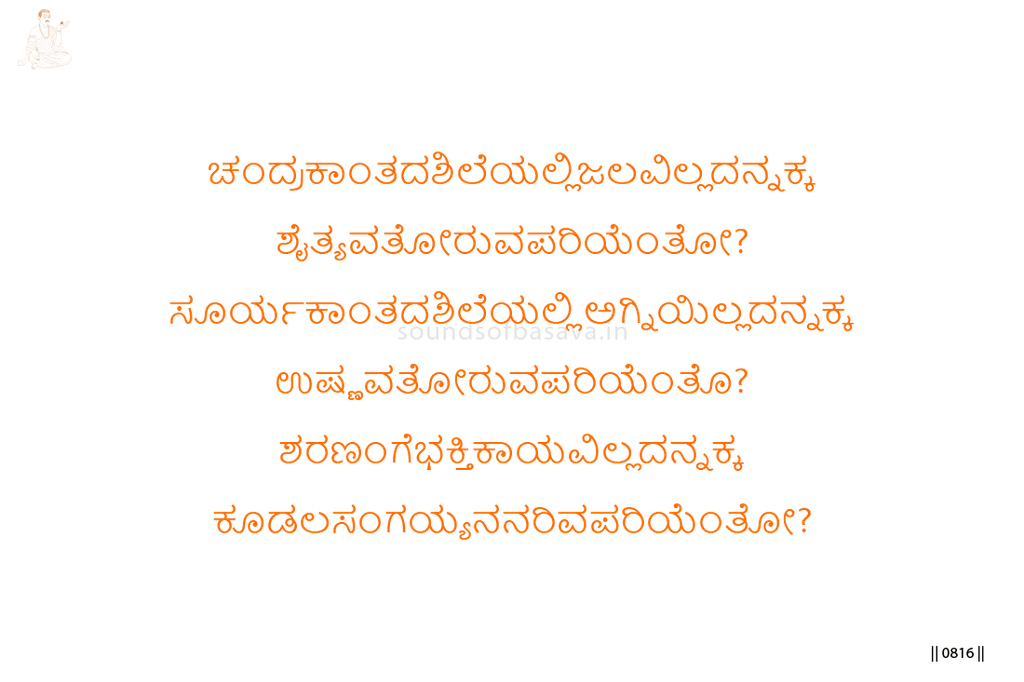
Basavanna asks how coolness appears in the moonstone if water is not present, and how heat appears in the sunstone if fire is not present. The questions turn attention from the visible object to the source of the quality it manifests.
He then applies the same test to the Sharana. If the Sharana does not have bhakti-kāya, the body or living condition of devotion, how can he know Kudalasangayya? The presence of the outer form is not enough. The source-quality must be alive within.
The teaching is direct: just as coolness and heat point beyond mere stone, the Sharana’s knowing of Kudalasangama Deva depends on living devotion. Without bhakti becoming embodied and inwardly present, the Sharana cannot know the Lord in truth.
Imagery & Symbolic Relevance
The moonstone is the first image. Basavanna asks how it can show coolness if there is no water. The image points to a quality that must have a source. Coolness is not treated as a random appearance.
The sunstone is the second image. Basavanna asks how it can show heat if there is no fire. This image parallels the first: a visible quality points to a hidden principle that makes it possible.
The contrast between moonstone and sunstone gives the vachana its structure. Coolness and heat are opposite qualities, yet both are used in the same way. Basavanna is not interested in the stones as objects alone, but in the relation between a manifest quality and its source.
The Sharana is then tested by the same principle. A Sharana without bhakti-kāya is like a stone without the source of its defining quality. The name or outer identity of Sharana cannot replace living devotion.
Bhakti-kāya is the decisive phrase. It should be kept close to the source. It suggests devotion not merely as feeling or speech, but as a living embodied condition through which knowing becomes possible.
The final question, “how can he know Kudalasangayya?” completes the movement. Knowing is not separated from devotion. The Sharana knows through living bhakti, just as coolness and heat appear through their proper source.
Lingayoga
In Lingayoga, this vachana teaches that spiritual identity must be animated by its inner source. The practitioner cannot rely on the outward name of Sharana while lacking living bhakti.
For Sharana Sthala, the practice-point is clear: devotion must become embodied. It must enter the seeker’s living condition, not remain only as speech, role, or affiliation.
Bhakti here becomes the condition through which Kudalasangama Deva is known. Without bhakti-kāya, the relation to Linga remains incomplete. The Sharana must therefore allow devotion to become the source-quality of the whole life.
Editorial Commentary
The moonstone and sunstone function is precise: each visible quality points to the source that makes the quality appear. Basavanna uses this pattern to test the Sharana. Without bhakti-kāya, the Sharana’s claim to knowing Kudalasangayya lacks its living source.
Related Vachana
Supporting Vachana
Pranalingi Sthala Vachana 963 — Body, Mind, and Being as the Vessels of Linga
Pranalingi Vachana 963 supports this teaching by assigning the proper vessel for each level of Linga-relation: Anga is the vessel for the Linga established upon Anga, mind is the vessel for the Linga established upon prana, and bhava is the vessel for the Linga established upon Arivu. It then says that Bhakti-pariyāṇa is the only vessel fit for Prabhudeva’s sacred receiving. This directly prepares Vachana 809. In Vachana 963, body, mind, bhava, and bhakti must become proper vessels; in Vachana 809, the Sharana without bhakti-kāya cannot know Kudalasangayya. Both teachings insist that the inner vessel of devotion must be living and fit before Kudalasangama Deva.
Advancing Vachana
Aikya Sthala Vachana 1182 — Can the Wave Exist Apart from the Ocean?
Aikya Vachana 1182 advances this teaching by showing that the qualities and virtues of the Pramathas cannot stand apart from Kudalasangama Deva. Waves do not arise apart from the ocean, nor do they subside elsewhere. This carries Vachana 809 into Aikya. Sharana Vachana 809 traces qualities such as coolness, heat, and bhakti back to their source; Aikya Vachana 1182 fulfills that movement by showing that all qualities, virtues, actions, and realizations rest within the Divine ocean and have no separate existence apart from Kudalasangama Deva.
