

Summary
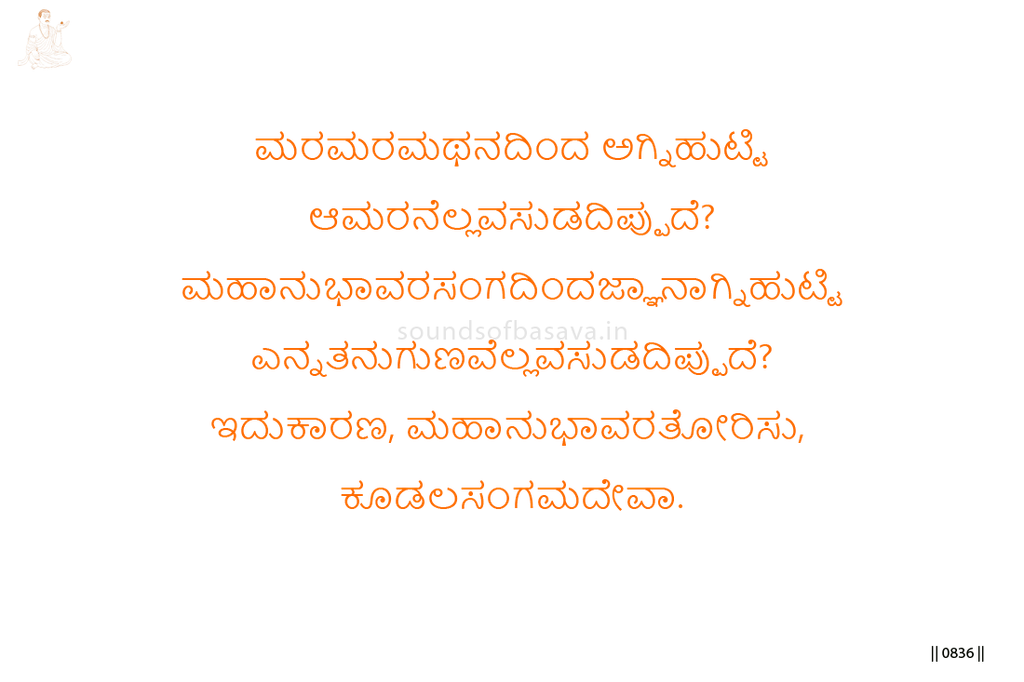
Basavanna asks whether fire is not born when wood rubs against wood, and whether that fire does not burn the very wood from which it arose. The image is exact: contact, friction, ignition, and burning belong to one process.
He then applies this to the company of the Mahānubhāvas. Through their association, the fire of knowledge arises and burns away all the qualities of the body. The presence of realized beings is therefore not merely consoling or instructional; it becomes the condition through which inner burning begins.
The final prayer follows naturally. For this reason, Basavanna asks Kudalasangama Deva to show him the Mahānubhāvas. The Sharana-stage teaching is clear: the company of realized beings is sought because it awakens the fire that consumes embodied self-qualities and prepares the seeker for deeper transformation.
Imagery & Symbolic Relevance
The rubbing of wood against wood is the opening image. Fire is not introduced from outside. It arises through contact and friction within the very material that will be burned.
The fire born from the wood is the second image. Basavanna’s emphasis is not only on ignition, but on consequence. Once the fire arises, it consumes the wood from which it came.
The company of Mahānubhāvas is the inward counterpart. Their association creates the spiritual condition in which jñānāgni, the fire of knowledge, arises. Such company is not casual social nearness; it is living contact with those established in realization.
The burning of body-qualities is the central transformation. Tanu-guṇa refers to the qualities, tendencies, and identifications attached to embodied selfhood. Basavanna does not ask that they be comforted, preserved, or decorated. He sees that they must be burned.
The final request to be shown the Mahānubhāvas gives the vachana its devotional force. Basavanna does not seek an easier path. He seeks the company that will bring about the necessary burning.
The movement is therefore precise: wood-friction gives birth to fire; fire consumes the wood; Mahānubhāva-sanga gives birth to jñānāgni; jñānāgni burns the body-bound qualities; therefore the seeker asks Kudalasangama Deva for the sight of such great ones.
Lingayoga
In Lingayoga, this vachana teaches that realized company is transformative. The practitioner does not mature through isolation alone, nor through words alone, but through contact with those whose realization ignites inner knowledge.
For Sharana Sthala, the practice-point is willingness to undergo burning. The Sharana does not seek Mahānubhāva-sanga for praise, comfort, or affiliation. He seeks it because it destroys what cannot remain before truth.
This also clarifies the nature of knowledge. Jñāna is not merely information. In this vachana it is fire. When it arises through the company of Mahānubhāvas, it burns the body-bound qualities and turns the seeker toward Kudalasangama Deva.
Editorial Commentary
The phrase tanu-guṇa should be understood as the qualities and tendencies bound to embodied selfhood. Its teaching is contained in the image itself: the fire that arises from contact consumes the very material from which it arose.
Related Vachana
Supporting Vachana
Pranalingi Sthala Vachana 991 — Transformed Through the Touch of Grace
Pranalingi Vachana 991 supports this teaching by showing transformation through Kudalasangama Deva’s touch and rebirth within the living Sharana-field. It presents transformation as grace-led, not self-achieved, and shows the seeker changed through contact with the Lord’s living presence. This prepares Vachana 883 directly. In Vachana 991, Divine touch transforms the seeker’s condition; in Vachana 883, the company of Mahānubhāvas ignites jñānāgni, which burns away the body-bound qualities before Kudalasangama Deva.
Advancing Vachana
Aikya Sthala Vachana 1092 — Consumed in the Name Beyond Name
Aikya Vachana 1092 advances this teaching by carrying the burning of selfhood into complete Aikya. There, Basavanna says that the Lord is the destination, repose, fulfillment, abode, summit, and ground of being; the Name becomes the Nameless, and the devotee becomes like camphor consumed in flame, leaving nothing but fragrance and light. This is the natural Aikya fulfillment of Vachana 883. In Sharana Vachana 883, the fire of knowledge born through Mahānubhāva-sanga burns the body-bound qualities; in Aikya Vachana 1092, the separate self is consumed without residue in Kudalasangama Deva.
