

Summary
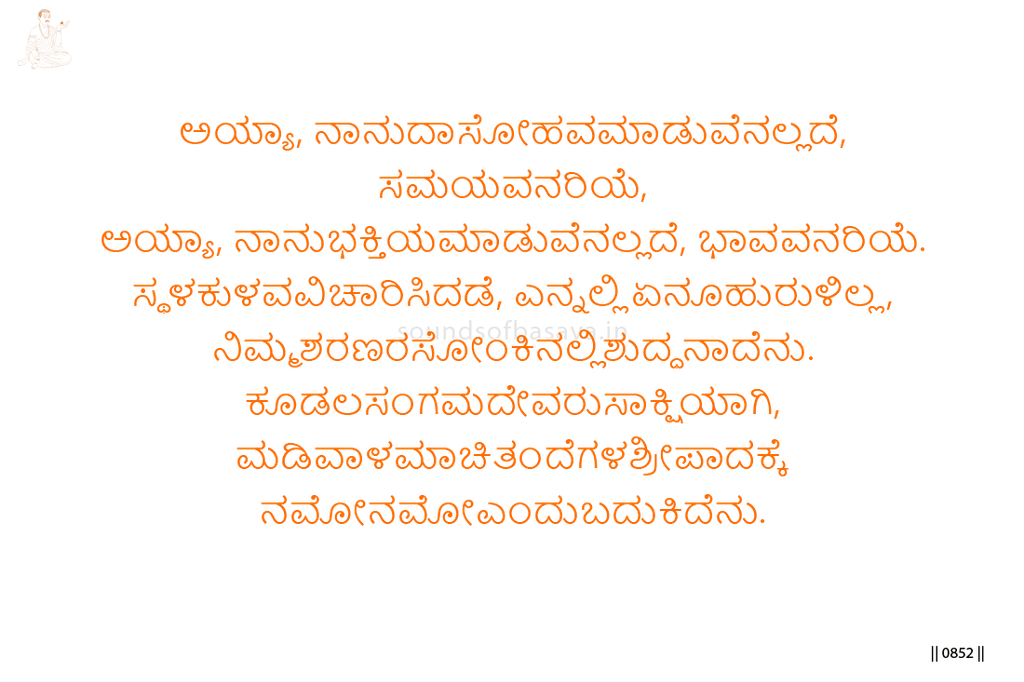
Basavanna confesses that he did not know how to perform Dasoha and did not know how to live Bhakti. When he examined himself, he found no inner substance worthy of claim. Yet through the touch of Kudalasangama Deva’s Sharanas, he became purified.
The vachana rests on humility. Basavanna does not present purity as self-earned achievement. He does not say that devotion, service, or worthiness arose from his own capacity. He places the cause of transformation in Sharana-sanga: the living nearness and contact of realized beings.
The phrase “with Kudalasangama Deva as witness” gives solemnity to the confession. This is not ornamental modesty. It is a witnessed truth: what he lacked in himself became possible through the transforming company of the Sharanas.
The final movement is gratitude. Basavanna lives saying “Namo, Namo” to the sacred feet of the great ones, especially Madivala Machitande. The seeker who once found nothing worthy within himself now lives by reverence. Purification becomes complete not in self-claim, but in bowing before the feet through which grace became accessible.
Imagery & Symbolic Relevance
The first image is the absence of knowing. Basavanna says he did not know Dasoha and did not know Bhakti. This does not mean he was ignorant of their words or outer forms. It means he did not possess them as living truth within himself. Dasoha and Bhakti are not merely acts to be performed; they must arise from inward transformation.
The second image is self-examination. When he examines his own sthala and kula, or his own spiritual standing and inner lineage, he finds nothing substantial within himself. This is not self-condemnation for its own sake. It is honest self-measurement before the truth.
The third image is the touch of the Sharanas. The Kannada points to purification through their contact. This touch should be understood as more than physical contact. It is the living influence of realized presence: association, nearness, correction, compassion, and transmission through those who embody Kudalasangama Deva’s path.
The fourth image is Divine witness. Kudalasangama Deva stands as the witness before whom Basavanna declares the truth of his transformation. This prevents the humility from becoming rhetorical. The Lord sees whether the confession is true.
The final image is repeated reverence at the sacred feet. The feet are the place where realized life touches the earth. To bow there is to accept the ground walked by the Sharanas. “Namo, Namo” is not a passing salutation; it becomes the rhythm of a life saved and purified by Sharana-sanga.
Lingayoga
In Lingayoga, this vachana teaches that spiritual transformation is not produced by self-claim. The seeker may know the language of Dasoha and Bhakti, yet still lack their living substance. True practice begins when this lack is seen without concealment.
Sharana-sanga becomes the transforming field. The Sharanas purify not because they are objects of admiration, but because their presence exposes, corrects, and reshapes the seeker. Through them, what was absent in the seeker begins to awaken.
For Sharana Sthala, the practice-point is humility before realized company. The Sharana does not claim purity as personal property. He receives purification as grace and lives in gratitude at the feet of those through whom Kudalasangama Deva’s presence became active.
Editorial Commentary
Madivala Machitande should remain central here. Basavanna’s “Namo, Namo” is directed to the sacred feet of the great Sharana, not to an abstract ideal. The vachana should therefore be read as both confession and gratitude: the seeker had no inner worth by self-measure, yet became purified through the touch of the Sharanas.
Related Vachana
Supporting Vachana
Pranalingi Sthala Vachana 431 — The Glance of Homecoming
Pranalingi Vachana 431 supports this teaching by showing the seeker asking Kudalasangama Deva to search him, look into him, and question him through whatever face the Lord may come. This prepares Vachana 989 directly. In Vachana 431, the seeker asks to be examined by the Lord; in Vachana 989, he examines himself and finds nothing worthy, yet through the touch of the Lord’s Sharanas he is purified. The Lord’s searching face is recognized in living Sharana-presence.
Advancing Vachana
Aikya Sthala Vachana 1034 — The Threefold Establishment
Aikya Vachana 1034 advances this teaching by showing the fuller fruit of grace received through the Sharana. There, Achara is established in the Anga, Anubhava in the Prana, and Mahajnana throughout the whole being; for this discernment, Basavanna bows again and again at the feet of Madivala Machayya. This is the natural Aikya fulfillment of Vachana 989. In Sharana Vachana 989, Basavanna is purified through the touch of the Sharanas and lives saying “Namo, Namo” at their feet; in Aikya Vachana 1034, that received purification matures into the establishment of conduct, experience, and wisdom throughout the whole being, again ending in repeated reverence at Madivala Machayya’s feet.
