

Summary
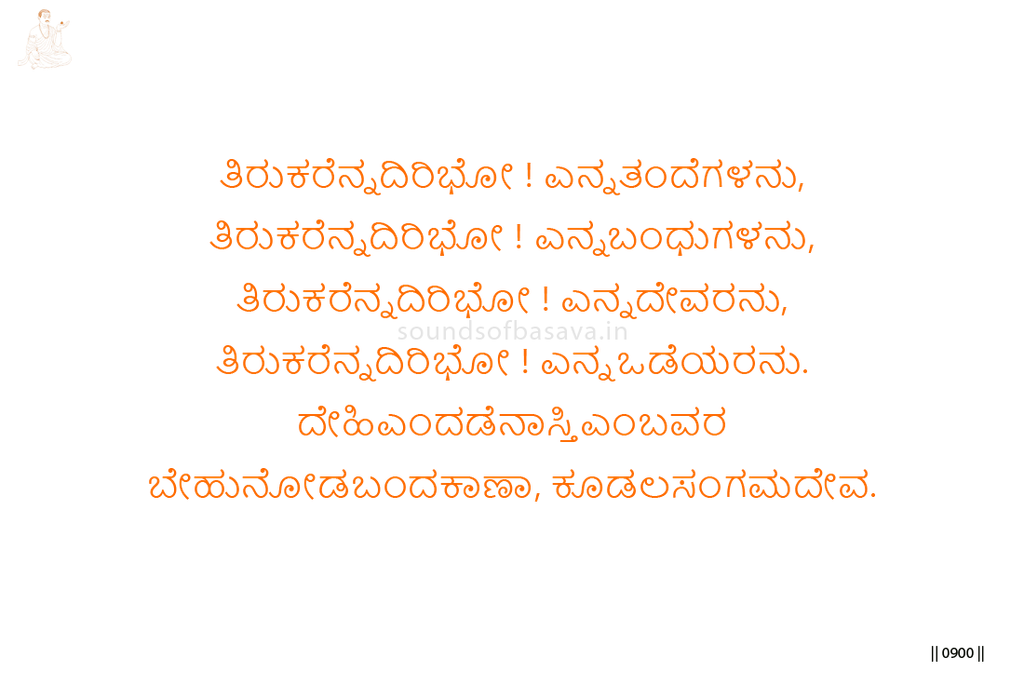
Basavanna warns against reducing the Sharanas to ordinary embodied persons. Do not call them mere men, he says. They are my fathers, my kinsmen, my gods, and my lords.
The repeated cry creates insistence. The Sharana is not to be measured by bodily appearance alone. To the outward eye, the Sharana may appear as a human being; to awakened vision, the Sharana bears living nearness to Kudalasangama Deva.
The relationships named in the vachana are not casual honorifics. Father, kinsman, god, and lord each mark a deeper form of dependence, reverence, and belonging. Basavanna places the Sharanas at the center of spiritual life.
The final warning is directed against those who say, “He is only a body-bound person,” and move about with hidden judgment. Such seeing is spiritually dangerous because it fails to recognize the Divine presence made living in the Sharana.
Imagery & Symbolic Relevance
The first image is the repeated command: “Do not call them mere men.” Basavanna does not argue slowly; he interrupts wrong perception at once. The repetition shows how strongly he rejects bodily reduction.
The second image is “my fathers.” The Sharana gives spiritual birth, guidance, protection, and nourishment. Basavanna’s reverence is not abstract; it is filial and intimate.
The third image is “my kinsmen.” The Sharana belongs to the deepest family, not the family of birth alone, but the family of realization and refuge.
The fourth image is “my gods.” This does not mean worship of personality. It means that the Divine is encountered through the realized being. The Sharana becomes a living field in which sacred presence is recognized.
The fifth image is “my lords.” Basavanna places himself in belonging and service. The Sharana is not approached as an equal object of examination, but as one before whom humility is required.
The word “Dehi” is crucial. It points to the embodied one. Basavanna’s warning is against stopping at the body and saying, “This is only a human being.” Such speech reveals not insight, but blindness to realized presence.
The final image is hidden judgment. Some may not openly reject the Sharana, but inwardly they reduce, inspect, and dismiss. Basavanna exposes this concealed contempt and places it before Kudalasangama Deva.
Lingayoga
In Lingayoga, this vachana teaches purified perception before the Sharana. The seeker must not measure realized beings by body, social identity, ordinary appearance, or private suspicion.
For Sharana Sthala, the practice-point is direct: see the Sharana as father, kinsman, god, and lord. Do not call the living bearer of realization a mere embodied person.
This reverence is not sentimental. It is discipline of vision. When perception is purified, the seeker recognizes where Kudalasangama Deva’s presence has become living and active.
Editorial Commentary
The word “Dehi” should be retained in meaning as “embodied person” or “body-bound human being.” Basavanna is not denying embodiment. He is warning against reducing the Sharana to embodiment alone. The teaching is therefore about transformed vision: the body is seen, but the realized presence within the Sharana is not missed.
Related Vachana
Supporting Vachana
Pranalingi Sthala Vachana 861 — The Alchemy of Awareness
Pranalingi Vachana 861 supports this teaching by distinguishing the Sharana from the ordinary human being through knowing and forgetting. There, Basavanna compares a vessel and a mirror made of the same metal: one merely holds, while the other reflects. One who knows is Sharana; one who forgets remains human. This prepares Vachana 1207 directly. In Vachana 861, realization is not a difference of body or substance, but of awakened awareness; in Vachana 1207, Basavanna demands that such awakened beings not be reduced to mere embodied humans, but revered as fathers, kinsmen, gods, and lords.
Advancing Vachana
Aikya Sthala Vachana 535 — Closer Than All Nearness
Aikya Vachana 535 directly advances this teaching by expanding sacred embodiment into the immeasurable Divine body. In Sharana Vachana 1207, Basavanna warns against reducing the Sharanas to ordinary embodied persons, recognizing them instead as fathers, kinsmen, gods, and lords because Divine presence lives through them. In Aikya Vachana 535, Rudra, Vishnu, Aja, Indra, the moon, sun, fire, air, space, earth, the directions, the hosts of gods, and the entire world are held within Kudalasangama Deva’s vast form. Thus the Sharana-stage correction of merely bodily seeing advances into Aikya as the recognition that embodied sacred presence is not limited by human appearance but opens into the all-containing presence of Kudalasangama Deva.
