

Summary
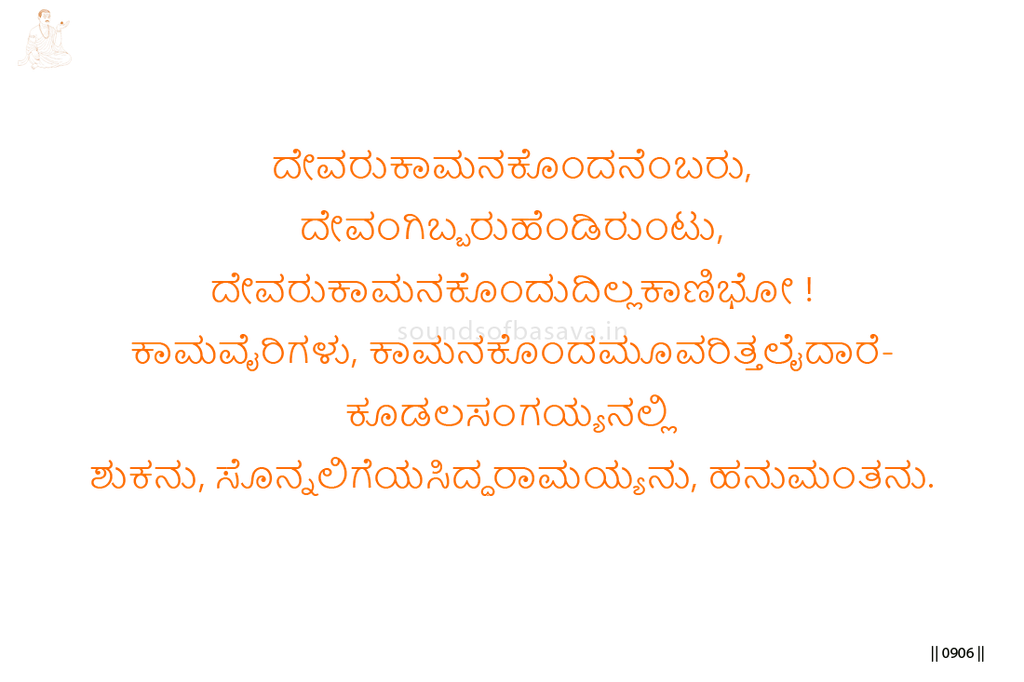
Basavanna challenges a familiar religious claim: people say that the Lord destroyed Kāma, desire. He immediately questions the claim by pointing to the Lord’s own consorts. If the story is read only outwardly, it does not explain the true destruction of desire.
His correction is direct: the Lord did not destroy desire in that simple literal sense. One must look carefully. The conquest of Kāma is not proved by repeating a mythic event.
Basavanna then points to the true enemies of desire: the realized Sharanas. Siddharamayya of Sonnalige, in the field of Kudalasangama, is named as one in whom desire has truly been conquered.
The vachana therefore shifts authority from inherited story to lived realization. Desire is not destroyed by narration, display, or symbolic claim. It is overcome where the compulsive movement of craving has actually lost its hold in the life of the Sharana.
Imagery & Symbolic Relevance
The first image is the public saying: “The Lord destroyed desire.” Basavanna begins with what people repeat. The statement is familiar, but familiarity is not realization.
The second image is the Lord with two consorts. Basavanna uses this to disturb a flat reading of the myth. If desire means all relation, all life, and all creative presence, then the claim that desire was simply annihilated becomes inadequate.
The repeated correction, “No, no,” is important. Basavanna is not casually disagreeing. He is forcing discernment. The seeker must not confuse a story about desire with actual freedom from desire.
Kāma here should be read as binding desire, craving, possessive impulse, and the compulsion that draws awareness away from Kudalasangama Deva. It is not the mere existence of life, relation, or embodied presence.
The phrase “enemies of desire” gives the vachana its true center. The real enemy of Kāma is not verbal doctrine, but realized life. One who has truly become free from craving stands as Kāma’s adversary.
The naming of Siddharamayya of Sonnalige is therefore decisive. Basavanna moves from mythic distance to living Sharana-presence. The true slayer of desire is not merely remembered in a story; he is seen among the realized.
Kudalasangama is the field in which this discernment is made. Before Kudalasangama Deva, one must look not at claims, but at the life in which desire has been inwardly conquered.
Lingayoga
In Lingayoga, this vachana teaches that desire is not conquered by repeating sacred stories. The seeker must examine whether craving, possessiveness, and sensory compulsion have actually been brought under sacred discipline.
For Sharana Sthala, the practice-point is direct: do not claim freedom from desire through doctrine, myth, or religious speech. Look for the mark of realization in lived freedom.
The true Sharana does not destroy life; he outgrows bondage to desire. When body, senses, mind, and inward movement are gathered into Kudalasangama Deva, Kāma loses its power to command.
Editorial Commentary
This vachana should not be read as a dismissal of sacred mythology. Basavanna is rejecting a superficial use of mythology. The myth of the Lord destroying Kāma must not become a substitute for actual conquest of craving. The sharper point is that Siddharamayya of Sonnalige stands as living evidence of what the story inwardly points toward.
Related Vachana
Supporting Vachana
Pranalingi Sthala Vachana 1370 — The Sharana Must Be a Brahmachari in the Five Senses
Pranalingi Vachana 1370 supports this teaching by carrying the conquest of desire into the sensory field. There, Basavanna says that the Sharana must be a Brahmachari in the ear, skin, eye, tongue, and nose, gathering all five senses into Kudalasangama Deva. This prepares Vachana 1223 directly. In Vachana 1370, desire is not addressed through mythic claim but through disciplined integration of the senses; in Vachana 1223, Basavanna identifies the true slayers of desire as realized Sharanas such as Siddharamayya of Sonnalige, whose life embodies the conquest that speech alone cannot prove.
Advancing Vachana
Aikya Sthala Vachana 976 — The Natural Abidance of Mahadevi Akka
Aikya Vachana 976 advances this teaching by showing the fulfilled state in which ignorance dissolves, pride withdraws, the six inner enemies are burnt without residue, the senses loosen their hold, and the mind falls silent. This is the natural Aikya fulfillment of Vachana 1223. In Sharana Vachana 1223, Basavanna says that the real enemies and slayers of desire are living realized beings; in Aikya Vachana 976, that victory is shown in its complete form, where desire and the other inner enemies have no remaining ground in the natural abidance of Mahadevi Akka before Kudalasangama Deva.
