

Summary
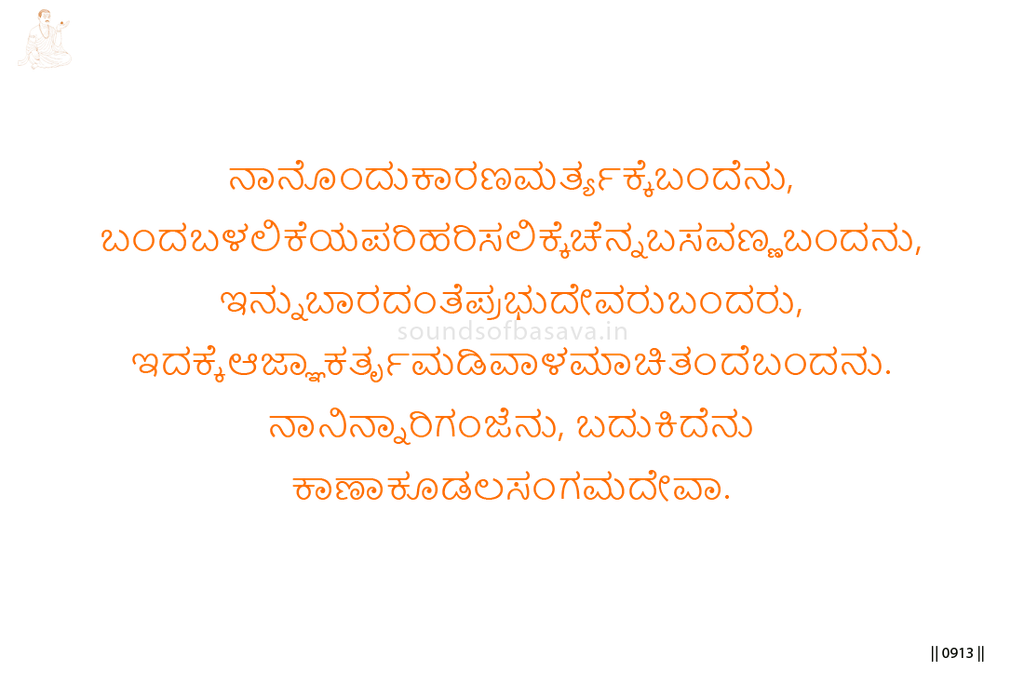
Basavanna says that he came into the mortal world for a purpose. His coming was not treated as accidental or meaningless; it belonged to a sacred unfolding before Kudalasangama Deva.
To remove the weariness of that coming, Chennabasavanna came. Mortal birth carries burden, fatigue, and the strain of embodied existence. Chennabasavanna’s coming relieves that weariness.
So that Basavanna would not return again, Prabhudevara came. This points beyond comfort within life toward release from repeated return into worldly becoming.
To command and ordain this entire unfolding, Madiwala Machitande came. The process is not loose or accidental. It is established through the authority of the realized Sharana.
The result is fearlessness and true life. Basavanna says he fears no one now, and that he has lived. Life becomes true when the seeker is no longer isolated, but upheld by the coming of the Sharanas before Kudalasangama Deva.
Imagery & Symbolic Relevance
The first image is coming into the mortal world for a purpose. Basavanna does not begin with complaint about birth. He recognizes that his coming had a reason known within the Lord’s order.
The second image is the weariness of coming. Mortal life brings fatigue not merely through physical effort, but through the burden of becoming, uncertainty, and repeated struggle.
Chennabasavanna’s coming is the first relieving movement. He appears as the one who removes weariness, steadies the seeker, and makes life bearable within the path.
Prabhudevara’s coming is the second movement. He comes so that Basavanna will not return again. His function is liberative: not only to ease the present life, but to cut the recurrence of becoming.
Madiwala Machitande’s coming is the third movement. He comes as the one who commands and ordains. The word suggests authority, ordering, and decisive establishment. The path is not merely consoled or liberated; it is also governed by realized discipline.
The three Sharanas therefore do not repeat the same function. Chennabasavanna removes weariness, Prabhudevara prevents return, and Madiwala Machitande commands and ordains. Together they form a complete field of Sharana-intervention.
The final declaration, “I fear no one,” does not arise from egoic courage. It arises because Basavanna no longer stands alone. He has been relieved, liberated, and established through the Sharanas.
The final line, “I have lived,” is stronger than survival. True life begins when mortal coming finds its purpose through the grace and intervention of Kudalasangama Deva’s Sharanas.
Lingayoga
In Lingayoga, this vachana teaches that the seeker is not completed by solitary effort. The living intervention of the Sharanas is necessary.
For Sharana Sthala, the practice-point is direct: recognize who removes weariness, who prevents return, and who establishes the path with authority. Do not reduce the Sharanas to remembered names; see their distinct work in the life of realization.
Fearlessness comes from this fellowship. The seeker who is upheld by Chennabasavanna, Prabhudevara, and Madiwala Machitande does not live from isolation. He lives within the field of Kudalasangama Deva’s grace.
Editorial Commentary
The three names should remain distinct. Chennabasavanna, Prabhudevara, and Madiwala Machitande are not interchangeable symbols. The vachana assigns each a precise function: relieving weariness, preventing return, and commanding the unfolding. The final “I have lived” should be read through this threefold Sharana-intervention.
Related Vachana
Supporting Vachana
Pranalingi Sthala Vachana 1240 — The Revelation of Ishtalinga
Pranalingi Vachana 1240 supports this teaching by showing Chennabasavanna as the active revealer and transmitter of the path. There, when the greatness of Shivachara had become buried in the mortal world, the Lord arose as Mahaprasadi, established the relation of Adi Guru and Anadi Shishya, placed Sanganatha Linga in Basavanna’s hand, and drew him toward Kudalasangama Deva through Chennabasavanna. This prepares Vachana 1243 directly. In Vachana 1240, Chennabasavanna draws Basavanna toward the Lord through revealed Linga and restored conduct; in Vachana 1243, Chennabasavanna’s role is named again as the one who came to remove the weariness of mortal coming, within the larger fellowship of Prabhudevara and Madiwala Machitande.
Advancing Vachana
Aikya Sthala Vachana 1119 — The Stainless Vision Beyond the Mind
Aikya Vachana 1119 advances this teaching by showing the fulfilled fruit of Prabhudeva’s liberating presence. There, the gaze turns inward through Karasthala, bodily limitation falls away, awareness rises beyond the mind’s farthest reach, thought and perception lose their hold, and Basavanna says that through Prabhudeva he has lived in Kudalasangama Deva, with Chennabasavanna called to witness. This is the natural Aikya fulfillment of Vachana 1243. In Sharana Vachana 1243, Prabhudevara comes so that Basavanna will not return again, and Basavanna declares that he has truly lived; in Aikya Vachana 1119, that living becomes direct abidance in Kudalasangama Deva through Prabhudeva, beyond the limits of body, mind, thought, and perception.
