

Summary
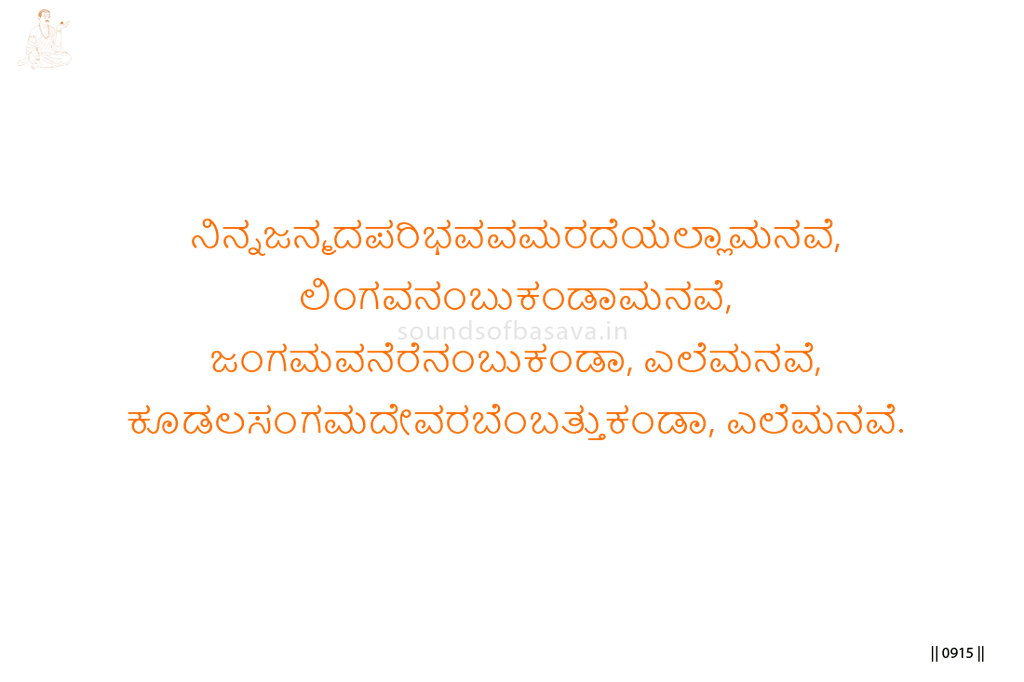
Basavanna addresses the mind directly. The mind has forgotten the hardship of birth, the vulnerability and burden that belong to embodied existence.
The remedy is given in three commands. Trust the Linga. Join the Jangama and trust. Hold fast to the support of Kudalasangama Deva.
The vachana is therefore not a general reflection on suffering. It is an instruction to the forgetful mind. The mind must be turned away from wandering and brought back to the supports that alone can steady it.
For Sharana Sthala, refuge becomes an act of inward recollection. The mind remembers its condition, trusts the Linga, joins the Jangama, and refuses to release the support of Kudalasangama Deva.
Imagery & Symbolic Relevance
The first image is the mind that has forgotten. Basavanna does not speak first to the body, the world, or another person. He speaks to the mind because forgetfulness begins there.
The second image is the hardship of birth. Birth is not treated as neutral. It carries exposure, limitation, dependence, and the danger of becoming lost in embodied life.
The third image is trusting the Linga. The mind is told to place its reliance in the sacred center rather than in its own restless movement. Trust here means inward orientation and steady dependence.
The fourth image is joining the Jangama and trusting. Linga is not isolated from living presence. The mind must also join the Jangama, the moving presence through which realization becomes living relation.
The fifth image is Kudalasangama Deva as support. The mind is not merely told to remember or believe; it is told to hold fast. Support must be grasped and not released.
The repeated address, “O mind,” gives the vachana its rhythm. It is compassionate correction. Basavanna calls the mind back again and again from forgetfulness into refuge.
Lingayoga
In Lingayoga, this vachana teaches remembrance as discipline. The mind must be reminded of its forgotten condition and then directed toward Linga, Jangama, and Kudalasangama Deva.
For Sharana Sthala, the practice-point is direct: when the mind forgets, do not let it scatter into self-reliance or worldly dependence. Tell it to trust the Linga, join the Jangama, and hold fast to the Lord’s support.
This is not passive belief. It is steadied refuge. The mind that remembers its condition becomes capable of holding to the support that does not fail.
Editorial Commentary
The phrase concerning birth should be kept close to the Kannada as hardship, burden, or vulnerability of birth. The vachana’s force lies in its simple commands to the mind: trust Linga, join Jangama, and hold fast to Kudalasangama Deva.
Related Vachana
Supporting Vachana
Pranalingi Sthala Vachana 1256 — Mahājñāna Rising Above Māyā Through Dṛṣṭi-Yoga
Pranalingi Vachana 1256 supports this teaching by showing how concealed knowing rises above Māyā through refined inward seeing and becomes fulfilled in the realization of Linga and Jangama by the grace of Kudalasangama Deva. This prepares Vachana 1249 directly. In Vachana 1249, the mind is first instructed to remember, trust Linga, join Jangama, and hold fast to the Lord’s support; in Vachana 1256, that trust matures into inward seeing where Linga and Jangama are realized through grace.
Advancing Vachana
Aikya Sthala Vachana 822 — The Lotus Where Mind Dissolves
Aikya Vachana 822 advances this teaching by showing the mind gathered into the inner lotus, where the seed of mind is held steady, the Lord alone becomes the inner mover, and the seen Linga and moving Jangama are beheld as one. This is the natural Aikya fulfillment of Vachana 1249. In Sharana Vachana 1249, Basavanna instructs the forgetful mind to trust, join, and hold fast; in Aikya Vachana 822, that instruction ripens into undivided seeing, where the mind no longer wanders and nothing remains apart from Kudalasangama Deva.
