

Summary
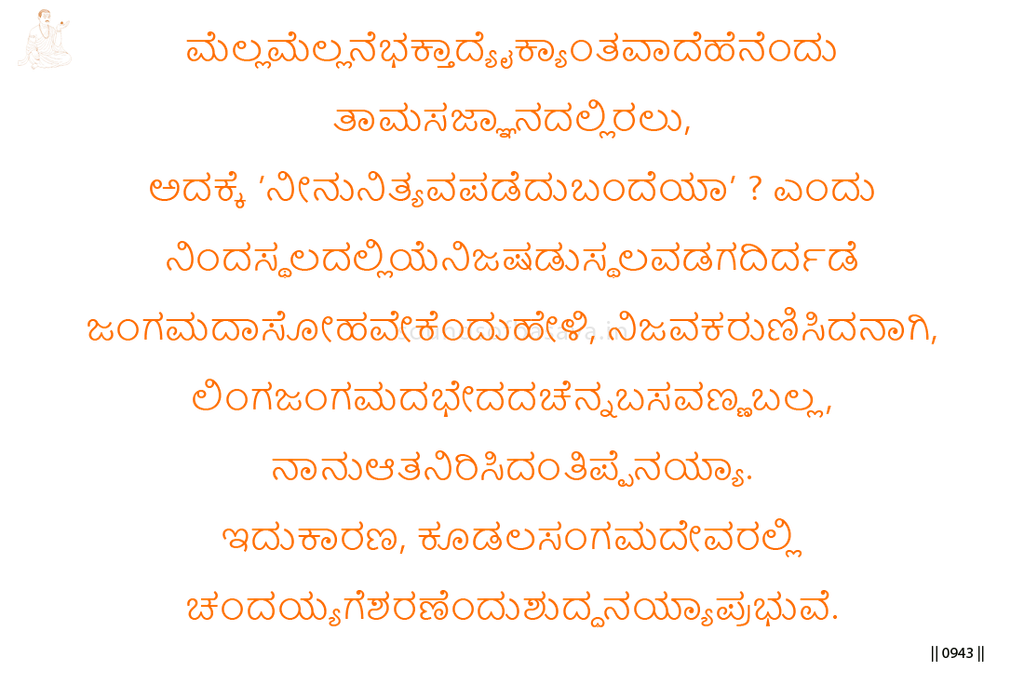
Basavanna warns against claiming spiritual attainment before it has become inward truth. One may gradually think, “I have become a Bhakta,” or even, “I have reached Aikya,” while still remaining within the darkness of incomplete understanding. Such self-claim is itself the sign that the Six Sthalas have not yet become established within one’s own state.
The correction comes through compassion. Chennabasavanna teaches that if the true Ṣaṭsthala has not become inwardly real, Jangama Dasoha itself loses its meaning. He also reveals the distinction between Linga and Jangama, so that the seeker does not confuse name, stage, or outer act with living realization. Basavanna therefore remains as instructed and takes refuge in Chandayya, the pure Sharana, in Kudala Sangama Deva.
Imagery & Symbolic Relevance
The first image is “slowly, slowly” becoming. Basavanna begins with gradual spiritual self-perception. The seeker thinks he is progressing, becoming Bhakta, becoming one established in Aikya. The danger is not gradual growth, but premature certainty about it.
The second image is remaining in the darkness of ignorance. The claim of attainment may arise while tamasic understanding still remains. Basavanna exposes the contradiction: one may speak of high states while still inwardly unillumined.
The third image is the Divine coming again and again. Grace returns because the seeker has not yet become true. The repeated coming is not confirmation of attainment; it is correction born of compassion.
The fourth image is the true Six Sthalas not established in one’s own state. The Ṣaṭsthala is not merely a sequence to be named or claimed. It must become one’s condition. Unless it is established inwardly, the stages remain words.
The fifth image is the question: what use is Jangama Dasoha? Basavanna does not reject Dasoha. He tests it. Dasoha has meaning only when it rises from true inner establishment. Without that, even sacred service can become outer performance.
The sixth image is Chennabasavanna bestowing true compassion. His compassion is not flattery. It reveals the truth and corrects false attainment. To be corrected by the realized Sharana is itself grace.
The seventh image is Chennabasavanna making known the distinction between Linga and Jangama. This distinction is not division. It is discernment. The seeker must know how Linga and Jangama stand in living relation, so that neither worship nor service becomes confused or superficial.
The final image is refuge in Chandayya, the pure Sharana. Basavanna does not rest in his own claim of attainment. He remains as Chennabasavanna instructed and takes refuge in the living purity embodied by Chandayya before Kudala Sangama Deva.
Lingayoga
In Lingayoga, this vachana teaches that the path cannot be fulfilled by claiming stages. Bhakta, Sharana, and Aikya are not names to be possessed; they must become the seeker’s lived state.
For Sharana Sthala, the practice-point is direct: do not claim the Ṣaṭsthala before it is established within. Let Jangama Dasoha arise from true realization. Receive correction from the realized Sharana, discern the relation of Linga and Jangama, and take refuge in those whose purity has become living truth.
Editorial Commentary
This vachana should not be read as a rejection of Ṣaṭsthala or Jangama Dasoha. Basavanna is rejecting premature claim and outer performance. The Six Sthalas must become inwardly established, and Dasoha must arise from that establishment. Only then does service to Jangama become true.
Related Vachana
Supporting Vachana
Pranalingi Sthala Vachana 961 — The Descent of Linga into Prana
Pranalingi Vachana 961 supports this teaching by showing that Linga must descend into prana and become living realization. It does not allow Linga to remain only outwardly borne or verbally claimed; realization must pass through life, breath, Dasoha, and Jangama-Mukhalinga. This prepares Vachana 1323 directly. In Vachana 961, Linga becomes inwardly alive and moves toward Jangama Dasoha; in Vachana 1323, Basavanna warns that Jangama Dasoha has no true use if the Ṣaṭsthala has not become established within one’s own state.
Advancing Vachana
Aikya Sthala Vachana 1334 — Who Showed Me That Linga and Jangama Are One?
Aikya Vachana 1334 advances this teaching by revealing the fulfilment of the Linga-Jangama relation. In Sharana Vachana 1323, Chennabasavanna compassionately makes known the distinction between Linga and Jangama so that the seeker does not fall into confusion or false claim. In Aikya Vachana 1334, that discernment matures into the direct recognition that Linga is Jangama and Jangama is Linga. Thus what is corrected in Sharana Sthala becomes fulfilled in Aikya as living unity before Kudala Sangama Deva.
