Poetic Rendering

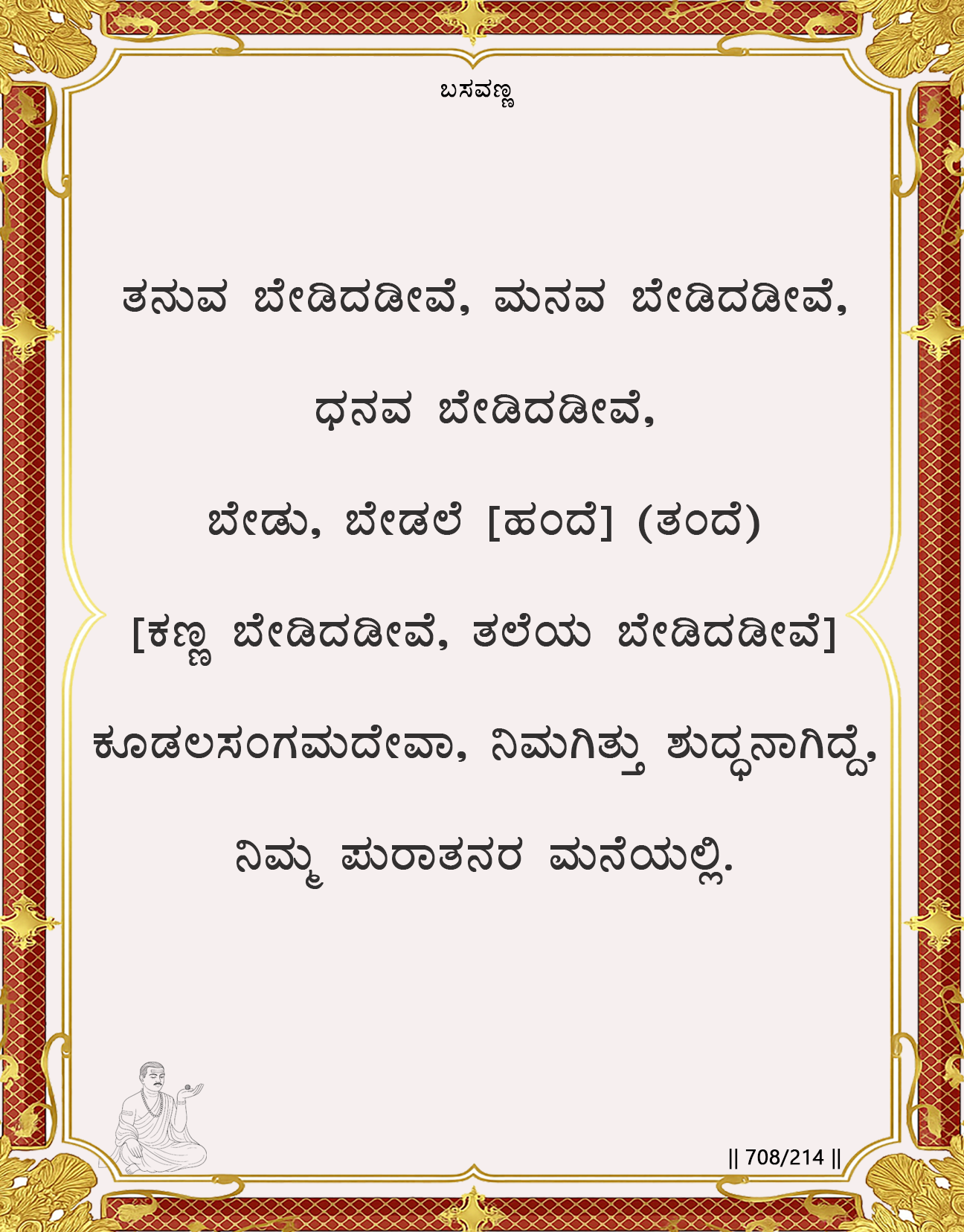
My body seeks nothing,
my mind seeks nothing
Your Sharanas ask not for the world’s passing wealth.
But if ever a flicker stirs within me,
a whisper of “I want… I want,”
O Eternal One
let that very moment wake me
from the dream of separation.
In this frail body,
in this wandering mind,
let no desire arise
that turns me away from You.
For should these instruments You gave me
stray even a step from Your presence,
O Kudalasangamadeva,
it is not You who cast me into ruin
it is my own wanting
that becomes the fire of my fall.
Outside of You
there is no heaven to seek.
Basavanna declares that true Sharanas have no worldly desires. If even the faintest thought of wanting arises an “I want” it signals the ego’s return and the beginning of separation from the Divine. Since everything already belongs to Kudalasangamadeva, any personal desire is a lapse into illusion. Basavanna prays for constant awareness so that neither body nor mind drifts away, for it is this drift not God that creates one’s suffering and downfall. Remaining desireless is remaining in God; to want anything else is to step into one’s own self-created hell.
Spiritual Context
Core Spiritual Principle: Desire (trishna) is the engine of the ego and the root of samsara (the cycle of birth and death). The final surrender is the surrender of the very faculty of desire. When the self is realized as the Divine, all wanting ceases because one already is the source and substance of everything.
A desire for anything external is a confession of perceived lack, which is the fundamental ignorance. Cosmic Reality Perspective: From the non-dual view, the cosmos is a perfect, complete expression of Shiva-Shakti. A personal desire is a localized fluctuation in consciousness that asserts, “This perfect whole is not enough; I need that specific part.” This is a contradiction of the cosmic reality, and the suffering that follows is the natural consequence of this contradiction.
Historical Reality (Anubhava Mantapa Context): This vachana sets the ultimate standard for the inner revolution. The Sharanas’ external revolution was against caste and ritual; the internal revolution was against the very structure of the desiring mind. This teaching ensured that the community’s focus remained on radical inner freedom, not on acquiring spiritual or material status.
Interpretation
“My body seeks nothing, my mind seeks nothing…”: This declares the accomplished state. The body and mind are not suppressed; they are satiated by their union with the Divine. They function as instruments of the divine will, not as petitioners for personal gratification.
“if ever a flicker stirs within me… let that very moment wake me”: This is the advanced practice. Instead of fighting the desire, one uses it as an alarm bell. The arising of “I want” is not a failure but the signal to deepen remembrance. The desire itself becomes the gateway back to God.
“it is my own wanting that becomes the fire of my fall”: This is a crucial theological point. God does not punish. The “fire” is the inherent, self-consuming nature of desire itself. The act of wanting creates a sense of lack and separation, which is the very essence of psychological suffering. The fall is not into a hell later, but into the hell of separation now.
Practical Implications: The path of Lingayoga is one of increasing subtlety. After mastering external actions (Kayaka) and offerings, one must now master the internal landscape of thought and impulse. The practice is to cultivate such a profound contentment (santosha) in the Linga that the mind simply has no inclination to wander.
The Cosmic Reality
Anga (Human Dimension): The potential locus of desire, which, when misidentified as self, generates endless wants. When correctly identified as the Linga’s property, it is a conduit for divine action, free of personal motive.
Linga (Divine Principle): The plenum, the fullness (purnatva). It is the state of no-want because it is everything. To be united with the Linga is to participate in this fullness.
Jangama (Dynamic Interaction): The moment-to-moment choice. It is the movement of attention from the content of the desire (the object wanted) to the source of the desire (the feeling of lack), and then through that feeling back to the Linga, the only true fulfillment.
Shata Sthala
Primary Sthala: Aikya The declaration of having no wants comes from the non-dual stage of Aikya. In this stage, the devotee’s consciousness is so merged with the Divine that the Divine’s will is their will. There is no separate will left to generate personal desires.
Supporting Sthala: Sharana The prayerful, vigilant stance is that of the Sharana. The Sharana, while striving for Aikya, remains in a relationship of refuge. This prayer “let that very moment wake me” is the voice of the Sharana relying on grace to maintain this highest state.
Practical Integration
Arivu (Awareness Practices): Practice “catching the whisper.” Sit in meditation and observe the mind. The moment the subtlest thought of “I want…” arises whether for a object, a state, or even a spiritual experience gently label it “wanting” and let it go, returning awareness to the Ishtalinga as the source of all.
Achara (Personal Discipline): Cultivate conscious consumption. Before eating, acquiring, or engaging in entertainment, pause and ask, “Is this for the maintenance of the temple (the body-mind) in service to the Linga, or is it a fulfillment of a personal craving?” Simplify your life to reduce the triggers for desire.
Kayaka (Sacred Action): Perform your work without desire for specific outcomes. Offer the action itself as the goal. This severs the link between work and personal want, allowing you to work with peace and detachment.
Dasoha (Communal Offering): Build a community that supports contentment. Share resources so that basic needs are met, reducing survival-based anxiety. Encourage each other in the practice of appreciating what is, rather than striving for what is not.
Modern Application
Consumer capitalism is an engine for the mass manufacture and amplification of desire. Our entire economy and culture are built on convincing us that we are incomplete and that happiness lies in the next purchase, experience, or achievement. This creates a perpetual state of lack, anxiety, and dissatisfaction.
This vachana is a radical antidote to consumerism and the burnout of endless striving. It offers the profound truth that freedom and peace are found not in getting what you want, but in no longer being driven by wants. It liberates immense energy previously spent on chasing and worrying, allowing it to be redirected into creative, compassionate, and contemplative life.
Essence
The only true poverty
is the thought “I need.”
The only true wealth
is the silence after
that thought has gone.
Desire is a quantum fluctuation in the field of consciousness that creates a localized potential well, pulling energy and attention toward a specific, limited object. This collapses the wavefunction of infinite potential into a single, finite outcome, creating the experience of lack. The state of “no want” is a state of coherent, superposed potential the ground state of consciousness where the mind is a perfect mirror of the Linga’s plenum, reflecting everything but grasping at nothing.
Imagine your mind is a vast, calm lake, perfectly reflecting the sky (the Divine). A desire is like tossing a pebble into the lake. The ripples (thoughts of wanting) disturb the perfect reflection. The practice is to stop tossing pebbles and allow the lake to become still again, realizing that the sky was always there, perfectly whole, and was only obscured by your own activity.
We are hardwired for seeking. We believe fulfillment lies in the object of our search. This vachana points to the revolutionary truth that fulfillment is the nature of the seeker itself, and that all seeking is a distraction from this inherent wholeness. It addresses our deepest existential anxiety by revealing that we are, and always have been, home.

Views: 11