Poetic Rendering

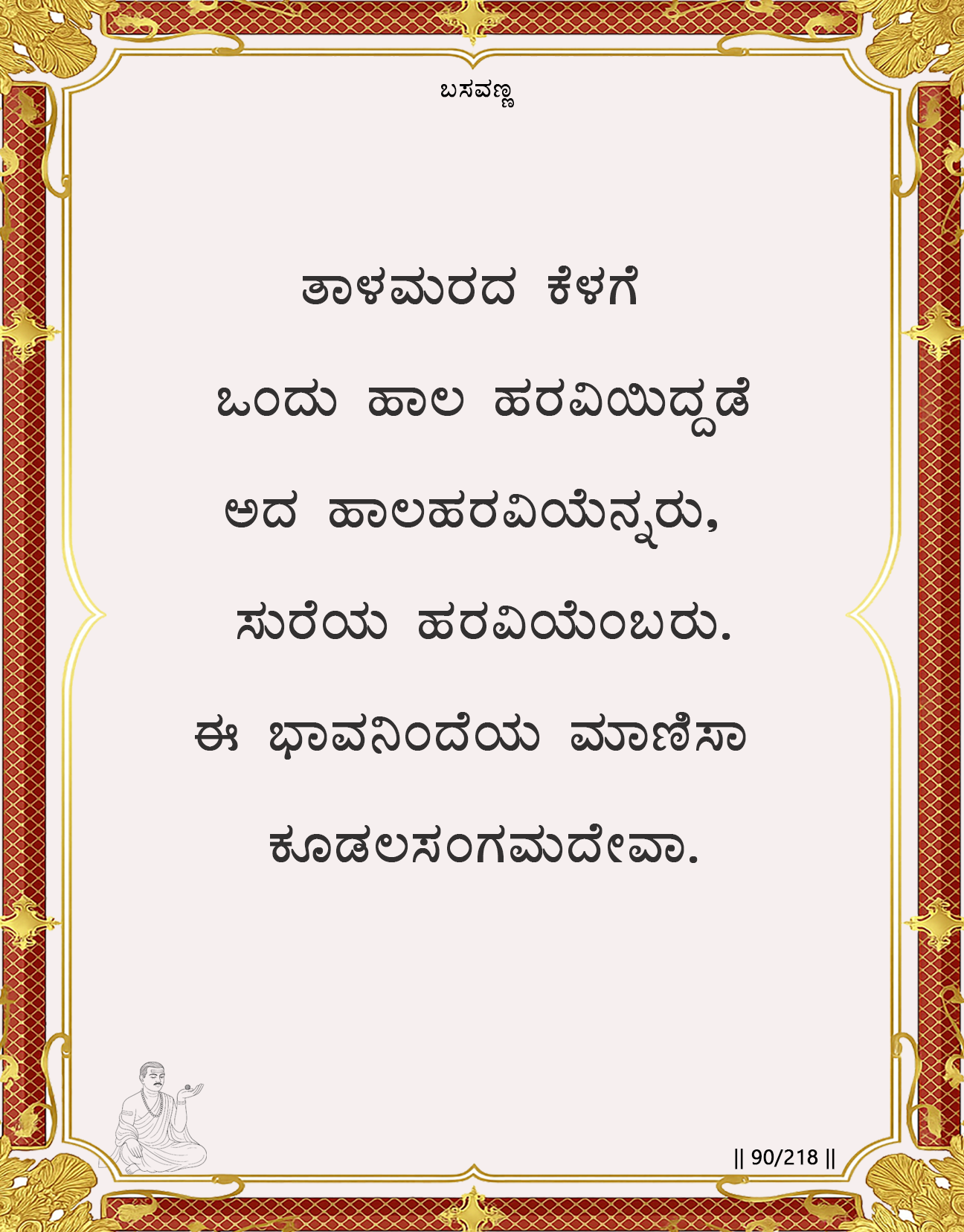
A single pot of milk rests
beneath the toddy palm.
One person declares it milk,
another insists it is liquor.
This is the disease of a clouded gaze,
O Kudalasangama
cut through this sickness of sight!
This vachana shifts the focus from the nature of truth to the pathology of the perceiving mind. Basavanna diagnoses a spiritual ailment: our perception does not reveal reality, but projects our own internal biases, fears, and limitations onto it. The “milk” is absolute, objective reality the divine essence inherent in all beings and situations. The “liquor” is a subjective delusion, a story spun by an impure consciousness. The conflict is not in the world, but in the flawed lenses through which we view it. The seeker’s work, therefore, is not to defend the milk, but to purify their own vision.
Spiritual Context
Core Spiritual Principle: The ultimate impurity is not in the world but in our perception of it (drishti dosha). Liberation involves the purification of consciousness (chitta shuddhi) so that it can reflect reality without distortion. What we see outside is a precise indicator of our inner state.
Cosmic Reality Perspective: The non-dual reality (Linga) is pure, unblemished, and ever-present (“milk”). The world of conflict and duality (“liquor”) is a mental construct superimposed upon this reality by a consciousness clouded by the malas (impurities) of ego, attachment, and aversion.
Historical Reality (Anubhava Mantapa Context): This vachana provides the psychological foundation for challenging social prejudices, particularly the caste system. The “diseased gaze” is what sees impurity in a human being based on birth. Basavanna calls for a revolution in perception, urging his followers to see the divine “milk” in every individual, regardless of social labels.
Interpretation
“A single pot of milk rests beneath the toddy palm.”: This establishes the objective fact. The “toddy palm” symbolizes the context of the world, which is often associated with intoxication and delusion. Yet, within this very context, the pure, nourishing reality (the Linga) is present and unchanged.
“One person declares it milk, another insists it is liquor.”: This illustrates the subjective distortion. The first person has clear perception (the realized soul). The second projects their own inner “intoxication” (biases, samskaras) onto the reality, seeing not what is, but what they expect or fear to see.
“This is the disease of a clouded gaze… cut through this sickness of sight!”: This is the diagnosis and the prescription. The “disease” is the ego’s habit of projection. The “cutting through” is the function of intense self-awareness (Arivu) and divine grace, which surgically severs the link between pure perception and the ego’s distorting narratives.
Practical Implications: The practice of Lingayoga is, at its core, the practice of correcting perception. Every moment of interaction is an opportunity to ask: “Am I seeing the ‘milk’ of the divine presence here, or am I projecting the ‘liquor’ of my own judgment, fear, or desire?”
The Cosmic Reality
Anga (Human Dimension): The perceiving self with its conditioned mind, the source of distorted perception and the suffering that results from it.
Linga (Divine Principle): The pure suchness (tathata) of reality, the “milk” that is ever-present and unchanging.
Jangama (Dynamic Interaction): The transformative process of aligning perception with reality. It is the moment of clarity where one sees the milk as milk, and the ongoing vigilance required to maintain that clarity against the mind’s habitual distortions.
Shata Sthala
Primary Sthala: Maheshwara The ability to diagnose the “disease of sight” is the supreme discernment of the Maheshwara. This stage involves taking lordly responsibility for one’s own perceptual errors, rather than blaming the external world.
Supporting Sthala: Prasadi The cure for this deep-seated disease is acknowledged to be beyond mere personal willpower. The plea for intervention is a quintessential expression of Prasadi, recognizing that the final clearing of vision is an act of grace.
Practical Integration
Arivu (Awareness Practices): Practice “perception checks.” When you have a strong negative or positive judgment about a person or situation, pause. Ask yourself: “Is this reality, or is this my projection? What within me is causing me to see it this way?”
Achara (Personal Discipline): Commit to suspending judgment. Make it a discipline to not immediately label things as good/bad, pure/impure. Instead, practice seeing them first as manifestations of the Linga, beyond your personal likes and dislikes.
Kayaka (Sacred Action): Perform your work without the filter of personal judgment. See the task itself as the “milk” a pure opportunity for service rather than judging it as desirable or undesirable “liquor” based on your mood.
Dasoha (Communal Offering): Create a community that practices clear seeing. Gently and compassionately help each other identify perceptual biases. Be a mirror for your fellow seekers, reflecting the “milk” of their divine nature back to them when they are lost in seeing the “liquor” of their own faults.
Modern Application
We live in an era of hyper-partisanship, “fake news,” and algorithmic echo chambers that relentlessly reinforce our biases. Our perception is more diseased than ever, conditioned to see not people, but political opponents; not information, but confirmation of our pre-existing beliefs.
This vachana is an urgent remedy for our times. It teaches that the solution to societal conflict begins with individual perceptual hygiene. It liberates us from the prison of our own projections, allowing us to engage with the world as it is, with clarity and compassion. It is the foundation for genuine dialogue and understanding in a fractured world.
Essence
The world is a clean mirror.
If you see a stain,
look not at the glass,
but at the face you have brought to it.
Perception is a measurement problem in consciousness. The “milk” is the quantum superposition of all potentialities the pure, unobserved reality. The act of perception by a conditioned mind (the “diseased gaze”) collapses this wavefunction into a single, definite, and often distorted outcome (“liquor”), based on the observer’s own state. The “sickness” is the observer effect corrupted by the noise of the ego. Purifying perception is achieving a state of consciousness that can observe without collapsing the wavefunction into a limited, personal interpretation.
Imagine a pristine lake that perfectly reflects the sky. A diseased gaze is like throwing mud into the lake. The muddied water now reflects a distorted, murky image. The person then blames the sky for being muddy. Basavanna’s prayer is to have the divine wind (grace) calm the waters and let the sediment settle, so the lake can once again reflect the sky with perfect clarity.
We are meaning-making machines, and we are terrified of ambiguity. We rush to label and judge to create a sense of certainty. This vachana reveals that our judgments are often confessions of our inner state. It points to the profound peace that comes from ceasing to project our inner turmoil onto the world and learning to see the inherent purity and divinity in all things.

Views: 18