
Poetic Rendering

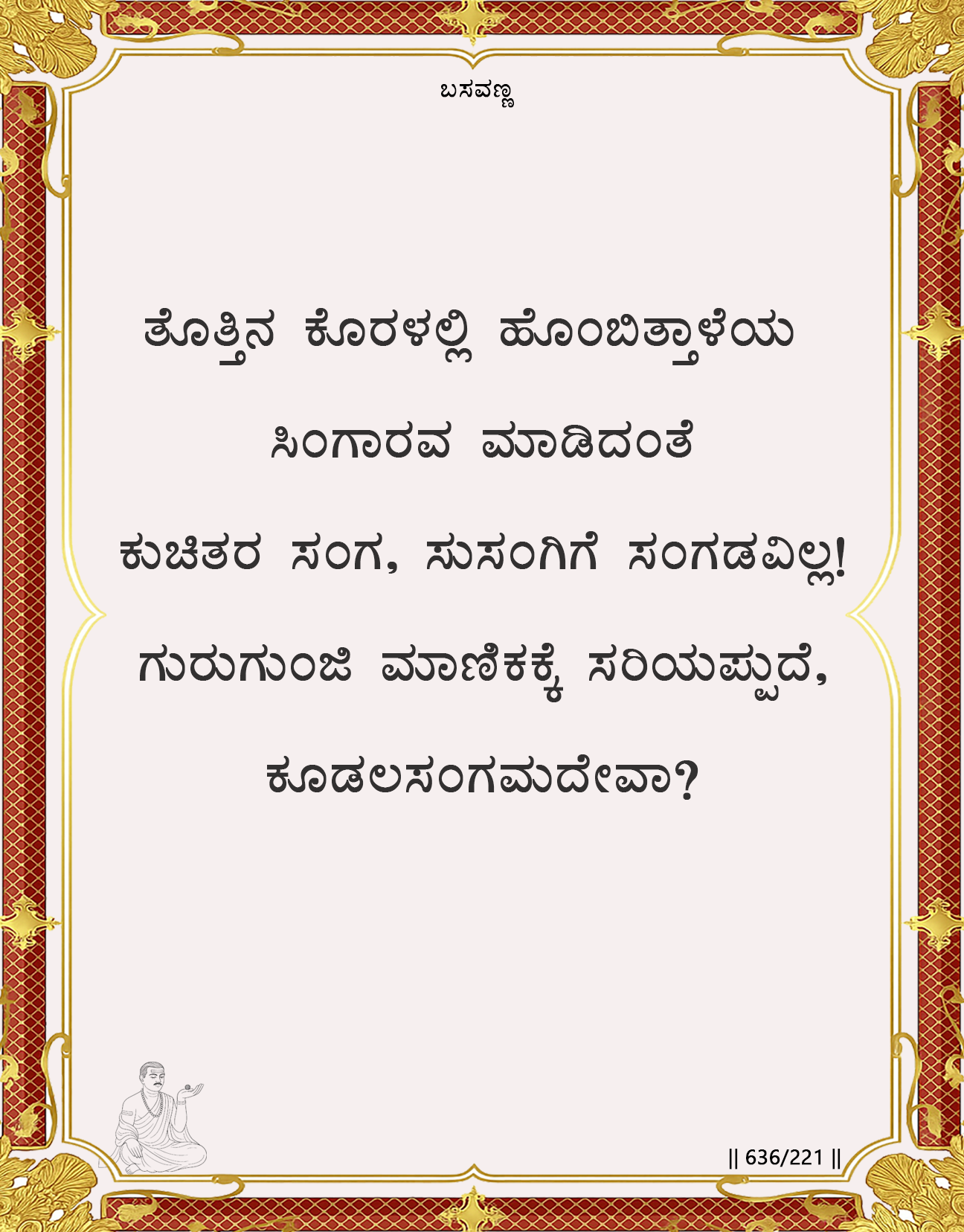
As the rattle of beads on a dancer’s anklet
all noise, no music
so is the company of the hollow.
And the Gunja seed, bright and uniform,
used to weigh gold and gems:
can it ever become the sapphire it measures?
O Kudalasangama,
how can the mere measure of worth
ever possess the worth itself?
This vachana is a profound lesson in discernment, targeting a fundamental cognitive error: the confusion of the standard of measurement with the quality being measured. Basavanna argues that society often venerates the instruments of value be they social metrics, ritualistic practices, or popular figures while remaining blind to the intrinsic essence of value itself. The spiritual path, therefore, demands a radical re-evaluation: one must learn to look past the functional or attractive “container” to perceive the “content,” or lack thereof.
Spiritual Context
Core Spiritual Principle: True value is ontological, not instrumental. A thing’s spiritual worth is its inherent divine nature (its “sapphire” quality), not its utility in measuring, facilitating, or symbolizing spirituality (its “Gunja seed” function). Liberation requires a perceptual shift from being impressed by the tool to recognizing the truth it is meant to point toward.
Cosmic Reality Perspective: In the non-dual reality, only the Linga (the “sapphire”) is real. All else, including the most sophisticated religious instruments and concepts, are like the “Gunja seed” useful within the relative world but utterly devoid of the luminous substance of the Absolute. To worship the measure is to remain in duality.
Historical Reality (Anubhava Mantapa Context): This is a direct critique of Brahminical ritualism, where the priest (the measure) and the rituals (the rattle) were often mistaken for the Divine itself (the sapphire/music). It empowers individuals to evaluate spiritual authority based on the intrinsic quality of a person’s consciousness and conduct, not their title, lineage, or ritual expertise.
Interpretation
“the rattle of beads on a dancer’s anklet all noise, no music”: The “beads” symbolize external religious observances: prayer beads, rituals, ascetic practices. They create the “noise” of spiritual activity. The “music” is the inner transformation, the harmony of a heart united with the Divine. The vachana warns that a life full of religious noise can be utterly devoid of spiritual music.
“the Gunja seed… can it ever become the sapphire it measures?”: This is the central epistemological error. The Gunja seed (a standard weight) is functional and uniform, but it is inert. The sapphire is precious, luminous, and unique. The one who only understands weight will never comprehend luminosity. Similarly, a mind that only values social status, scriptural knowledge, or ritual purity will remain blind to the brilliance of a humble, devoted heart.
“how can the mere measure of worth ever possess the worth itself?”: This rhetorical question cuts to the core of spiritual materialism. The measure (a wealthy donor, a learned scholar, a strict ascetic) may be associated with worth, but does not automatically possess it. True worth is the quality of one’s connection to the Linga.
Practical Implications: A Lingayogi must constantly inquire: “Am I attracted to the noise or the music? Am I valuing the Gunja seed or the sapphire?” This applies to choosing teachers, evaluating one’s own practice, and interacting with the community.
The Cosmic Reality
Anga (Human Dimension): The perceiver who must learn to calibrate their internal “scales” to weigh true value, not just external activity.
Linga (Divine Principle): The sapphire-like reality of pure consciousness, the only thing of intrinsic, ultimate value.
Jangama (Dynamic Interaction): The act of testing and discerning. It is applying the touchstone of sincere devotion to see what rings true (the music) and what is merely hollow (the noise). It is the process of seeking the sapphire in every encounter.
Shata Sthala
Primary Sthala: Maheshwara The ability to make this fundamental distinction between the intrinsic and the instrumental, the essential and the accidental is the “great” wisdom (maha-jnana) of the Maheshwara stage.
Supporting Sthala: Sharana This discernment is crucial for taking true refuge. The Sharana must be able to identify and reject the “hollow company” and the false measures, in order to find and unite with the genuine Jangamas and the true Sangha.
Practical Integration
Arivu (Awareness Practices): In meditation, observe the difference between going through the motions (the “rattle” of sitting in posture) and the actual state of surrendered awareness (the “music”). In daily life, notice when you are performing for social approval versus acting from inner integrity.
Achara (Personal Discipline): Let your discipline be for the sake of inner purity (the sapphire), not for building a spiritual resume (the Gunja seed). A simple, sincere practice is worth more than a complex, ego-driven one.
Kayaka (Sacred Action): Evaluate your work not by its salary or status (the measure), but by its authenticity, its service, and the consciousness you bring to it (the worth).
Dasoha (Communal Offering): Build a community that values the “music” of sincere hearts over the “noise” of wealth, learning, or power. Honor those who embody the teachings, not just those who can quote them.
Modern Application
We live in a society obsessed with metrics: followers, likes, net worth, job titles, academic credentials. We constantly measure ourselves and others with these “Gunja seeds,” mistaking these inert numbers for actual worth, happiness, and success. Our lives are full of the “rattle” of busyness and consumption, often devoid of the “music” of meaning and connection.
This vachana is a call to a profound values reset. It liberates us from the tyranny of external validation and quantitative measurement. It invites us to seek the “sapphire” within ourselves and others the qualities of love, wisdom, compassion, and authenticity. It teaches that a life dedicated to accumulating “Gunja seeds” is a life wasted, while a life oriented toward realizing the “sapphire” is a life of true wealth.
Essence
Do not praise the scale for the gold’s weight.
Do not praise the gate for the palace’s splendor.
I seek the gold itself.
I seek the King.
This vachana describes a category error in consciousness. The mind is using a subsystem (the measuring function, which operates on relative, quantitative data) to try and comprehend the entire system (being, which is qualitative, non-local, and absolute). The “Gunja seed” is a datum within the system; the “sapphire” is a state of the system itself. The error is like a thermometer believing it is the weather.
Imagine a perfect, delicious meal. A food critic’s review (the measure) is not the meal (the worth). You can read a thousand reviews, but you will still be hungry. The reviews might tell you where to find the meal, but they can never be the meal itself. Basavanna is urging us to stop reading the menu and to start tasting the food.
We are easily dazzled by proxies and symbols of value. This vachana speaks to our deep desire for the real, the authentic, the substantial. It warns us against the seduction of the map, reminding us that the map is not the territory. It points to the profound fulfillment that comes from seeking direct experience of the true “sapphire” of divine consciousness, rather than settling for the empty “rattle” of second-hand spirituality.

Views: 6