Poetic Rendering

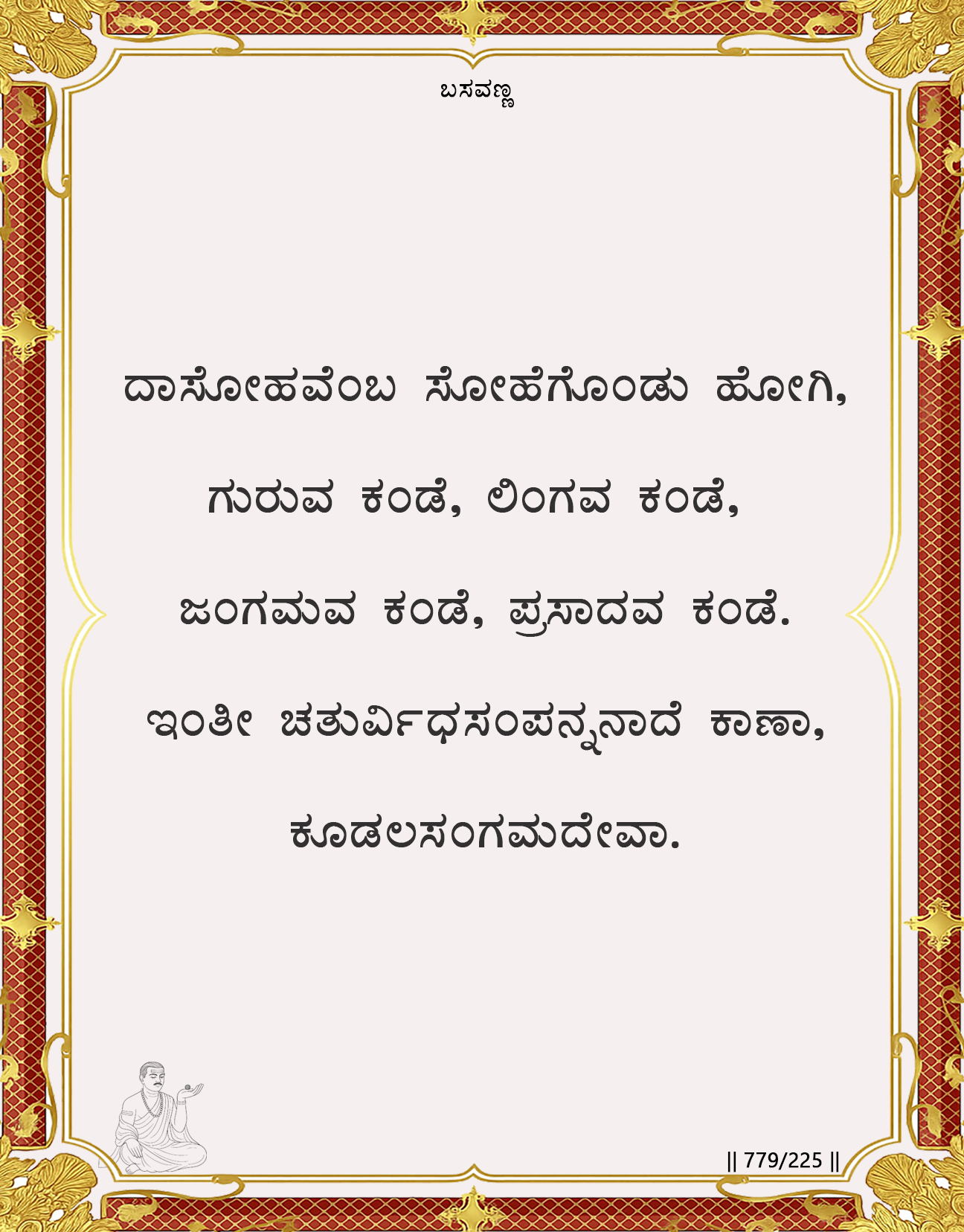
In the joy of service, I beheld:
I saw the Guru,
I saw the Linga,
I saw the Jangama,
I received the Prasada.
Thus, I was graced with the fourfold treasure,
O Kudalasangama!
This vachana is Basavanna’s holistic vision of the complete spiritual ecosystem. He presents not a linear path, but an integrated, four-pillared structure of awakening where each element is interdependent and simultaneously accessible. The experience is framed within “the joy of service” (dāsoham), indicating that this wholeness is not attained in isolation but through active, selfless engagement with life. The “fourfold treasure” is the birthright of every human being, a universal framework for a life of complete fulfillment, seamlessly uniting the inner journey with outer expression.
Spiritual Context
Core Spiritual Principle: Spiritual fulfillment is not a single attainment but a holistic integration of four essential dimensions: awakened awareness (Guru), inner divinity (Linga), perception of divinity in all (Jangama), and the grace that sustains and circulates through this whole system (Prasada). This integration occurs not in withdrawal, but in the crucible of selfless service.
Cosmic Reality Perspective: This is the full flowering of Shiva-Advaita. The one reality (Linga) is simultaneously the inner truth, the outer manifestation, the illuminating power of consciousness (Guru), and the blissful substance of existence itself (Prasada). The vachana describes the moment when a human being becomes a conscious, functioning node within this singular divine organism.
Historical Reality (Anubhava Mantapa Context): This vachana provides the complete theological blueprint for the Lingayoga community. It defines the goal: not escape from the world, but the transformation of the individual into a microcosm of the divine community, where inner realization (Guru/Linga) and outer engagement (Jangama/Dasoha) are inseparable, fueled by grace (Prasada).
Interpretation
“In the joy of service, I beheld…”: The container for this entire revelation is Dasoha selfless offering. This establishes that the highest realization is ecologically engaged; it is found in action, not apart from it. The “joy” indicates that this is not burdensome duty but the natural expression of a liberated heart. “I saw the Guru, I saw the Linga, I saw the Jangama…”: The use of “saw” signifies direct perception (anubhava), not intellectual understanding. The sequence is not chronological but simultaneous and holographic. Each “seeing” implies the others: Guru: The inner light that allows one to see the Linga and recognize the Jangama. Linga: The stable center whose discovery allows the Guru’s light to shine and reveals the Jangama’s true nature. Jangama: The expansive field that validates the inner realization of the Linga and is the arena for the Guru’s wisdom. “I received the Prasada.”: This is the culmination. Prasada is the grace that is both the cause and the effect of this integrated vision. It is the nourishment received from the Guru’s wisdom, the Linga’s presence, and the Jangama’s communion, and it is itself the energy that fuels further service and realization. “the fourfold treasure…”: This is the complete inheritance of a human being. It is not four separate things, but one reality with four inseparable aspects. To have one is to have all; to lack one is to be incomplete.
Anga (Human Dimension): The individual who has become a fully integrated and transparent vessel for the fourfold treasure.
Linga (Divine Principle): The singular reality that expresses itself as Guru (Chit, Consciousness), Linga (Sat, Being), and Jangama/Prasada (Ananda, Blissful Dynamism).
Jangama (Dynamic Interaction): The entire, joyful process of service, perception, and reception that constitutes the living relationship between the Anga and the Linga, resulting in the continuous flow of Prasada.
Practical Implications: The path of Lingayoga is to consciously cultivate this fourfold treasure. One practices mindfulness (Guru), devotion to the Ishtalinga (Linga), service to the community and the world (Jangama), and receives all outcomes as grace (Prasada). These are not sequential steps but concurrent practices that reinforce each other.
Shata Sthala
Primary Sthala: Aikya The voice is that of one abiding in union. The dissolution of boundaries between the seeker, the path, and the goal is the definitive characteristic of Aikya. The fourfold treasure is the functional description of this state.
Supporting Sthala: Sharana The practical means to this end is the life of a Sharana, which is defined by taking refuge in the Guru, Linga, and Jangama, and living a life of Dasoha, which naturally leads to the experience of Prasada.
Practical Integration
Arivu (Awareness Practices): Meditate on the fourfold treasure. Sit with the Ishtalinga (Linga), invoke the inner guide (Guru), extend your awareness to include all beings (Jangama), and receive the peace of the moment as grace (Prasada).
Achara (Personal Discipline): Structure your daily life around these four pillars. Begin with mindfulness (Guru), center yourself in your spiritual practice (Linga), engage with others compassionately (Jangama), and end the day in gratitude for all that was given and received (Prasada).
Kayaka (Sacred Action): Let your work be the field where all four converge. Do your work with awareness (Guru), as an offering to the Divine within (Linga), as a service to the world (Jangama), and accept the results as a gift (Prasada).
Dasoha (Communal Offering): The community itself should be a living embodiment of the fourfold treasure a place of wisdom (Guru), devotion (Linga), selfless service (Jangama), and shared abundance (Prasada).
Modern Application
Modern spirituality is often fragmented. We have mindfulness apps (Guru) disconnected from devotion, devotional practices (Linga) disconnected from social action, and social activism (Jangama) fueled by burnout instead of grace (Prasada). We seek one piece of the puzzle and wonder why we feel incomplete.
This vachana offers a complete and sustainable model for an integrated spiritual life. It liberates us from one-sided approaches and provides a framework for wholeness. It shows that personal awakening, divine connection, compassionate service, and receptive gratitude are not separate goals but parts of a single, glorious tapestry. It is the antidote to spiritual fragmentation and burnout.
Essence
The map, the territory,
the journey, and the sustenance
I saw they were one.
And in that seeing,
I was found.
The fourfold treasure represents a fully coherent state of the human system. The Guru is the programming (the software of consciousness), the Linga is the hardware (the fundamental substrate of the self), the Jangama is the network connection (the relational interface with the rest of the universe), and the Prasada is the continuous, harmonious flow of energy/information through this entire integrated system. The “joy of service” is the system’s optimal functioning state, where output (service) and input (grace) create a self-sustaining, positive feedback loop of awakening.
Imagine a perfectly functioning cell. The nucleus contains its DNA (the Linga its core identity and blueprint). The enzymes and signals that regulate its function are the Guru. Its membrane, through which it exchanges energy and information with the body, is the Jangama. The nutrients and oxygen it receives are the Prasada. The cell is healthiest and most “joyful” when all four are working in perfect harmony, serving the whole body. Basavanna describes the human as just such a “cell” in the body of the Divine.
We yearn for a life of meaning, connection, purpose, and joy. This vachana reveals that these are not separate yearnings but facets of a single, attainable state of being. It addresses the universal feeling of fragmentation by providing a divine architecture for wholeness, showing that the deepest human fulfillment is found in the joyful service that unites us with the source, substance, and community of all life.

Views: 7