Poetic Rendering

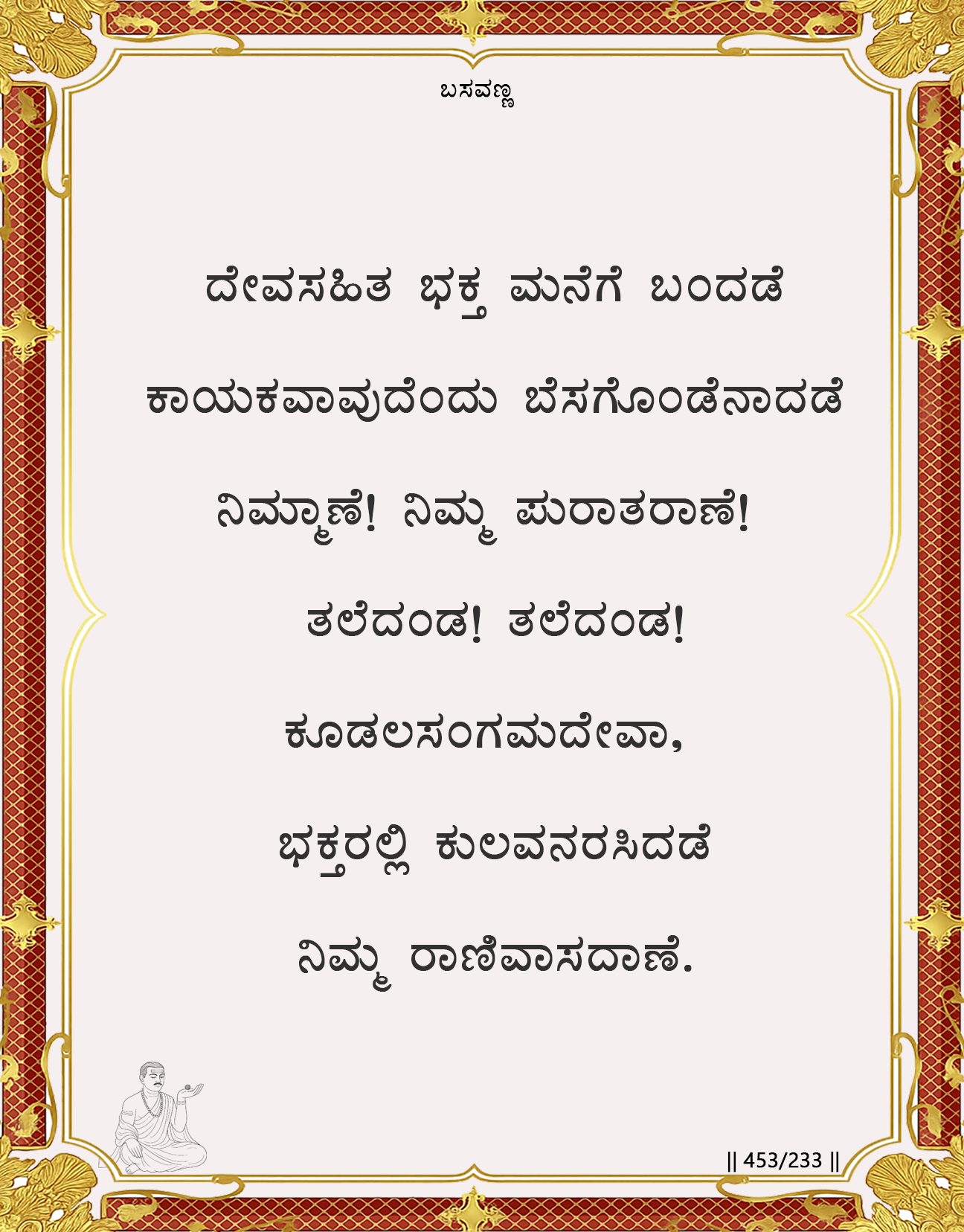
When the Lord Himself enters a home
with His Sharana bearing the sacred Linga,
and you stop to ask
“His caste? His clan? His sect? His standing?”
Shame upon such blindness
a thousand shames upon it!
I swear by You, O Lord,
I swear by my elders and my lineage:
If ever such a thought arises in me,
may my head part from my shoulders
for all my acts would be rendered worthless.
O Kudalasangama,
never shall I question a Sharana’s birth or rank,
for in the celestial palace
of Your divine consort,
no measure of caste, creed, or lineage exists
only the pure fragrance of devotion.
To dishonor the Sharana
is to shut the very gates of heaven
with one’s own hands.
In this vachana, Basavanna lays down an uncompromising spiritual protocol: a true Sharana is the living threshold of the Divine, and questioning their caste or social status is an act of spiritual blindness. He frames such discrimination not merely as a social failure but as a desecration of the Divine Guest Himself. Basavanna takes a solemn personal vow that if even the slightest thought of caste-based judgment arises in him, his life becomes unworthy. By declaring that the heavenly abode of Kudalasangama’s consort recognizes no categories of birth or hierarchy, he completely dismantles the foundations of social prejudice. The Sharana’s presence becomes the supreme test of one’s spiritual maturity: honor them, and heaven opens; dishonor them, and one closes the door of liberation upon oneself.
Spiritual Context
Core Spiritual Principle: The presence of a God-realized being (or one sincerely on the path) sanctifies a space and demands the highest reverence. To apply worldly, discriminatory filters like caste to such a presence is to commit the ultimate sacrilege. It is to prefer the illusion of social hierarchy over the reality of divine immanence, thereby cutting oneself off from the flow of grace.
Cosmic Reality Perspective: In the non-dual reality of Shiva, all distinctions of caste and creed are utterly non-existent. They are fabrications of the unenlightened mind (Maya). The Sharana is one who abides in or moves toward this reality. To impose caste upon them is to violently drag them back into an illusion, an act of profound spiritual violence.
Historical Reality (Anubhava Mantapa Context): This vachana served as the definitive social code for the Lingayoga community. It was a direct, theological war on the caste system. It mandated that within the Sangha, no Sharana could ever be questioned about their birth. This ensured that the community remained a true sanctuary of equality, where spiritual merit was the sole measure of a person.
Interpretation
“When the Lord Himself enters a home with His Sharana… and you stop to ask ‘His caste? His clan?’…”: Basavanna equates the Sharana with the Lord. The questioning is not just about the person, but about the Divine presence they carry. The act of questioning itself is the blasphemy.
“Shame upon such blindness a thousand shames upon it!”: The repetition emphasizes the severity. This is not a minor faux pas; it is a catastrophic failure of spiritual perception a form of “blindness” to the light of the Divine standing before one.
“If ever such a thought arises in me, may my head part from my shoulders for all my acts would be rendered worthless.”: This is the most severe personal vow. The “head” symbolizes the intellect that generates such discriminatory thoughts. Basavanna declares that if his own intellect becomes so corrupted, it is better that it be severed, for a life lived with such a fundamental error renders all other spiritual practices null and void.
“in the celestial palace… no measure of caste, creed, or lineage exists only the pure fragrance of devotion.”: This provides the ultimate rationale. The divine realm operates on a completely different value system. The only “currency” is devotion. To use the counterfeit currency of caste is to be refused entry at the gates.
Practical Implications: For a Lingayoga, welcoming every fellow seeker with equal reverence is a core spiritual discipline. It is a practical test of one’s own understanding of non-duality. The community must be a caste-free zone, where anyone asking such questions would be seen as spiritually immature.
The Cosmic Reality
Anga (Human Dimension): The individual who must purify their perception to see the Linga in the Jangama, overcoming the deep-seated samskaras of caste prejudice.
Linga (Divine Principle): The absolute, non-dual reality that is equally present in all Sharanas, making them identical in their essential nature.
Jangama (Dynamic Interaction): The act of darshan of seeing and being seen by the Sharana without filters. It is the sacred exchange where the host’s devotion meets the guest’s divinity, and where any discriminatory thought interrupts and nullifies this holy communion.
Shata Sthala
Primary Sthala: Sharana The entire vachana is about the ethics of being in a community of Sharanas. The unconditional honor given to every member is what defines the refuge of the Sangha.
Supporting Sthala: Maheshwara The vow to excise caste-thinking from one’s own mind with surgical precision is an act of supreme self-governance and discernment, characteristic of the Maheshwara’s “great” responsibility.
Practical Integration
Arivu (Awareness Practices): Vigilantly monitor your own mind for any subtle judgments based on a person’s background, appearance, or social demeanor. When meeting a fellow seeker, consciously affirm: “This is a vessel of the Divine. I honor the Linga within them.”
Achara (Personal Discipline): Make it a strict personal rule to never inquire about or speculate on anyone’s caste, ethnic background, or social status within a spiritual context. Actively challenge such talk in others.
Kayaka (Sacred Action): In your work and social interactions, practice this unconditional respect. Let your professional and personal relationships be free from the biases that this vachana condemns.
Dasoha (Communal Offering): The community must be a safe and sacred space for all. Leadership should come from those who embody this principle most fully. Any instance of discrimination must be addressed not as a social slip, but as a spiritual failure, with compassion and firmness.
Modern Application
While overt casteism may be less common in some societies, the human tendency to judge, exclude, and create in-groups and out-groups persists in new forms: racism, classism, political tribalism, and spiritual elitism. We constantly rank people based on education, wealth, and social influence.
This vachana is a timeless antidote to all forms of prejudice. It liberates us from the prison of “us vs. them.” It teaches that our spiritual progress is measured by our ability to see the same divine core in every human being, especially those whom our conditioning tells us to disregard. It calls for a society where a person’s character and consciousness are their only identity, and where every encounter is treated as a potential meeting with the Divine.
Essence
When God comes to your door,
do not ask for His pedigree.
To question the guest
is to insult the Host.
The only question is:
Is your heart clean enough to receive Him?
Caste-based thinking is a virulent “mental malware” that corrupts the operating system of consciousness, causing it to misread the data packet (the human being) and assign a false, limited identity. The Sharana is a “clean file” containing the pure data of divine consciousness. The act of questioning their caste is the malware attempting to infect the clean file, or worse, the system rejecting the file because it doesn’t match its corrupted database. Basavanna’s vow is to install a powerful “antivirus” a root-level commitment to non-duality that quarantines and deletes the caste malware on sight, ensuring the system can receive the high-integrity data of the Sharana’s presence without corruption.
Imagine a king sends his most trusted ambassador to your house. The ambassador carries the king’s own seal and message. Instead of listening to the message, you stop the ambassador at the door and demand to know what village he was born in and what his father did for a living. This is not just rude to the ambassador; it is a direct insult to the king who sent him. Basavanna says the Sharana is the ambassador, and the Linga they carry is the king’s seal. To focus on caste is to be deaf to the king’s message.
We are conditioned to feel safe by categorizing people. This vachana confronts this deep-seated insecurity and reveals that true safety and grace are found only in surrendering these categories. It speaks to our longing for a world where we are valued for who we are, not for where we come from. It affirms that the most sacred community is one where every person is received as a direct emissary of the Divine.

Views: 19