
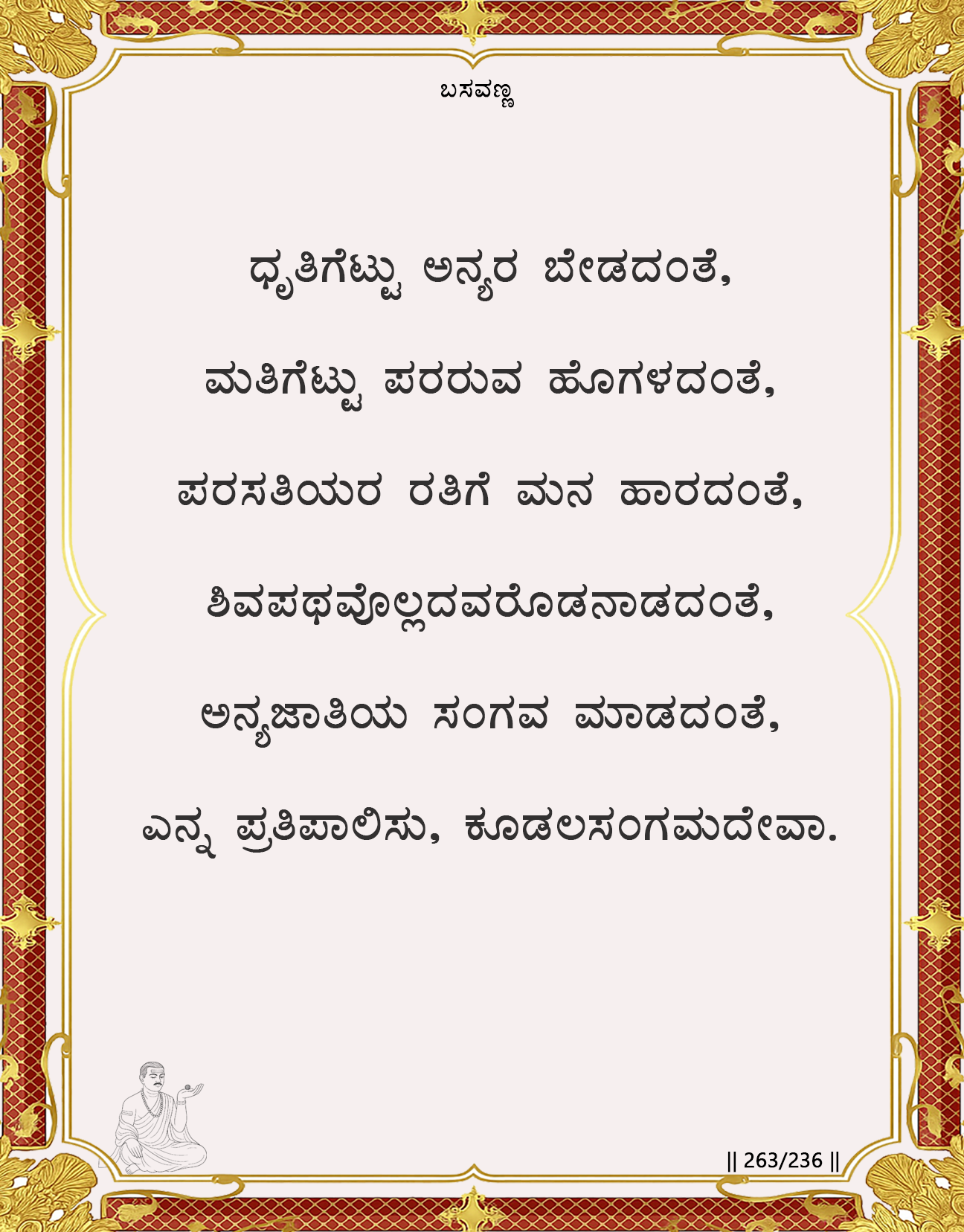
Poetic Rendering

Let me never bow in fear before another,
nor pour out praise
where understanding is absent.
Let my mind not wander
toward another’s desire,
nor let the company of
the faithless cling to me
those who know
nothing of the Shiva within,
nothing of the One who dwells in all.
Guard me from such confusion,
and keep me walking the clear path,
O Kudalasangamadeva,
for only Your refuge is freedom.
In this vachana, Basavanna asks for the inner discipline that preserves spiritual integrity. He prays not to fall into fear, flattery, lust, or the influence of those disconnected from the Divine presence within. These external pulls false praise, unexamined admiration, sensual wandering, and unworthy companionship are portrayed as leaks in consciousness that drain spiritual strength. True protection is not physical but psychological and moral: the unwavering alignment of thought, desire, and company with the indwelling Shiva. Basavanna affirms that only conscious surrender to Kudalasangama can keep a seeker on the authentic path, shielding them from both inner distortion and outer misguidance.
Spiritual Context
Core Spiritual Principle: Spiritual progress is safeguarded by conscious, moment-to-moment choices that protect one’s inner integrity. The path requires vigilant discipline over one’s fears, desires, speech, and associations, all of which must be surrendered to and aligned with the Divine.
Cosmic Reality Perspective: In Lingayoga, the Linga is the only true source of power, value, and attraction. To bow in fear to another mortal, to be mentally pulled by external desires, or to seek validation from the “faithless” is to be deluded by Maya, forgetting the singular reality of the Shiva within. Surrender to the Linga is the only alignment that confers true freedom from these entanglements.
Historical Reality (Anubhava Mantapa Context): This Vachana provided an ethical and psychological compass for Sharanas living in a society that opposed their revolutionary values. It taught them to draw their strength and validation from within their spiritual community and their inner connection to Shiva, rather than from the approval or fear of the orthodox social hierarchy.
Interpretation
“Let me never bow in fear before another…”: Fear is the acknowledgment of a power other than God. This prayer is for the courage that comes from the realization that the Linga is the only ultimate reality; all other powers are transient and illusory.
“…nor pour out praise where understanding is absent.”: This is a discipline of truth in speech and relationship. Empty flattery reinforces ignorance in others and compromises one’s own integrity. Praise should be reserved for genuine wisdom and virtue, which reflect the Linga.
“Let my mind not wander toward another’s desire…”: This is the discipline of mental chastity. “Another’s desire” signifies being swayed by external cravings and social pressures, which distracts from the single-pointed desire for the Divine.
“…nor let the company of the faithless cling to me…”: This is the discipline of association (Satsangha). The “faithless” are those who live without awareness of the indwelling Shiva. Their company can subtly normalize a consciousness devoid of the sacred, acting as a drain on one’s spiritual energy (Satsangha).
“…only Your refuge is freedom.”: This is the culmination. Basavanna identifies that the conscious, continuous act of taking refuge in the Linga is the active practice that makes all the other disciplines possible. It is not a passive state but the dynamic source of liberation.
Practical Implications: The seeker is guided to practice constant vigilance (sadhana chatushtaya). Every interaction and every thought must be evaluated against the standard: “Does this strengthen my connection to the Linga, or does it weaken it?” The path is one of proactive purification and conscious boundary-setting.
The Cosmic Reality
Anga (Human Dimension): The seeker who actively cultivates a purified vessel through discipline. This Anga is a fortress whose gates are guarded by discrimination and surrender.
Linga (Divine Principle): Koodalasangamadeva as the indwelling source of all strength, truth, and attraction the sole worthy object of fear, praise, and desire.
Jangama (Dynamic Interaction): The dynamic is the continuous act of seeking refuge. It is the living process of turning away from distracting energies and turning towards the Linga in every moment of choice, thereby forging an unbreakable connection.
Shata Sthala
Primary Sthala: Maheshwara. This Vachana is a manual for the Maheshwara stage, which is defined by the intense inner purification and discipline required to burn away the vasanas of fear, lust, and social dependency.
Supporting Sthala: Sharana. The practice of seeking refuge, which is the solution offered, is the defining characteristic of the Sharana stage. The disciplines of Maheshwara naturally culminate in the total reliance of the Sharana.
Practical Integration
Arivu (Awareness Practices): Practice a daily “examination of conscience.” Review moments where you felt fear, gave insincere praise, felt envious, or were influenced by negative company. Observe these patterns without judgment and consciously offer them to the Linga.
Achara (Personal Discipline): Make conscious vows. Vow to speak only truthful praise. Vow to mentally offer up desires that arise when seeing others’ possessions or lives. Vow to spend time in positive Satsangha regularly.
Kayaka (Sacred Action): In your workplace, practice this integrity. Do not act out of fear of your boss or flatter colleagues insincerely. Let your work be an expression of your alignment with inner truth.
Dasoha (Communal Offering): Help foster a strong Sangha. Protect the community’s spiritual integrity by encouraging these same standards of fearless truth and mindful association among fellow seekers.
Modern Application
Social anxiety, the pressure to conform on social media, the “fear of missing out” (FOMO), absorbing the negative and cynical energy of digital or workplace environments, and the loss of personal boundaries.
This Vachana is a vital guide for mental and spiritual hygiene in the modern world. It provides the tools to build an inner citadel, protecting one’s peace and purpose from the relentless pressures of consumer culture, social media, and a often faithless zeitgeist. It teaches that true freedom is the courage to be authentic, guided solely by one’s inner divine compass.
Essence
From fearful bow, and flattering word,
From wandering gaze, so oft inferred,
From faithless company’s dull chain,
O Lord, Your refuge, make me sane.
This Vachana describes the maintenance of a Coherent Spiritual System. The seeker’s consciousness is a system that can be perturbed by external “noise” (fear, flattery, desire, faithless company). These are entropic inputs that increase internal disorder and dissipate spiritual energy. The conscious surrender to the Linga is the application of a corrective feedback loop. Each prayerful alignment (“refuge”) is a moment of negative feedback that counteracts the entropic perturbations, restoring the system to a state of high coherence, low entropy, and stable resonance with the divine frequency. The Vachana is a formula for dynamic equilibrium on the spiritual path.
A ship in a storm must constantly adjust its rudder to stay on course. The storm is the world of fear, desire, and bad company. The ship’s compass is the Linga. The act of consciously taking refuge is the sailor’s hand on the rudder, making constant, small corrections to prevent the ship from being thrown off course, capsized, or swept into dangerous waters. Basavanna is the sailor, praying for the strength and awareness to never let go of the rudder.
Your inner peace is your most valuable possession, and it is protected by your choices. You cannot control the world, but you can choose where you place your attention, your fear, your praise, and your company. The ultimate freedom is not the absence of challenges, but the presence of an unshakeable inner refuge. To know what to let in and what to keep out is the very essence of wisdom and the foundation of a tranquil mind.

Views: 6