

Summary
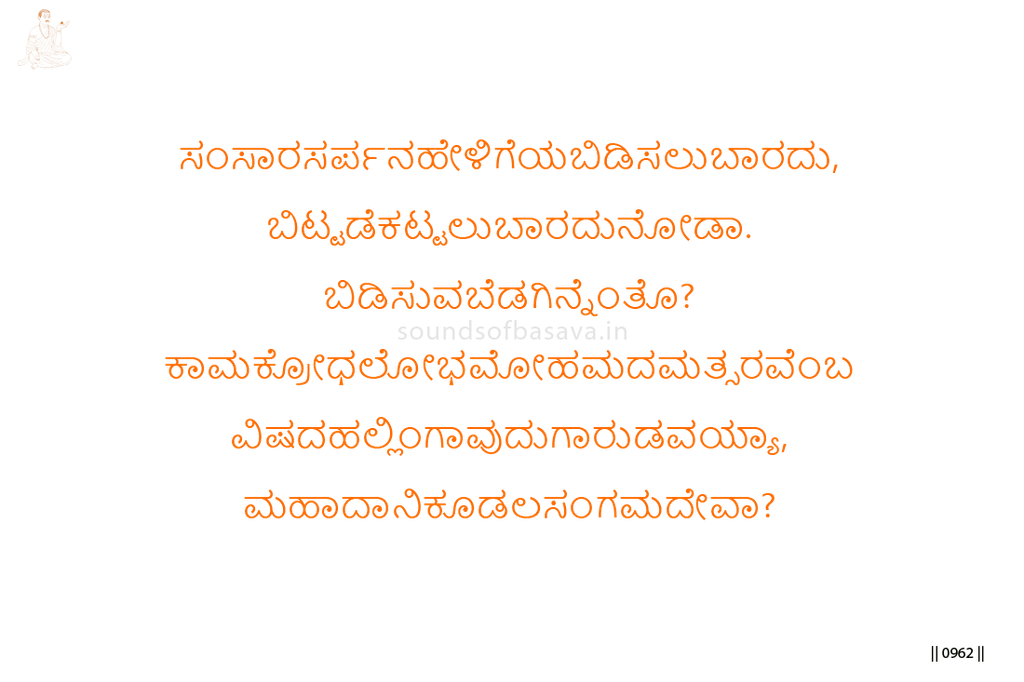
Basavanna presents samsara as a serpent that cannot be driven away by shouting and cannot be restrained merely by binding. The force of worldly bondage is not removed by noise, force, suppression, or outward control.
The serpent’s poison-fangs are desire, anger, greed, delusion, pride, and jealousy. These inner forces are the true danger because they carry the venom of bondage into consciousness. Basavanna therefore asks who can be the Garuda capable of subduing such a serpent, and the answer is placed before Kudalasangama Deva alone.
Imagery & Symbolic Relevance
The first image is the serpent of samsara. Basavanna does not present bondage as a harmless condition. It is living, dangerous, and capable of striking.
The second image is the attempt to drive it away by shouting. Noise does not remove the serpent. In the same way, mere verbal effort, complaint, or outer declaration cannot end bondage.
The third image is the attempt to bind it. Restraint alone does not master the serpent. Suppression may hold for a time, but the poison remains.
The fourth image is the question: who can truly subdue it? Basavanna turns the seeker away from self-confidence. The serpent cannot be mastered by ordinary personal force.
The fifth image is the poison-fangs. The serpent’s danger lies in its bite, and Basavanna names those fangs as desire, anger, greed, delusion, pride, and jealousy. These are not secondary faults; they are the channels through which samsara wounds the seeker.
The final image is Garuda. Garuda is the power that can overcome the serpent. Basavanna asks who can be such a Garuda except Kudalasangama Deva. The remedy is not self-suppression, but Divine mastery of the poison at its source.
Lingayoga
In Lingayoga, this vachana teaches that inner bondage must be recognized at the level of its poison. The seeker should not merely fight outer circumstances while desire, anger, greed, delusion, pride, and jealousy remain active within.
For Sharana Sthala, the practice-point is surrender joined with vigilance. The seeker must see the serpent clearly, stop relying on shouting or binding, and turn to Kudalasangama Deva as the only power capable of neutralizing the poison.
Editorial Commentary
This vachana should not be read as encouraging passivity. Basavanna is not saying that discipline has no value; he is saying that force and suppression alone cannot remove the serpent’s venom. The central issue is the six poison-fangs. The prayer to Kudalasangama Deva marks the need for grace that reaches deeper than outward control.
Related Vachana
Supporting Vachana
Pranalingi Sthala Vachana 857 — Not Time, but Becoming that Binds
Pranalingi Vachana 857 supports this teaching through another serpent-image. There, the serpent has no head or tail to grasp, moves through the subtle path, and is finally named as Aham, the self-claiming “I” that swallows those who are not Kudalasangama Deva’s Sharanas. This prepares Vachana 1373 directly. In Vachana 857, the hidden serpent is the subtle egoic claim; in Vachana 1373, the serpent of samsara strikes through the poison-fangs of desire, anger, greed, delusion, pride, and jealousy. Both show that bondage cannot be mastered by ordinary force and must be overcome through refuge in Kudalasangama Deva.
Advancing Vachana
Aikya Sthala Vachana 1383 — Where Is Anubhava?
Aikya Vachana 1383 advances this teaching by carrying the exposure of inner poison into the test of genuine realization. In Sharana Vachana 1373, the six inner enemies are named as the poison-fangs of the serpent of samsara, and only Kudalasangama Deva can subdue them. In Aikya Vachana 1383, Basavanna asks where Anubhava can be if the six inner enemies remain, if pride and jealousy continue, and if self-praise, falsehood, and inner agitation still rule. Thus the Sharana-stage cry for the Garuda-power of Kudalasangama Deva advances into Aikya as the recognition that true Anubhava exists only where these poisons no longer govern consciousness.
