

Summary
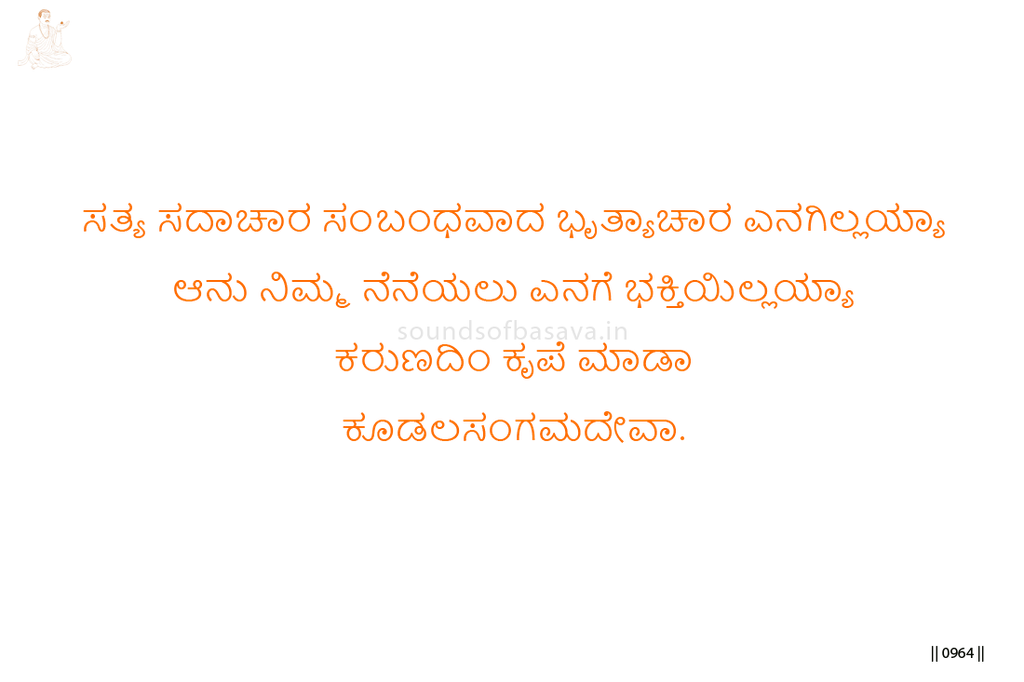
Basavanna confesses that he does not possess the servant-conduct joined to truth and right living. He does not claim virtue, discipline, or spiritual fitness. Even the conduct expected of a faithful servant is absent.
The confession deepens further: he says he does not have the devotion needed to remember Kudalasangama Deva. Remembrance itself is not claimed as personal strength. Having abandoned all claim to worthiness, Basavanna turns only to compassion and asks Kudalasangama Deva to bestow grace.
Imagery & Symbolic Relevance
The first image is Satya-Sadachara, truth joined with right conduct. Basavanna does not present himself as one established in this. The absence is named plainly.
The second image is Bhrityachara, the conduct of a servant. A servant lives in humility, loyalty, and readiness before the Lord. Basavanna says that even this servant-conduct is not present in him.
The third image is remembrance. He does not say merely that his remembrance is weak. He says he does not possess the devotion required to remember Kudalasangama Deva. This makes remembrance itself a gift, not an achievement.
The final image is compassion and grace. When conduct, devotion, and remembrance cannot be claimed, the only remaining movement is prayer. Basavanna does not ask to be accepted because he is worthy; he asks Kudalasangama Deva to act out of compassion.
Lingayoga
In Lingayoga, this vachana teaches that the path cannot be built on self-claim. Truthful conduct, servant-conduct, devotion, and remembrance are not possessions to be displayed before Kudalasangama Deva.
For Sharana Sthala, the practice-point is radical honesty. The Sharana does not cover lack with spiritual language. When even devotion and remembrance cannot be claimed, the seeker must stand in humility and depend wholly upon grace.
Editorial Commentary
This vachana should not be read as despair or self-condemnation. Basavanna’s confession is a form of spiritual truthfulness. By refusing to claim conduct, devotion, or remembrance as his own possession, he makes room for grace. The center of the vachana is not unworthiness alone, but grace beyond worthiness.
Related Vachana
Supporting Vachana
Pranalingi Sthala Vachana 479 — The Unrealized Lotus
Pranalingi Vachana 479 supports this teaching by refusing premature spiritual claim. There, Basavanna asks how he can call himself a devotee, a Sharana, or one united with Linga when the inner truth has not yet been known and the mind has not found peace. This prepares Vachana 1378 directly. In Vachana 479, sacred identity cannot rest on words alone; in Vachana 1378, Basavanna goes further and confesses that even servant-conduct, devotion, and remembrance cannot be claimed, so he turns only to Kudalasangama Deva’s compassion.
Advancing Vachana
Aikya Sthala Vachana 1380 — One Vessel, One Offering
Aikya Vachana 1380 advances this teaching by carrying grace beyond worthiness into complete non-separation. In Sharana Vachana 1378, Basavanna abandons all claims to conduct, devotion, and remembrance, depending only on grace. In Aikya Vachana 1380, the distinctions between devotee, Guru, Linga, and Jangama dissolve into one living communion. Thus the Sharana-stage poverty of self-claim advances into Aikya as the state where separate possession, separate merit, and separate identity no longer remain before Kudalasangama Deva.
