Poetic Rendering

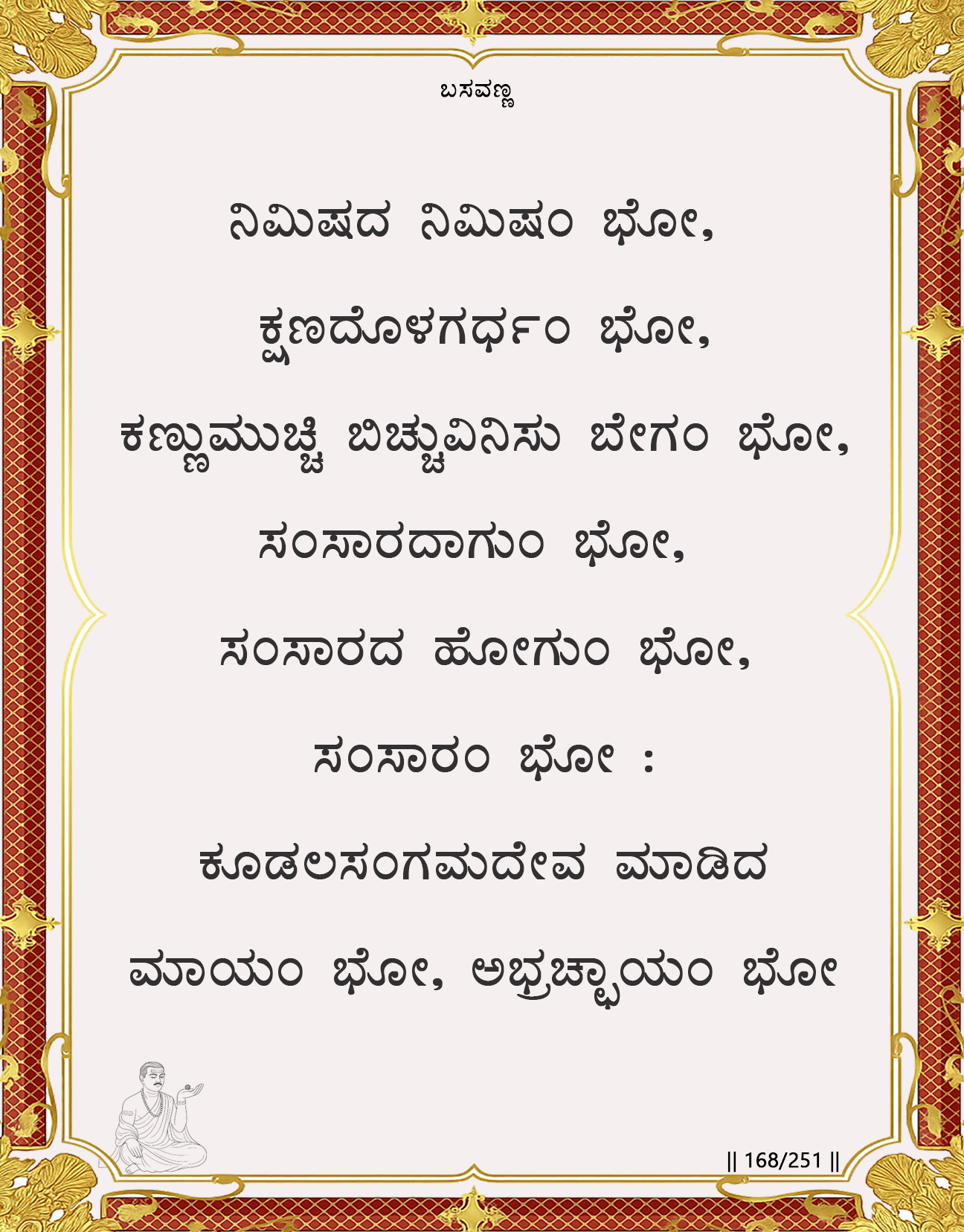
In a moment gone!
In half a breath gone!
Eyes close and open and the world turns to dust.
Rising, falling, grasping, losing
all is the shimmer of the same mirage.
The wealthy man, the beggar, the learned, the fool
all dance upon the same fleeting cloud.
All this, a play of illusion,
the flickering stage of Koodalasangama’s cosmic theatre.
Look beyond the passing clouds
see the clear sky of the eternal within you.
Basavanna here speaks not with despair but with illumined detachment. He lifts the veil on the fragile theatre of existence life that begins, ends, and restarts in a breath. In these few lines, he compresses the cosmic truth: “Everything you see is movement, but you the seer are still.” When he exclaims, “Gone in half a breath!”, it is not the cry of a nihilist but the awakening of a seer who perceives the endless birth and death of moments within the infinite stillness of consciousness. The blink of an eye is the measure of creation and dissolution and yet, beyond that blink lies the eternal witness, the unmoving Shiva-consciousness (Chaitanya). Basavanna reminds us that worldly success and suffering are but cloud shadows they pass, but the sky remains unscarred. He teaches not renunciation of life, but realization within life: to act, serve, love, and create, all while knowing their impermanence.
Spiritual Context
Core Spiritual Principle: The Standpoint of the Substratum (Adhishthana). Liberation is achieved by shifting one’s identity from the objects of consciousness (which are transient) to the conscious ground (chit) itself (which is eternal). This is the essence of atma-vichara (self-inquiry) within the Lingayoga tradition.
Cosmic Reality Perspective: This is a non-dual exposition of Shiva-Shakti. Shakti is the dynamic, creative power that manifests as the entire play of impermanent formsthe “flickering stage.” Shiva is the silent, unchanging consciousness that is the screen for this projection. Realization is seeing that the play is the Divine in motion, while abiding as the motionless Divine principle.
Historical Reality (Anubhava Mantapa Context): This vachana provided the metaphysical foundation for the Sharanas’ radical social equality. If a king and a pauper are both “dancing on the same fleeting cloud,” then caste hierarchy is the ultimate illusion. This understanding dismantled attachment to social status, freeing individuals to relate from the level of the shared, eternal Self (Anga) rather than temporary, worldly roles.
Interpretation
“Eyes close and open and the world turns to dust.” This is a microcosm of the cosmic cycle of projection (srishti) and dissolution (laya). Each moment of perception is a creation; each moment of forgetting or sleep is a dissolution. The seeker is invited to notice this cycle in the immediacy of sensation.
“The shimmer of the same mirage.” This phrase collapses duality. Pleasure and pain, success and failure, are not opposites but different textures of the same insubstantial appearance. To seek one and avoid the other is to chase a mirage.
“The flickering stage of Koodalasangama’s cosmic theatre.” The stage itself is divine. Impermanence is not a flaw but the essential nature of the divine play. The goal is not to stop the play but to know yourself as both the actor and the eternal space in which the performance occurs.
Practical Implications: All spiritual practice becomes a means of de-hypnotization from the content of experience to the context of awareness. Meditation is the sustained “looking beyond the clouds” to abide as the “sky.”
The Cosmic Reality
Anga (Human Dimension): The human is a momentary configuration of elements, thoughts, and social labelsa specific, fleeting pattern in the cosmic dance. It is the “cloud” with a recognizable form.
Linga (Divine Principle): The Linga is the boundless, formless space of awarenessthe “sky.” It is the unmoved witness, the silent background that contains and permits all movement without being altered by it.
Jangama (Dynamic Interaction): This is the liberated relationship between the Anga and the Linga. It is the human being who, while appearing as a cloud, operates from the knowing of being the sky. This results in action that is compassionate yet detached, engaged yet free.
Shata Sthala
Primary Sthala: Aikya. The final instruction” see the clear sky of the eternal within you” is the definitive marker of the Aikya stage. This is not intellectual understanding but abiding identity. The seeker has stabilized as the witnessing consciousness, untouched by the play of forms.
Supporting Sthala: Pranalingi. To reach this point, one must have mastered awareness of the most fundamental vibration of life: the breath (prana). The Pranalingi has merged their awareness with this life-force, and from that intimate vantage point, can now see its transient nature and leap to the still source from which it arises.
Practical Integration
Arivu (Awareness Practices): Practice “gap awareness.” In meditation, pay attention to the space between thoughts, the stillness after an exhale and before an inhale, the silent moment after a sound ends. These are direct tastes of the “sky” behind the “clouds.”
Achara (Personal Discipline): The discipline is to consciously de-identify. When strong emotions or solid identities arise (“I am successful,” “I am hurt”), silently add: “…and this too is a passing cloud in the sky of my awareness.”
Kayaka (Sacred Action): Perform all action as an offering into the eternal. Do your work impeccably, knowing the results will dissolve “in a moment.” This brings immense focus and freedom from anxiety.
Dasoha (Communal Offering): Offer the gift of presence that sees beyond roles. Treat everyone the powerful and the marginalized with the same reverence, recognizing the same eternal sky within their temporary cloud-form.
Modern Application
“The Tyranny of the Temporary.” Modern life is an accelerated chase after fleeting experiences, status updates, and material gains, mistaking this flux for reality itself. This leads to burnout, existential anxiety, and a profound sense of groundlessness.
This vachana is the ultimate antidote to stress and the fear of missing out (FOMO). It teaches how to find profound peace and stability not by securing the temporary, but by rooting oneself in the permanent. It allows one to engage fully in life to build, create, and love without the suffering that comes from clinging, because one is anchored in that which “outlives them all.”
Essence
The world is a story written on water,
read in the brief light between two blinks.
Don’t clutch the flowing script and weep.
Be the still, deep lake below,
where the tale is told,
and untold.
This vachana articulates the principle of Consciousness as the Absolute Frame of Reference. In physics, all motion is relative to a frame of reference. Basavanna posits that all experienceall “motion”is relative to the frame of pure Consciousness. Suffering is the result of adopting another transient event within the frame (a thought, a feeling, a social role) as one’s reference point. Liberation is correcting this error and establishing the frame itself as one’s identity.
You are the movie screen. The dramas of life the romances, tragedies, and adventures are the movies projected onto it. If you identify with a character in a movie, you will experience all its joys and sorrows. But if you remember you are the screen, you can enjoy the entire show without ever being scratched, burned, or changed by what plays out. Basavanna says: Remember you are the screen.
This speaks to the deepest human longing for something permanent, reliable, and true in a world of constant change and loss. It points to the resolution of that longing not outside in an eternal object, but inside as the eternal subject the one who is aware of the loss, change, and longing itself. It is the discovery of the deathless within the heart of mortality.

Views: 9