

Summary
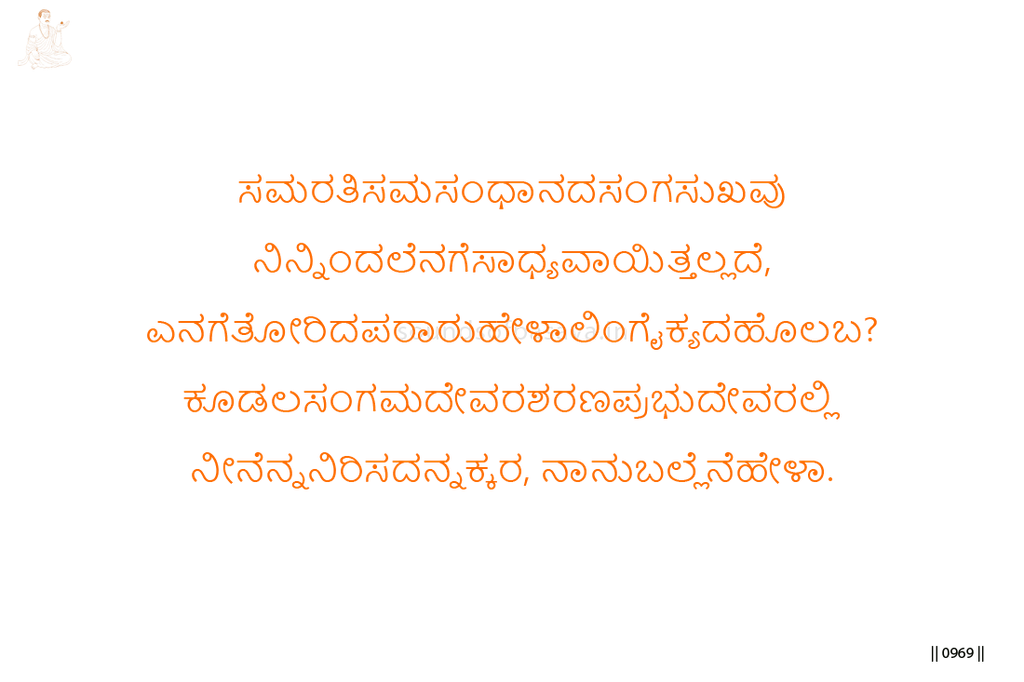
Basavanna says that Samarati, Samasandhana, and Sangasukha became possible for him only through Kudalasangama Deva. Equal love, inward union, and the bliss of sacred togetherness are not claimed as his own achievement. They are received through grace.
He then asks who else could have shown him the path of Linga-Aikya. The answer is contained in the question itself: no one else. If Kudalasangama Deva had not placed him in the refuge of Prabhudeva, the Lord’s Sharana, Basavanna says he would not have known. The vachana is therefore a confession of indebtedness to Divine grace and living Sharana-guidance.
Imagery & Symbolic Relevance
The first image is Samarati. This points to equal love or inward harmony that does not arise from ordinary preference. Basavanna says this became possible only through Kudalasangama Deva.
The second image is Samasandhana. This is the joining or inward unification through which separation is brought into sacred relation. It is not produced by self-effort alone; it is shown and made possible through grace.
The third image is Sangasukha, the bliss of sacred togetherness. The joy here is not private pleasure. It is the bliss that arises when the seeker is brought into living relation with Linga-Aikya.
The fourth image is the path of Linga-Aikya. Basavanna does not say that he discovered this path by himself. He asks who else showed it to him, making clear that the path was revealed, not invented.
The fifth image is being placed in Prabhudeva. Prabhudeva is not mentioned as an ornament or example. He is the living Sharana through whom the path becomes knowable. Without being placed in that refuge, Basavanna says he could not have known.
The final movement is the repeated question: “Tell me.” This is not uncertainty. It is devotional emphasis. Basavanna places the whole realization before Kudalasangama Deva and acknowledges that the bliss of Linga-Aikya came through Him alone.
Lingayoga
In Lingayoga, this vachana teaches that union is not self-achieved. Samarati, Samasandhana, Sangasukha, and the path of Linga-Aikya arise through Divine grace and through the living guidance of the realized Sharana.
For Sharana Sthala, the practice-point is humility before the source of realization. The seeker must not claim the bliss of union as personal attainment. When the path is shown through Prabhudeva and made possible by Kudalasangama Deva, the only true response is grateful recognition.
Editorial Commentary
The emphasis of this vachana is not on describing Linga-Aikya as a doctrine, but on acknowledging how it was made known. Basavanna names the states of harmony and bliss, then immediately places their source in Kudalasangama Deva and Prabhudeva. The teaching should therefore remain centered on grace, transmission, and gratitude.
Related Vachana
Supporting Vachana
Pranalingi Sthala Vachana 928 — The Measureless State
Pranalingi Vachana 928 supports this teaching by showing that Samarati, Samakale, Samasukha, and Svānubhāva cannot be measured by ordinary judgment. Their truth belongs to lived realization, and Guru is the touchstone through whom such measureless states are rightly known. This prepares Vachana 1385 directly. In Vachana 928, subtle inward states require Guru-guided recognition; in Vachana 1385, Basavanna says that the bliss of Linga-Aikya became possible only through Kudalasangama Deva and through being placed in the refuge of Prabhudeva.
Advancing Vachana
Aikya Sthala Vachana 930 — The River of Equality
Aikya Vachana 930 advances this teaching by showing the fruit of Linga-worship as Samarati, Samakale, and Samasukha, fulfilled in the image of one river merging into another. In Sharana Vachana 1385, Basavanna acknowledges that the bliss of Linga-Aikya was shown to him through Kudalasangama Deva and Prabhudeva. In Aikya Vachana 930, that shown path becomes the fulfilled state of worship, where separation dissolves like river joining river. Thus the Sharana-stage gratitude for the revealed path advances into Aikya as the lived fruit of equality, harmony, and indivisible union.
