

Summary
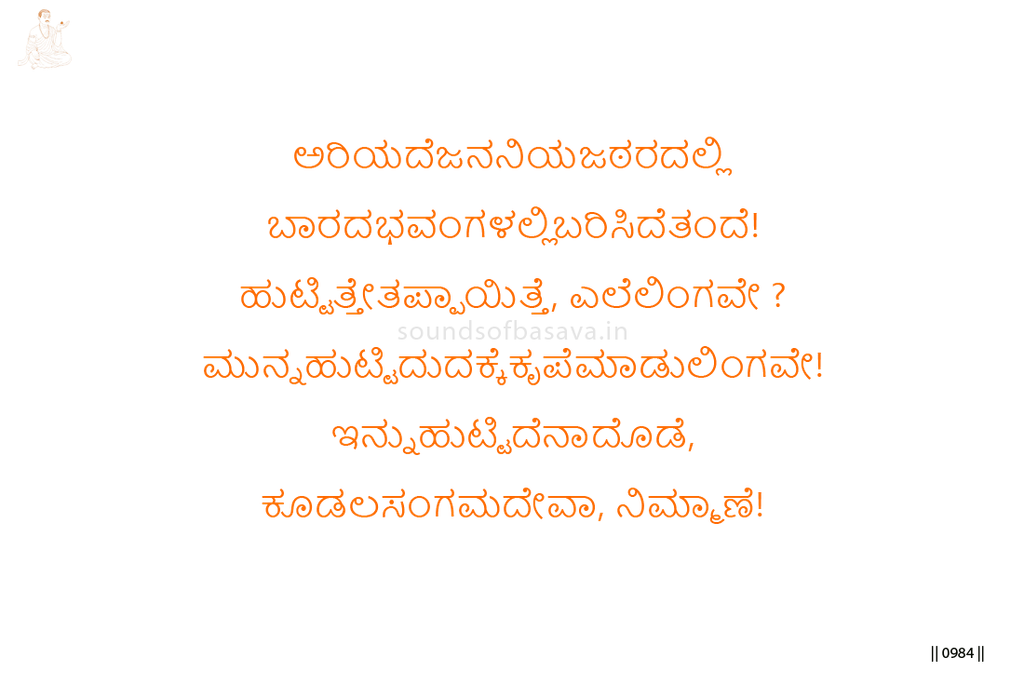
Basavanna turns from the visible burden of becoming to its unseen source. He says that, without knowing, becomings have arisen within the womb. The concern is not only what has already appeared in life, but the hidden place where arising begins before it is clearly seen.
The speaker does not deny participation in what has arisen. He acknowledges the fault and turns to the Linga for grace over what has already been born. The movement then becomes sharper: he does not merely ask for correction of past arising; he prays that no further such birth should occur.
This is the Aikya movement of cessation. The Aikya source states that the vachana moves from consequence to origin, and that the Anga no longer seeks only to correct what arises, but prays for the ending of arising itself before Kudalasangama Deva.
Imagery & Symbolic Relevance
The opening word “unknowing” gives the first movement of the vachana. Becoming has not arisen through clear seeing. It has arisen in the absence of awareness.
The “womb” is the central image. The source explains that the womb signifies the unseen ground where forms begin before they are known. The image therefore points to origin, not merely to outer birth.
The phrase “becomings that need not have come” shows that what arises is not always necessary or liberating. Basavanna is concerned with formations that bind because they arise without seeing.
The address “Father” places this confession before Kudalasangama Deva. The speaker does not analyze the condition from a distance. He brings the hidden arising directly before the Lord.
The line “it was born; it became fault” marks responsibility. The source clarifies that this does not assign blame in a harsh sense, but recognizes participation in what has formed. The speaker does not deny that what has arisen has passed through him.
The address to “Linga” turns the confession into prayer. The speaker does not remain with fault alone. He asks the Linga to meet what has already appeared.
The request for grace upon what was previously born is the next movement. Basavanna does not say that the past can be erased by denial. What has already arisen must be brought under grace.
The final prayer, “if anything more is born, O Kudalasangama Deva, it is Your vow,” gives the closing force of the vachana. The source explains that the prayer for “no more birth” points not merely to outer cycles, but to the end of inner formation, where the movement that gives rise to identity ceases.
Together, the images move from hidden arising, to acknowledged fault, to grace, and finally to the prayer that the source of further becoming may be stilled.
Lingayoga
In Lingayoga, this vachana teaches inward attention to the source of arising. The seeker is not asked merely to manage what has already appeared. The deeper movement is to see where becoming begins before it takes form.
The practice-point is direct: what has already arisen must be placed before the Linga for grace, and the source of further arising must be surrendered to Kudalasangama Deva. The source states that this marks a profound turning, where the Anga no longer addresses only what has appeared, but seeks the stilling of the source from which appearance arises.
Editorial Commentary
This vachana should be read as a prayer of origin. Basavanna does not speak here of outward correction alone. He turns toward the hidden beginning of becoming and asks that what has already arisen be met by grace, and that no further binding formation arise.
Related Vachana
Supporting Vachana
Sharana Sthala Vachana 19 — The Śaraṇas’ Assurance
In Sharana Vachana 19, Basavanna says that weariness, burden, and suffering do not cease merely by being named; the body must bear the fruit of action. The turning point comes when Kudalasangama’s Sharanas arrive and say, “Do not fear,” and through that assurance life is restored. Aikya Vachana 21 carries this further inward: after the body bears what has already arisen and fear is removed, Basavanna turns toward the source from which becoming itself arises and prays that no more such becoming occur.
Advancing Vachana
Aikya Sthala Vachana 25 — The Ocean of the Self
Aikya Vachana 25 advances this teaching within Aikya Sthala itself. In Vachana 21, Basavanna prays for the stilling of the source from which further becoming arises. In Vachana 25, the Anga settles into a state where its movement is no longer governed by reaction, and Kudalasangama Deva is known as the only constant while passing disturbances leave no mark. The prayer for cessation in Vachana 21 thus deepens into the steadiness of Vachana 25, where responsiveness remains but reactivity dissolves.
