
Poetic Rendering

For the river, beauty is the
lotus opening its soft hands.
For the ocean, beauty is the rising wave,
silver-crested.
For woman, beauty lives in her
quiet virtue and grace.
For the sky, beauty is the cool,
moon-washed night.
But for the Sharana,
beauty rests in the three sacred lines of ash
drawn across the brow,
drawing the mind back home.
They whisper the ancient truth:
From the Source I came;
to the Source I return.
O Koodalasangamadeva,
this ash is no mere dust
it is remembrance made visible,
the fire of awakening resting lightly on the skin.
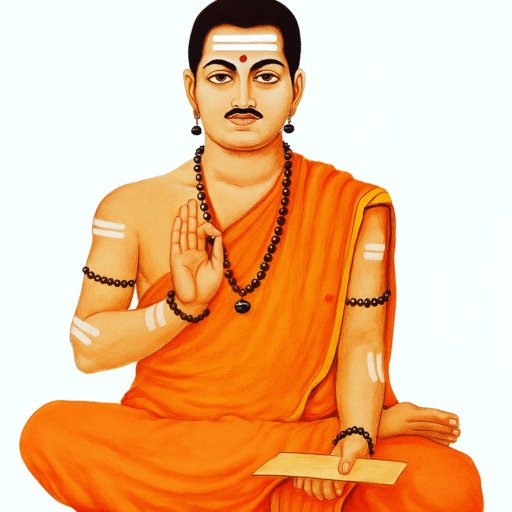
Basavanna contrasts natural and worldly forms of beauty with the highest beauty cherished by a Sharana: the sacred ash on the forehead. While rivers, oceans, the sky, and human beings each have their own expressions of beauty, the Sharana finds beauty only in the sign of inner realization. The three horizontal lines of ash (Tripuṇḍra) symbolize the burning away of ignorance, the dissolution of ego, and the recognition of one’s origin and destiny in the Divine. For the awakened one, ash is not ornament but revelationthe reminder that all returns to the Source, and that true beauty lies in this conscious return.
Spiritual Context
Core Spiritual Principle: Beauty as Alignment with Origin (Yatha-sthiti). True beauty (saundarya) is not aesthetic pleasure but ontological harmony. The most beautiful thing is that which most clearly expresses its true nature and origin. The ash is beautiful because it is the most accurate statement about the human condition: we are dust (bhasma) animated by divine breath, destined to return to that state, and our purpose is to realize that truth consciously.
Cosmic Reality Perspective: From the non-dual view, all the listed beauties are expressions of Shiva-Shakti (the lotus, the wave, grace, the moon). However, they are temporary, changing forms (vikara). The ash represents the foundational, formless substance (prakriti in its pure state) from which all forms arise and into which they dissolve. To see beauty in the ash is to see beauty in the fundamental process of creation and dissolution (Shiva’s dance) itself, not just in its transient manifestations.
Historical Reality (Anubhava Mantapa Context): This vachana established the vibhuti or bhasma as the central, democratizing insignia of the Lingayoga community. Unlike caste marks (tilaka) which denoted birth-based hierarchy, the ash was available to allmen, women, and all castesas a mark of spiritual intent and realization. It was a public declaration of identity that superseded and obliterated social markings, creating a visual unity among the Sharanas.
Interpretation
Contrasting Beauties: The river’s lotus, ocean’s wave, woman’s grace, and sky’s night are all beautiful effects. The ash is beautiful as a symbol of the cause the transformative fire of knowledge (jnana agni) that reduces all effects to their essential cause.
“Drawing the mind back home.” The forehead is the seat of the ego and the intellect. The horizontal lines literally draw a barrier across the ego’s forward-projecting, acquisitive energy, redirecting awareness inward (antar-mukha) and upward toward its source.
“The fire of awakening resting lightly on the skin.” This redefines the ash. It is not a morbid symbol of death but a vibrant symbol of the life that comes after the ego’s death. The “fire” is the burning away of illusions; the “ash” is the peace, wisdom, and lightness that remain.
Practical Implications: The daily application of ash is not a superstition but a profound psychological and spiritual recalibration. It is a mindful act of re-dedicating the body and mind to the path of return, a tactile reminder of one’s true nature amidst daily life.
The Cosmic Reality
Anga (Human Dimension): The Anga is the field upon which the sacred geometry is drawn. The marked body becomes a walking yantra (instrument), a constant reminder to itself and a declaration to the world of its intended destiny.
Linga (Divine Principle): The Linga is the source of the ashthe sacrificial fire of cosmic consciousness. It is both the origin (“From the Source I came”) and the destination (“to the Source I return”).
Jangama (Dynamic Interaction): Jangama is the living practice of being marked by the ash. It is the continuous, dynamic relationship between the individual (who remembers) and the symbol (that which reminds), ensuring that every interaction in the world is filtered through the awareness of return.
Shata Sthala
Primary Sthala: Sharana. The wearing of the sacred ash is the definitive external characteristic of a Sharana. It visually signifies one who has taken refuge and whose standard of beauty/value has been utterly transformed from worldly standards to the standard of divine remembrance.
Supporting Sthala: Aikya. The three lines often symbolize the dissolution of the three bonds (tripasha) of ego, karma, and maya. Their successful burning, represented by the ash, results in the state of Aikya. Thus, the ash is both the sign of the path (Sharana) and the symbol of the goal (Aikya).
Practical Integration
Arivu (Awareness Practices): When applying or touching the ash, mentally recite its meaning: “I am not this body; this body is ash. I am the eternal consciousness that wears it.” Use it as a trigger for moments of self-inquiry throughout the day.
Achara (Personal Discipline): The discipline is to wear the mark with understanding and humility, not as a social badge. It is a vow to live in accordance with the truth it represents with non-attachment and constant remembrance.
Kayaka (Sacred Action): Perform all actions with the awareness that the doer is transient (ash) and the action is an offering into the eternal fire. This brings detachment and purity to work.
Dasoha (Communal Offering): The shared ash creates a visible bond of community (sangha). It is a silent promise to recognize the same divine truth in every other marked forehead, fostering equality and mutual reverence.
Modern Application
“The Cult of Superficial Beauty and Permanent Identity.” Society is obsessed with preserving the appearance of the body (anti-aging, cosmetic enhancement) and cementing a fixed, personal identity (personal branding, rigid ideologies). This leads to a fear of aging, change, and death.
This vachana offers a radical redefinition of beauty and identity. Beauty is the graceful acceptance of transience. Identity is not a fixed construct to be defended, but a flowing process of return to Source. The ash is an antidote to vanity and a gateway to a profound, peaceful identity rooted in the eternal, not the temporal.na
Essence
The world paints its beauty on the leaf,
the wave, the face, the moon.
I wear mine in three simple lines
the quiet dust of a fire gone too soon.
A map traced where the self once burned,
a road for the soul that has finally learned:
All color fades, all form will flee.
This grey reminder sets me free.
This vachana outlines a Semiotics of Liberation, distinguishing between signs pointing to finite beauty and a sign pointing to the ultimate metaphysical referentinvolution and return. The three lines of ash (Tripuṇḍra) are a mantric-yantric inscription. They are not just symbolic but energetic. Each line is charged with a specific Bīja (Bowis) energy’A’ (अ) for creation/beginning on the right, ‘U’ (उ) for preservation/sustenance in the center, and ‘M’ (म) for dissolution/return on the get together forming the silent, vibrating matrix of AUM. The ash is the tangible residue of the inner fire that has activated these seed-energies, burning the tri-fold illusion of ego, action, and world (tripuṭi) into the unified ash of consciousness. For the Sharana, wearing it is not marking the body but tuning it to the fundamental frequency of creation and return.
Imagine the body is a radio receiver. The world’s beauties are different radio stations playing complex songs. The three lines of ash are not a decoration on the radio’s surface; they are the precise, physical calibration of the tuner to one frequency the primal hum of the universe itself, the sound of “home.” The Sharana finds this single, clear signal more beautiful than any song, because it is the source from which all music comes and to which it returns.
This speaks to the tension between our love for the beautiful, fleeting forms of life and our longing for the eternal, the simple, the true. Basavanna does not deny worldly beauty, but reveals a higher beauty: the conscious, energetic alignment with the cycle of return. The ash resolves the fear of death by transforming the symbol of mortality into a charged, living emblem of spiritual life a wearable reminder that we are not static beings, but dynamic processes of sacred sound and energy, perpetually flowing from and back to the Source.

Views: 32