
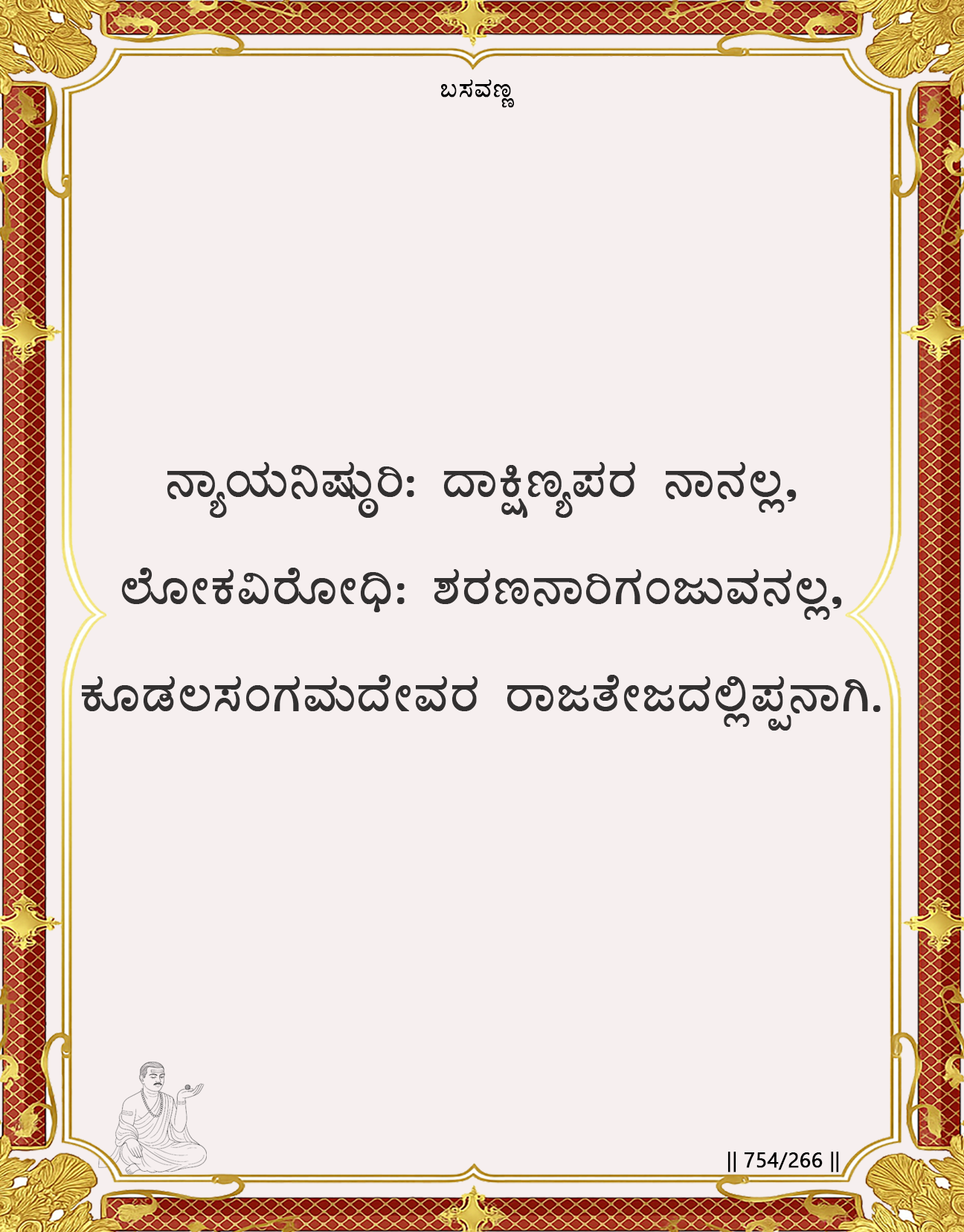
Poetic Rendering

He who speaks harshly, even if wise, knows not the warmth of compassion.
He who quarrels with the world, no matter his piety, has not tasted the sweetness of surrender.
The true Sharana dwells not in anger or argument, but in the serene splendor of Koodalasangama’s grace where judgment dissolves into mercy,
and the heart shines brighter than a thousand suns of knowledge.
This vachana serves as a litmus test for authentic spirituality, distinguishing between external religiosity and internal realization. Basavanna asserts that intellectual knowledge and ritual piety are spiritually worthless if they are not accompanied by a fundamental transformation of one’s character specifically, the replacement of harshness with compassion and conflict with peace. He defines the true Sharana not by what they know or what rituals they perform, but by their state of being: a serene, compassionate presence that is the natural radiance of a heart united with the divine grace of Koodalasangama. This is a call from a religion of dogma to a spirituality of being.
Spiritual Context
Core Spiritual Principle: Ontological Ethics. Ethics are not a separate set of rules but the inevitable expression of a transformed consciousness. If harshness and quarrel remain, it is proof that the heart has not yet been fundamentally restructured by divine grace, regardless of intellectual or ritual accomplishments. Compassion and peace are not virtues to be added but signs of the Linga’s presence within.
Cosmic Reality Perspective: From the non-dual view, the Divine is Satchidananda (Existence-Consciousness-Bliss). Harshness and conflict are contractions of this expansive, blissful consciousness. They are signs of identifying with the separate, threatened ego. The “serene splendor of Koodalasangama’s grace” is the experience of one’s true nature as that non-dual bliss. To dwell there is to radiate its qualities naturally, as the sun radiates light.
Historical Reality (Anubhava Mantapa Context): This vachana was essential for maintaining the integrity of the Lingayoga community during vigorous debate and social reform. It prevented scholars from using knowledge as a weapon and ascetics from using piety as a cudgel. It ensured that the revolution was conducted with a compassionate heart, not just a polemical mind. It was a check against the movement itself becoming another source of dogma and conflict.
Interpretation
“Even if wise… no matter his piety…” This severs the assumed link between knowledge/practice and realization. It states that realization has its own independent signature: a gentle, unified consciousness. One can be a brilliant theologian or a rigorous ascetic and still be fully identified with the ego.
“The sweetness of surrender.” Quarrel with the world stems from the ego’s resistance to what is. Surrender (prasada) is the dissolution of that resistance, leading to an inner “sweetness” or peace that makes conflict unnecessary and foreign.
“The heart shines brighter than a thousand suns of knowledge.” This establishes the hierarchy of spiritual faculties. The illuminating power of a heart united with the Divine (hrdaya-jyoti) surpasses all intellectual illumination (buddhi-jyoti). It is the light of being, not of knowing about being.
Practical Implications: Spiritual practice must include the cultivation of relational qualities. Meditation and ritual are incomplete if they do not result in kinder speech and more patient, less quarrelsome interactions. The quality of relationship becomes a primary gauge of spiritual depth.
The Cosmic Reality
Anga (Human Dimension): The Anga is the instrument through which grace becomes audible and visible. Harsh speech is a malfunction; compassionate speech is the instrument playing its true note.
Linga (Divine Principle): The Linga is the “serene splendor” itselfthe source code of compassion and peace. It is not a being that has compassion; it is compassion-consciousness.
Jangama (Dynamic Interaction): Jangama is the process of the Anga’s tuning. It is the lifelong practice of letting the Linga’s serenity recalibrate one’s reactions, transforming harsh retorts into compassionate responses and quarrelsome energy into peaceful discernment.
Shata Sthala
Primary Sthala: Sharana. The true mark of a Sharana is this embodied compassion and peace. The vachana suggests that if one claims refuge but remains harsh and quarrelsome, the refuge is superficial. The Sharana stage is where the theoretical acceptance of the path becomes the practical transformation of personality.
Supporting Sthala: Aikya. The radiant, non-dual consciousness described is the fruit of Aikya. In that state, there is no “other” to be harsh toward or to quarrel with. All is experienced as the Self. Thus, the behavior described is both the practice leading to Aikya and the natural expression of having attained it.
Practical Integration
Arivu (Awareness Practices): Practice mindful speech. Before speaking, pause to feel the tone and intent in the heart. Is it contracting in judgment (harshness) or expanding in understanding (compassion)? Use this pause to let the “serene splendor” of the Linga inform the response.
Achara (Personal Discipline): The discipline is to adopt a vow of ahimsa (non-harming) in speech and mental attitude. When the impulse to quarrel arises, turn it into an inquiry: “What in me feels threatened? Can I surrender this feeling to Koodalasangama?”
Kayaka (Sacred Action): Let your work be a field for practicing compassionate engagement. Deal with colleagues, clients, and challenges not as adversaries but as aspects of the divine play, responding with clarity infused with mercy.
Dasoha (Communal Offering): Offer the gift of a peaceful presence. Be a calming, unitive force in community discussions. Praise compassionate action over winning arguments. Make the community a safe space where the heart’s radiance is valued above intellectual victory.
Modern Application
“The Ideology of Righteous Anger and Toxic Debate.” Our culture often glorifies harsh, confrontational speech under the banners of “truth-telling,” “clapbacks,” and ideological warfare. Online and offline discourse is characterized by quarrel, cynicism, and a lack of compassionate listening, even within spiritual and wellness circles.
This vachana is a radical call for a spirituality of integration and kindness. It challenges the notion that one can be “spiritually correct” but interpersonally cruel. It asserts that true wisdom and power manifest as unshakable compassion and a refusal to engage in the ego’s wars. In a hyper-critical world, to become a non-quarrelsome, gentle presence is a revolutionary and healing act.
Essence
The scholar’s knife can cut the knot,
the ascetic’s will can bend the steel.
But if the heart remembers not
the warmth that other hearts can feel,
then all their light is just a spark
that dies in self-made, barren dark.
But one who lets the Grace descend
finds every quarrel has an end,
and in that peace, a light is born
to greet the sun of every morn.
This vachana outlines The Thermodynamics of Spiritual Realization. Knowledge and ritual piety represent the potential energy of a system. Compassionate being represents the kinetic energythe energy actually doing the work of transformation in the world. A system can have high potential (great learning, strict practice) but zero kinetic energy if it is locked in the frozen state of ego (harshness, quarrel). Grace is the heat that melts the ego, converting potential into the kinetic energy of loving action. The “heart shining brighter” is the system radiating the warmth of that conversion.
Imagine two cups. One is beautifully engraved with all the scriptures (knowledge) and made of the finest ritual metal (piety), but it is empty. The other is a simple clay cup, but it is full of cool, clear water (compassionate grace). In the desert of life, which cup truly matters? Basavanna says: Don’t just polish the empty cup. Find the spring and fill it. Then, your very presence will be a refreshment to the world.
This speaks to our universal experience of being wounded by harsh words and drained by conflict, and our profound appreciation for genuinely kind, peaceful people. We instinctively trust the compassionate heart over the combative intellect. The vachana validates this instinct as a spiritual compass: the quality of a person’s being is the ultimate testament to their spiritual truth. It reminds us that we are not here to win debates, but to become a sanctuary.

Views: 15