Poetic Rendering

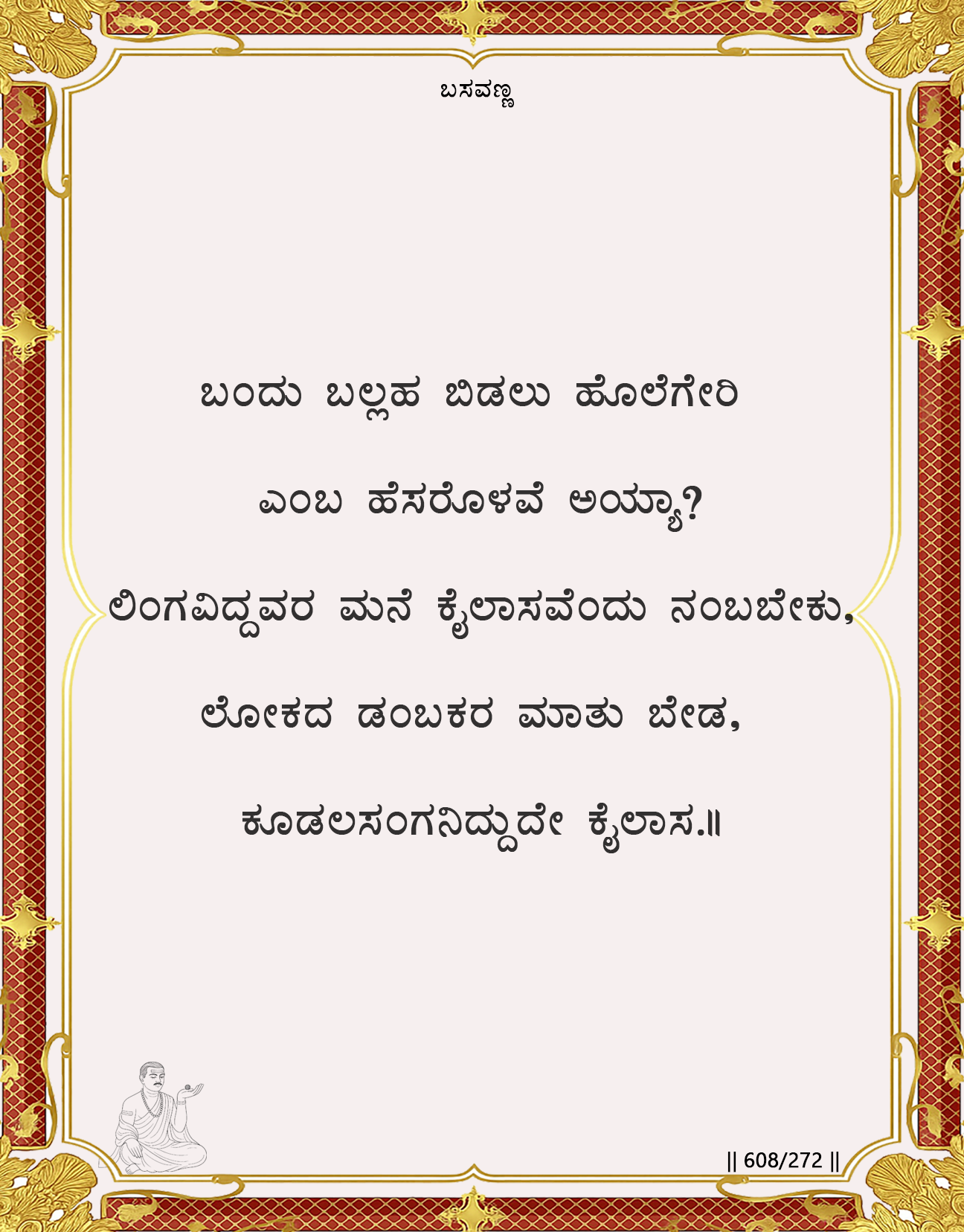
Why question the worth of one
who has turned from worldly ties
and offered his heart to Koodalasangama?
Even if he was born in a
house the world calls “low,”
what weight does lineage carry
before the radiance of devotion?
Where the Linga is worshipped
with a mind washed clean in love,
that very place becomes Kailasa
not a mountain far away,
but the heaven revealed within.
Set aside empty talk of caste, purity, or place.
Where awareness of Koodalasangama awakens,
where the soul bows in truth
there, the gates of Kailasa open.
In this vachana Basavanna declares that spiritual worth is not determined by caste, birth, or social standing. One who has turned wholeheartedly toward the Divine is beyond such worldly measures. Kailasa, the supreme spiritual realm, is not a distant location but the inner state that arises wherever the Linga is worshipped with purity of heart. All external distinctions fade before true awareness. Thus, Basavanna dismantles social and ritual hierarchies, affirming that heaven is realized within through devotion, sincerity, and inner awakening.
Spiritual Context
Core Spiritual Principle: Ontological Equality through Divine Refuge. The only valid identity is spiritual identity. By taking refuge (sharanagati) in the Linga, one is reborn into the “caste of consciousness” (lingaja), where the old marks of birth are erased. The inner experience of divine love (prema) and awareness (jnana) becomes the sole measure of a person, making external social metrics not just irrelevant but spiritually obstructive.
Cosmic Reality Perspective: From the non-dual view, all is Shiva. Caste is a superimposition (adhyasa) on this unity, a fundamental error of perception. Kailasa is the experiential state of abiding in this unified reality. To see a “low” or “high” birth is to see a division in the indivisible. The awakening to Koodalasangamadeva is the correction of this error, revealing the divine substratum in all beings.
Historical Reality (Anubhava Mantapa Context): This was the theological bedrock for the casteless society of the Lingayoga community. In direct opposition to the Brahminical varna system, it stated that devotion, not birth, qualified one for spiritual leadership and community respect. It empowered saints from so-called “untouchable” castes (like Dohara Kakkayya) and women (like Akka Mahadevi) as spiritual authorities, embodying the truth that Kailasa opens within anyone, anywhere.
Interpretation
“What weight does lineage carry before the radiance of devotion?” This rhetorical question asserts a new hierarchy of value. The “radiance” (tejas) of inner awakening has a metaphysical weight that makes the social construct of lineage feel weightless, like dust in sunlight.
“With a mind washed clean in love…” The purifying agent is not ritual water but love (prema). This love dissolves the mental stains of ego and social prejudice, preparing the inner space for revelation.
“Set aside empty talk of caste, purity, or place.” This is a direct command to the community. These topics are “empty talk” (prapancha) because they pertain to the unreal, constructed world, distracting from the real work of inner awakening.
“Where the soul bows in truth there, the gates of Kailasa open.” The “bow” is the total surrender of the ego, including its social persona. Truth (satya) here is the recognition of one’s divine essence beyond all roles. This bowing is not subjugation but the key that unlocks the inner gate.
Practical Implications: Spiritual practice involves actively de-identifying from social conditioning and seeing oneself and others primarily as consciousness on the path. Community life must be organized around this principle, where respect is accorded based on spiritual maturity, not worldly status.
The Cosmic Reality
Anga (Human Dimension): The Anga is the site of transformation. Its socially imposed “low” or “high” status is a costume. The true Anga is the conscious being capable of devotion, which is universal and status-less.
Linga (Divine Principle): The Linga is the great equalizer. It accepts the worship of any sincere heart, oblivious to and unconcerned with the social markings on the worshipper’s body. Jangama (Dynamic Interaction): Jangama is the living proof and process. It is the transformed individual who walks as a sharana, and the community that interacts based on this new, sacred identity. Their very existence validates the vachana’s truth.
Shatsthala
Primary Sthala: Sharana. This vachana is the manifesto for the Sharana stage. To become a Sharana is to publicly renounce the authority of caste and birth, taking refuge in a identity defined solely by relationship to the Divine. The described stateof turning from worldly ties and worshipping with a pure mindis the lived experience of this stage.
Supporting Sthala: Aikya. The ultimate goal hinted at the opening of Kailasa’s gates within is Aikya. The social equality experienced in the Sharana community is a foretaste and necessary precondition for the full ontological unity realized in Aikya.
Practical Integration
Arivu (Awareness Practices): Meditate on your own identity. When thoughts of social superiority or inferiority arise, see them as passing mental formations. Anchor yourself in the awareness that witnesses these thoughts: “I am the awareness that wears these temporary identities.”
Achara (Personal Discipline): Consciously reject casteist or classist thoughts, language, and behavior. In your interactions, make a deliberate effort to see and honor the divine presence in every person, regardless of their social or economic background.
Kayaka (Sacred Action): Let your work be a statement of equality. Collaborate with and value people based on their skill, integrity, and consciousness, not their titles or lineage. Create equitable and respectful work environments.
Dasoha (Communal Offering): Build and support spiritual communities that are radically inclusive. Offer service and reverence based on wisdom and compassion, not social rank. Protect the community from the re-introduction of hierarchical thinking.
Modern Application
“Identity Politics and the New Caste Systems.” While old caste structures persist, new forms of hierarchy based on wealth, profession, education, or even “spiritual seniority” create division and alienation. We often judge our own and others’ worth by these external markers.
This vachana offers freedom from all identity-based suffering. It provides a way to find self-worth that is unshakeable because it is internal and divinely sourced. It calls for creating communities and societies where a person’s inherent dignity and conscious potential are the primary values, liberating human relations from the tyranny of manufactured status.
Essence
Why weigh the soul in scales of birth,
when love can melt the rocks of earth?
The house you’re born in, high or deep,
cannot contain the love you keep.
Where reverence turns the heart to flame,
the mountain and the seeker are the same.
Cast off the name, and step inside;
in your own heart, the gods abide.
This vachana presents Spiritual Realization as a Topological Transformation. Social hierarchy is a rigid, linear structure a ladder with fixed “high” and “low” positions. Spiritual awakening performs a topological operation, bending this ladder into a circle where every point is equidistant from the center (the Linga). From this new, non-linear perspective, the concepts of “high birth” and “low birth” lose all meaning, as all points on the circle are essentially the same in their relation to the center. The “gates of Kailasa” open at the center, accessible to any point on the circumference through the radial path of devotion.
Imagine society as a school with strict grades (1st, 2nd, 3rd caste). Basavanna says: Forget the grades. The real school is within you, and the final exam is your direct, loving awareness of the Principal (Koodalasangamadeva). When you pass that inner exam, you graduate. It doesn’t matter what grade you were in; all graduates are equal alumni of the same University of Consciousness. The diploma is the opened gate within your heart.
This speaks to our profound pain of being judged or valued for things we did not choose our ancestry, our appearance, our start in life. It also speaks to the unearned privilege that creates guilt or blindness. Basavanna offers a path to a self-esteem and a social order based on the only thing we truly own and can cultivate: the quality of our consciousness and the sincerity of our love. It replaces the anxiety of social positioning with the profound peace of being seen and valued for your essential, divine core.

Views: 10