Poetic Rendering

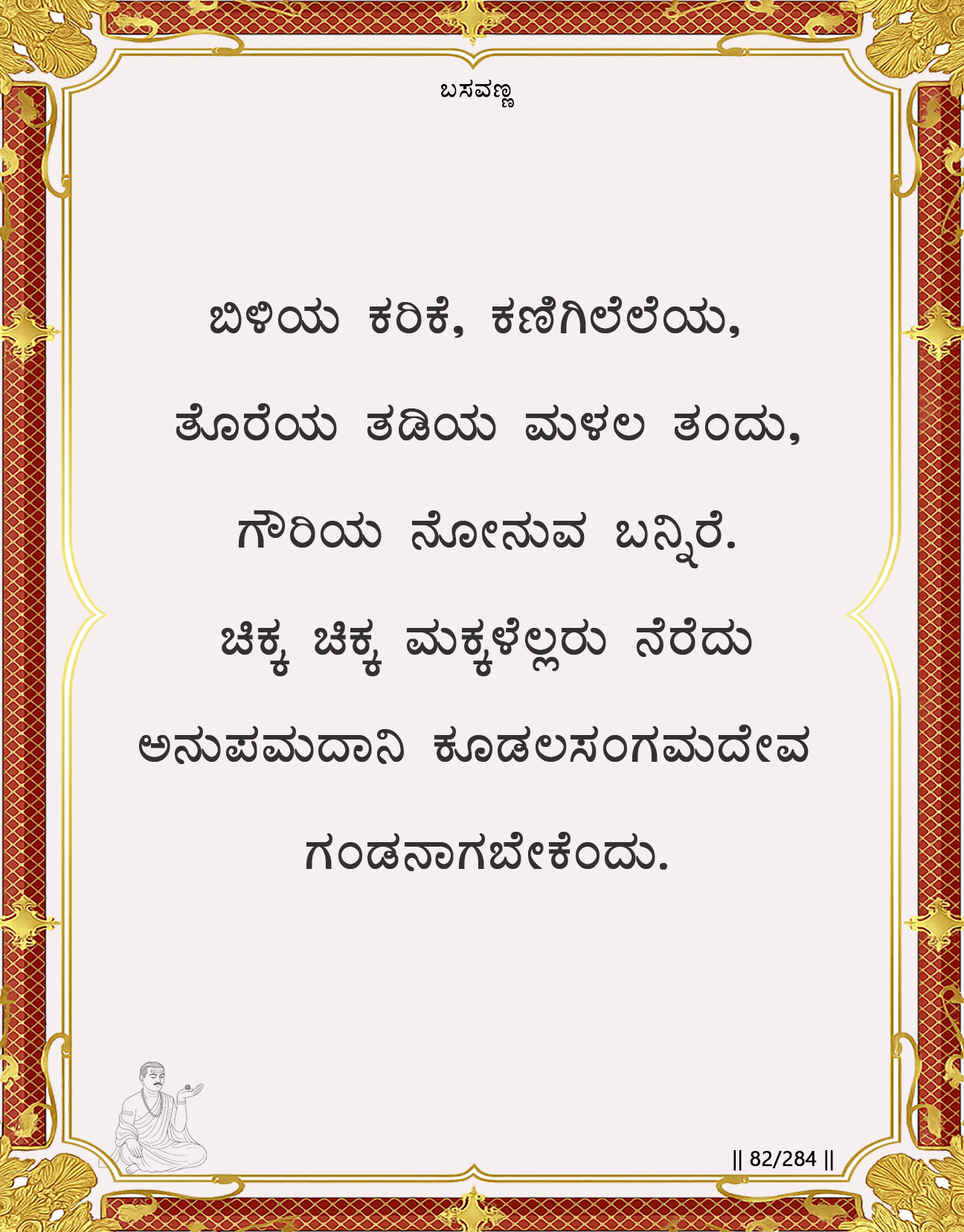
Bring the tender green stalks,
bring the white oleander blooms,
bring clear sand from the singing stream
let all be gathered,
as Gauri gathered her offerings
to adorn her Lord.
Step by step, leaf by leaf,
flower by flower,
let us prepare the inner altar,
that Koodalasangamadeva
may enter the heart
as the Bridegroom of our soul.
Basavanna recalls the traditional gathering of simple natural offerings green stalks, white oleander flowers, sand from a pure stream used by Gauri when she prepared herself for Shiva. These external items symbolize the inward gathering of virtues, purity, and devotion. The vachana shifts from physical ritual to inner worship: the true adornment of the Divine comes from cultivating inner qualities, not external decorations. The community of seekers is invited to prepare themselves as Gauri did, so that Koodalasangamadeva may dwell in the heart as the eternal, inner Bridegroom.
Spiritual Context
Core Spiritual Principle: The Alchemy of Preparation (Sadhana-Samskara). In Lingayoga, external ritual is not rejected but its purpose is redefined: it is a template for inner work. The true offering is not the flower but the devotion that gathers it; the true altar is not a physical space but the consciousness purified and arranged through deliberate practice.
Cosmic Reality Perspective: The myth of Gauri and Shiva represents the union of individual consciousness (Shakti) with universal consciousness (Shiva). Basavanna identifies the community of seekers with Gauri, emphasizing that every soul is the feminine principle (Shakti) whose innate purpose is to consciously prepare for and unite with its divine source. The “gathering” is Shakti organizing itself for this union. Historical Reality (Anubhava Mantapa Context): This vachana provided a Shivayoga reinterpretation of popular Shaiva devotional rituals. It redirected the community’s energy from costly, priest-mediated temple offerings to a personal, internalized worship using simple, accessible nature symbols. It elevated daily life and the natural environment into a continuous ritual of heart-preparation.
Interpretation
“Tender green stalks”: Symbolizes the fresh, growing virtues (Dharma) and the sprouting of new, tender awareness free from cynicism or rigidity.
“White oleander blooms”: Represents purity (Sattva) and the flowering of one’s inner offering despite external toxicity (oleander is beautiful but poisonous). It signifies offering one’s essence, transcending inherent flaws.
“Clear sand from the singing stream”: Denotes clarity (Vishada) and stability. The sand is purified by the flow of conscious living (the stream); it is the grounded, stable base upon which the altar is built.
“As Gauri gathered her offerings to adorn her Lord”: This establishes the paradigm. Adornment is not for embellishment but for joyous welcome. The seeker’s cultivated qualities “adorn” the Linga by creating a fitting, beautiful vessel for its manifestation.
“Step by step, leaf by leaf… prepare the inner altar”: Spiritual progress is incremental and holistic. Every thought (leaf), every emotion (flower), every perception (grain of sand) must be consciously gathered and offered. The altar is the integrated, purified consciousness.
“That Koodalasangamadeva may enter the heart as the Bridegroom”: The culmination is non-dual intimacy (Aikya). The Divine is not an external recipient but an indwelling presence. The prepared heart experiences not visitation, but unveiling.
Practical Implications: Every daily chore, every encounter with nature, can be seen as an opportunity to “gather” an inner quality. Walking becomes gathering clarity; gardening becomes cultivating tenderness; cleaning becomes purifying the heart’s space.
The Cosmic Reality
Anga (Human Dimension): The realm of effort, selection, and assembly. It is the stage of becoming, of actively shaping the raw materials of one’s character and perception into a coherent, inviting whole.
Linga (Divine Principle): The ever-present, ever-available Bridegroom. It does not need to be adorned but awaits the adornment of the heart as the sun awaits a clean window to shine through. It is the still, silent center that becomes dynamically present in a prepared space.
Jangama (Dynamic Interaction): The sacred activity of gathering and preparing. This is the love-in-action of Shakti yearning for Shiva. It is not a passive wait but an engaged, creative process that itself becomes the dance of union. The community collectively gathering is this Jangama on a macro scale.
Shata Sthala
Primary Sthala: Maheshwara. The vachana’s focus on meticulous, loving preparationthe symbolic ritual actaligns perfectly with the Maheshwara stage, where one engages wholeheartedly in devotional forms as a path to internalize divine qualities.
Supporting Sthala: Pranalingi. The intended outcome“ enter the heart as the Bridegroom” is the defining experience of the Pranalingi stage, where the Linga is felt as a living, breathing reality within one’s own life force, the culmination of successful preparation.
Practical Integration
Arivu (Awareness Practices): Practice “symbolic gathering.” During a walk, consciously pick up a leaf or stone as a physical symbol for an inner quality you wish to cultivate (e.g., a smooth stone for peace). Place it on your home altar as an offering, focusing on internalizing that quality.
Achara (Personal Discipline): Create a daily “inner altar preparation” ritual. Spend a few minutes reviewing the day ahead: what “green stalk” (new growth) will you nurture? What “oleander” (pure offering amid difficulty) will you make? What “clear sand” (stable, clear intention) will you establish?
Kayaka (Sacred Action): Let your work be the gathering. If you are a teacher, gather clarity to offer. If you are a healer, gather tenderness. See each task as collecting a specific element for the collective altar of your community’s consciousness.
Dasoha (Communal Offering): Organize a community ritual where each person brings a natural element representing an inner quality they are working on. Assemble them into a collective mandala or altar, verbally dedicating each offering as a step toward preparing the community’s heart for the Divine.
Modern Application
Spiritual Consumerism and Fragmentation. We often seek spiritual fulfillment by acquiring things books, courses, retreats or hopping between practices, without engaging in the sustained, subtle inner “gathering” and preparation of our own consciousness. Our inner space remains cluttered and unprepared, leaving us feeling perpetually unready for depth or transformation. This vachana prescribes Consciousness as Craftsmanship. It invites us to see our inner life as a sacred artisanal process. Each day, we intentionally gather the raw materials of our experience moments of patience, acts of integrity, glimpses of beauty and lovingly assemble them into a coherent, inviting inner sanctuary. This shifts spirituality from consumption to creation, making every moment a deliberate step toward making the heart a fit dwelling for the Divine.
Essence
Not for the temple floor, this gathered green,
But for the soil of the heart, unseen.
With every leaf of virtue gently laid,
A bridal chamber in the soul is made.
Till the Guest who has always been,
Steps forth from within, as Gauri’s kin.
This vachana describes the morphogenetic field of devotion. Just as Gauri’s archetypal act creates a pattern in the collective unconscious, the individual seeker’s repeated acts of inner gathering establish a subtle, patterned field within their own consciousness. This field gains coherence and potency until it reaches a critical threshold, at which point it perfectly matches the “frequency” of the Divine (the Bridegroom), causing a phase shift from seeking to indwelling the Linga “enters” because it recognizes its own pattern fully reflected.
Imagine tuning a musical instrument (the heart). Each act of virtue or devotion is a slight turn of the tuning peg (gathering a leaf or flower). The step-by-step process is meticulous. Only when the instrument is perfectly in tune does it become capable of resonating fully with the master note played by the Divine musician. The note was always there, but now the instrument can sing it back clearly.
We yearn not just to believe in the sacred, but to host it, to feel it as an intimate, indwelling reality. This requires active preparation of our inner being a cleaning, decorating, and making welcome that is the most profound work of a lifetime. The joy is in the gathering itself, the loving anticipation that transforms the gatherer into the bride.

Views: 5