
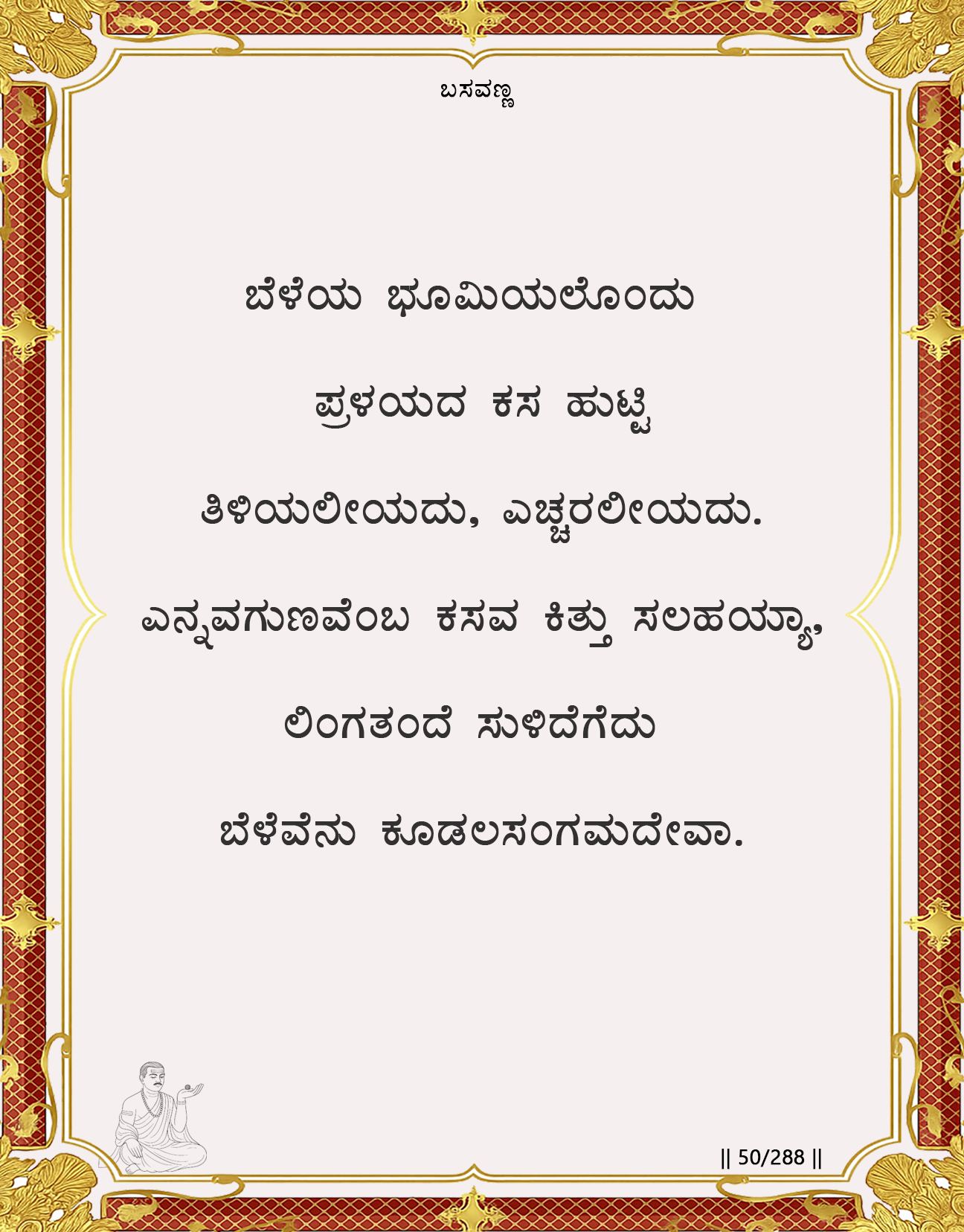
Poetic Rendering

In the soft, fertile field
even the hidden weed
takes root, grows tall,
and stands as if it belongs.
So too, in the tilled soil of this heart,
quiet faults sprout beneath the lushness
of whatever virtues I claim
growing unnoticed, undisturbed.
O Kudalasangama Deva,
You who see the seed in shadow,
the weed beneath the leaf
plough the field of my being.
Uproot these unseen tendencies,
clear the ground of what I cannot see,
and let only Your Linga,
the true harvest,
ripen within me.
Basavanna compares the inner self to a fertile field where weeds can grow unnoticed. Just as hidden weeds flourish beneath thriving crops, subtle flaws and unconscious tendencies arise even in a heart rich with virtue. These cannot be recognized or removed by one’s own effort alone. Only Kudalasangama Deva the divine knower of all seeds, pure or impure can till this inner field and uproot what the seeker cannot detect. True spiritual maturity, he teaches, comes from surrendering these hidden tendencies so that the harvest of divine realization may grow unhindered.
Spiritual Context
Core Spiritual Principle: Divine Discernment (Daiva-Viveka). In Lingayoga, self-purification has a limit. The final and most subtle layer of ignorance consists of samskaras so ingrained they are invisible to the egoic self. Ultimate cleansing requires surrendering to the Divine’s own discernment and allowing it to perform the surgery of grace.
Cosmic Reality Perspective: From the non-dual view, the “weed” is a latent configuration of Shakti (energy) that retains a self-oriented pattern. The “crop” is Shakti arranged in devotion-oriented patterns. Both arise in the same field of consciousness. Only Shiva, the conscious ground itself, can fully discern and re-pattern these energy configurations at their root. The “ploughing” is the forceful, graceful intervention of pure consciousness into the subconscious layers of individualized energy.
Historical Reality (Anubhava Mantapa Context): This vachana addressed the advanced practitioners within the Basavayoga community. After reforming overt social evils (caste, ritual pride), they faced the subtler “weeds” of spiritual pride, hidden hypocrisy, and unconscious bias. Basavanna directs them beyond personal willpower to the necessary stage of grace, preventing the stagnation of the revolution in a new form of subtle ego.
Interpretation
“In the soft, fertile field… the hidden weed takes root”: Spiritual practice softens and enriches the heart, but this very fertility also provides ideal conditions for subtle egoic patterns (like pride in one’s piety) to grow strong, “as if it belongs.”
“Quiet faults sprout beneath the lushness of whatever virtues I claim”: This is the central danger. Virtues (Dharma) can become the canopy under which their shadow opposites thrive compassion hiding possessiveness, discipline hiding rigidity, devotion hiding expectation.
“Growing unnoticed, undisturbed”: Because they are intertwined with the virtues, self-inspection (Swasamvedana) cannot easily distinguish them. The ego, pleased with the visible “lushness,” is undisturbed by the hidden corruption.
“You who see the seed in shadow”: This attributes to the Divine the power of total, non-dual perception. It sees the potential weed in the latent seed (Vasana) before it even sprouts, and sees its tangled roots within the mature crop.
“Plough the field of my being… Uproot these unseen tendencies”: The prayer is for a violent, gracious upheaval. Ploughing is not gentle weeding; it turns the entire soil upside down. This signifies a transformative crisis or deep insight that radically exposes and removes subconscious patterns.
“Let only Your Linga, the true harvest, ripen within me”: The goal is not a weed-free field but a monocrop of the Divine. The Linga is both the seed and the harvest. The self’s role is to become the clear field for this autonomous divine fruition.
Practical Implications: One must move from the mindset of “building virtues” to “preparing for grace.” Practice includes prayers of surrender that specifically ask for the revelation and removal of hidden faults, and the humility to welcome the upheaval this may cause.
The Cosmic Reality
Anga (Human Dimension): The cultivated but mixed field. It possesses agency in initial tilling and sowing but lacks the perspective to see its own depths. It is the realm of becoming, which inherently contains the duality of crop and weed.
Linga (Divine Principle): The pure, unmixed source and end. It is the totality of consciousness that contains no hidden seeds of ignorance. It is the only “harvest” of true value and the only power capable of ensuring its own growth.
Jangama (Dynamic Interaction): The grace of divine intervention. This Jangama is not guided by the Anga’s will. It is the Linga’s autonomous, intelligent action upon the Angathe plough, the wind, the fire that purifies the field so it may serve a single purpose.
Shata Sthala
Primary Sthala: Maheshwara. The practitioner at this stage has achieved a well-cultivated “field” through discipline and worship. The confronting awareness of hidden, persistent weeds marks a critical turning point in this stage.
Supporting Sthala: Prasadi. The heartfelt prayer for divine ploughing is the quintessential act of invoking Prasadi. This grace is the force that resolves the Maheshwara’s dilemma, purifying the subtle base to allow progression toward Sharana and beyond.
Practical Integration
Arivu (Awareness Practices): During meditation, practice “The Farmer’s Prayer.” After quieting the mind, actively invite the Divine to reveal what you cannot see. Say, “Show me the weed hidden beneath my favorite flower.” Sit in receptive silence, noting what thoughts, fears, or memories arise without judgment.
Achara (Personal Discipline): Implement “Shadow Hospitality.” When criticized or provoked, instead of defending yourself, ask: “Could this be pointing to a hidden weed?” Write down the critique and contemplate it as potential divine ploughing, not as an attack.
Kayaka (Sacred Action): In your work, dedicate one specific recurring challenge or friction point as the “field to be ploughed.” Ask for grace to see the hidden tendency (e.g., impatience, need for control) within it, and consciously surrender the outcome of that task to the Divine.
Dasoha (Communal Offering): Foster a community culture of “graceful weeding.” Create a confidential, compassionate practice where trusted companions, with permission, may lovingly point out potential “hidden weeds” they observe in each other’s behavior, always framing it as an observation for the other to offer in prayer, not as a personal correction.
Modern Application
The Cultivated Persona & Hidden Shadow. In self-help and wellness culture, we diligently cultivate a persona of positivity, productivity, and mindfulness. Yet, beneath this “lushness,” unseen weeds of performative virtue, repressed anger, or spiritual bypassing grow strong. We lack the tools to see these patterns, and our self-reflection often reinforces the persona, not pierces it.
This vachana teaches Prayer as Radical Self-Inquiry. It moves us beyond affirmations and into a surrender that asks for the disruption of our most cherished self-image. It means praying not just for peace, but for the upheaval that exposes our hidden hypocrisy. It suggests that true growth requires consenting to the divine plough welcoming crises, feedback, and dark nights of the soul as necessary acts of grace to uproot what we are too attached to see.
Essence
The field is soft, the crop stands high,
A pleasing sight to any eye.
Beneath, a root no hand can find
Draws secret poison from the mind.
I call the Ploughman of the Soul:
Turn the deep soil, make the broken whole,
And let what grows be Yours alone.
This vachana describes the quantum measurement problem in spiritual evolution. The seeker’s conscious mind (the classical observer) can only measure (perceive) the “crop” of overt virtues. The hidden weeds are like quantum super positions latent, unobserved tendencies that remain in a state of potent possibility until “measured” by a higher consciousness (the Divine). The prayer for divine ploughing is an invitation for that supreme consciousness to “collapse the wave function” of the subconscious, definitively observing and eliminating the latent negative patterns, leaving the field in a purified, classical state ready for a single divine outcome.
Imagine a garden monitored by a drone (the ego). It sees healthy plants (virtues) and reports “all is well.” Beneath the soil, however, root parasites (hidden faults) are spreading. Only the gardener (the Divine) who knows the soil’s history and has a deeper view can see the problem. The drone must alert the gardener and allow him to dig up the garden, trusting his deeper knowledge despite the temporary destruction of the beautiful surface.
We fear most the unseen places within ourselves the parts we sense but cannot clearly behold. Basavanna’s vachana offers relief: we are not responsible for seeing what lies beyond our sight. Our task is simply to admit our blindness and call upon the One who truly sees. Real courage is allowing the divine plough to turn over our inner field, even disturbing what we believe to be our finest achievements, so that a deeper harvest born of ultimate love can grow.
Humanity too is a vast field of consciousness. When technology, power, or religion grow without discernment, they become weeds choking compassion and harmony. Only when awareness tills this collective soil can true civilization, rooted in truth and ecological balance, take birth again.
Thus Basavanna speaks not only to the individual soul but to the entire planet guiding a form of planetary cultivation, where consciousness is the soil and love becomes the rain that renews life.

Views: 3