Poetic Rendering

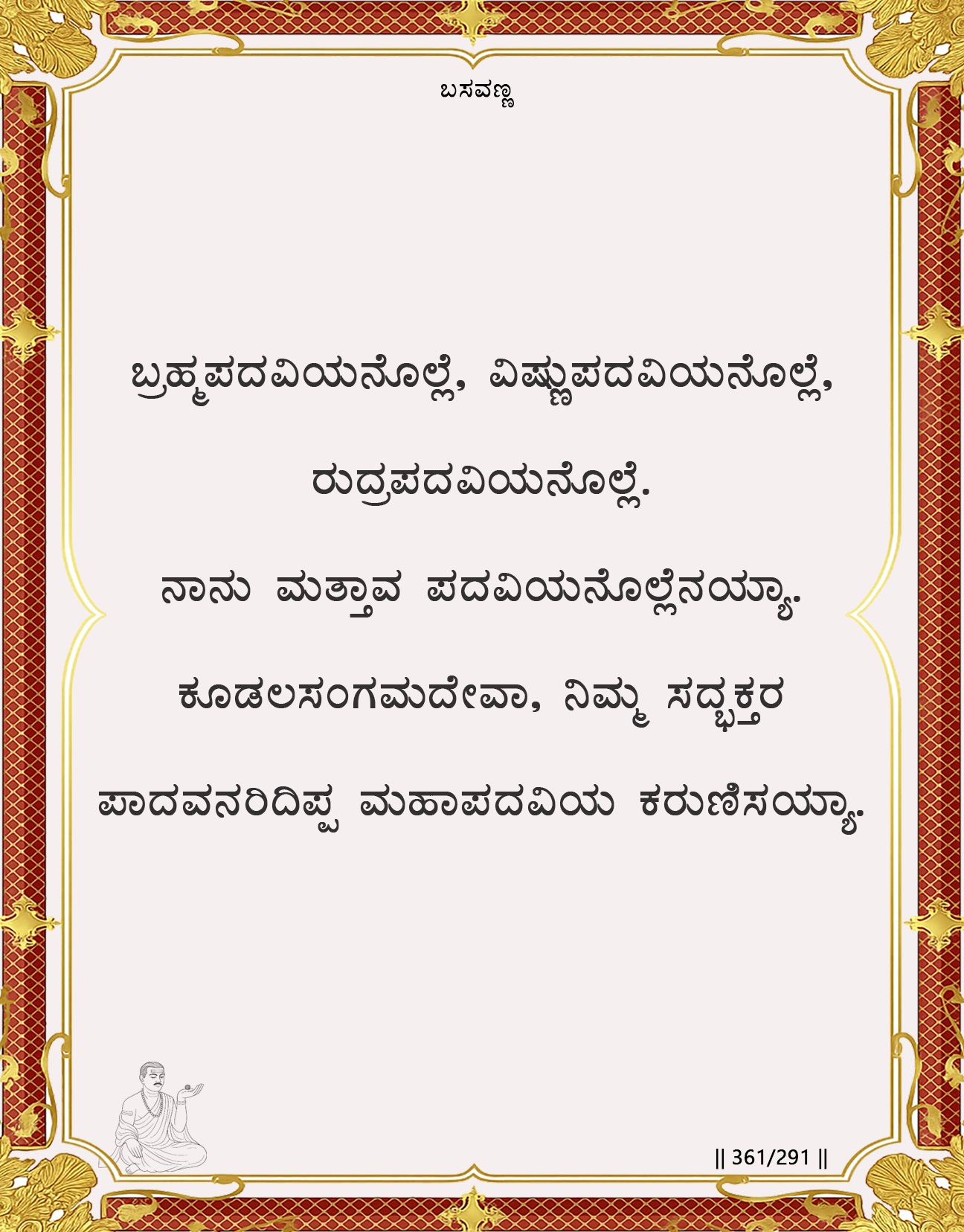
I do not long
for Brahma’s lofty seat of creation,
nor for Vishnu’s radiant realm of preservation,
nor for Rudra’s fierce throne
where worlds are dissolved.
These exalted stations,
bright with celestial power
I seek none of them, O Lord.
Give me instead
the lowly, wondrous place
where Your Sharanas walk
the dust that rises from their feet,
the kingdom of humility where the ego dies
and only Your light remains,
Koodalasangamadeva.
In this vachana, Basavanna rejects the greatest cosmic honors Brahma’s creative authority, Vishnu’s sustaining dominion, and Rudra’s transformative power. These thrones symbolize the highest ambitions of both worldly and spiritual ego: to create, to preserve, or to control existence itself. Basavanna declares that none of these divine seats compare to the simple, sacred dust at the feet of Shiva’s devotees. This dust represents radical humility, egolessness, and the lived presence of truth within the community of Sharanas. The vachana affirms that true sovereignty is not cosmic power but inner surrender. The real “kingdom” is found not above creation but beneath it in the grounded, luminous awareness shared with those who walk the path of the Divine. Basavanna’s renunciation is not escape but a profound reorientation: the highest throne is humility itself.
Spiritual Context
Core Spiritual Principle: Sovereignty in Surrender (Sharanagati). The highest spiritual attainment is not acquiring divine powers (Siddhis) or cosmic roles, but the voluntary relinquishment of all such ambitions in favor of humble association with the realized community. True power is found in powerlessness.
Cosmic Reality Perspective: From the non-dual view, Brahma, Vishnu, and Rudra are functional aspects (Trimurti) of the one Shiva-Shakti dynamics. To desire these roles is to desire a particular mode of manifestation, which still binds one to the relative realm. The dust of the Sharanas’ feet represents the formless essence from which all forms arise and to which they return the humble ground of being.
Historical Reality (Anubhava Mantapa Context): This vachana was a radical critique of the traditional Hindu aspiration for merging with or becoming a deity. In the Basavayoga community, where many came from priestly or warrior backgrounds accustomed to hierarchy, Basavanna redefines the pinnacle of success: not becoming a god, but becoming the dust under the feet of the devotees. This inverted the social and spiritual pyramid, making service and humility the highest virtues.
Interpretation
“Brahma’s lofty seat of creation… Vishnu’s radiant realm… Rudra’s fierce throne”: These represent the triple functions of the cosmic ego: the desire to create, control, and destroy. They are the ultimate extensions of the individual “I” projected onto the universe.
“I seek none of them”: This is the total renunciation (Tyaga) of spiritual materialism. Even the highest spiritual achievements are recognized as subtle traps that perpetuate the sense of a separate self.
“Give me instead the lowly, wondrous place where Your Sharanas walk”: The “lowly” place is the antithesis of the lofty thrones. It is the ground level, the place of service and insignificance. Yet it is “wondrous” because it is here that the ego dies and true wonder (divine presence) is revealed.
“The dust that rises from their feet”: Dust is the most humble substance, trodden upon, yet it is also the medium that carries the fragrance of the sacred. To be that dust is to be uplifted by the very act of being beneath, to be animated by the movement of the saints.
“The kingdom of humility where the ego dies and only Your light remains”: This defines the true “kingdom” (Rajya). It is not a realm to rule over, but an inner state where the ruler (ego) is absent, leaving only the illumination of the Divine.
Practical Implications: Spiritual aspiration should be directed not toward gaining powers or high status, even in the spiritual hierarchy, but toward cultivating genuine humility and seeking the company of those who embody egolessness. The test of progress is the decrease of self-importance.
The Cosmic Reality
Anga (Human Dimension): The faculty of desire and ambition. It can project itself onto the highest cosmic roles. Its transformation occurs when it desires its own annihilation to become “dust.”
Linga (Divine Principle): The “light that remains.” It is the immutable awareness that shines when the ego-construct is completely surrendered. It is the essence of all thrones but is not confined to any of them.
Jangama (Dynamic Interaction): The Sharanas’ walking. Their movement in the world is a dynamic expression of the Linga. The dust rising is the subtle, pervasive influence of their sanctity. To become that dust is to be in constant, humble motion with the divine movement, rather than sitting static on a throne.
Shata Sthala
Primary Sthala: Sharana. The explicit choice of the Sharanas’ dust over divine thrones is the hallmark of the Sharana stage taking refuge in the community of the awakened and valuing that association above all celestial achievements.
Supporting Sthala: Aikya. The result of this choice is the death of ego and the remaining of “only Your light,” which is the state of Aikya, non-dual union. Thus, the Sharana’s path leads directly to Aikya.
Practical Integration
Arivu (Awareness Practices): When desires for recognition, control, or importance arise (whether worldly or spiritual), consciously reframe them. Instead of wanting to be “Brahma” (the creator of your projects), aspire to be the “dust” that supports and invisibly enables the work of others. Meditate on the image of dust at the feet of saints.
Achara (Personal Discipline): Practice “dust-like” actions: perform helpful deeds anonymously, take on tasks that are menial or unnoticed, and deliberately choose the lesser role in collaborative efforts. Dedicate these actions to the Sharanas.
Kayaka (Sacred Action): In your profession, resist the lure of titles and positions of power. Instead, focus on the quality of service and the well-being of the community. See your role as supportive, not dominant.
Dasoha (Communal Offering): In the community, create rituals that honor humility. For example, have members take turns performing servile tasks. Celebrate those who consistently take the back seat, making their humility the new standard of honor.
Modern Application
The Cult of Personal Achievement and Spiritual Superstardom. Contemporary society, including spiritual circles, glorifies success, influence, and personal brand-building. Individuals aspire to be “gurus,” “influencers,” or “thought leaders” the modern equivalent of Brahma, Vishnu, and Rudra. This fuels ego, competition, and alienation.
This vachana invites us to Aspire to Anonymity. It challenges us to find fulfillment not in climbing ladders but in becoming the ground that supports others. It suggests that true freedom lies in desiring no credit, no throne, and no title only the joy of being part of a sacred movement larger than oneself. This counters burnout and spiritual pride.
Essence
Not the seat from which worlds are spun,
Nor the throne that holds the sun,
Nor the peak where eras end.
Let all those heights away be sent.
I choose the path where saints have trod,
The dusty, low, and humble sod,
Where losing self, I find the One
The only kingdom to be won.
This vachana illustrates the principle of inversion in spiritual thermodynamics. In worldly systems, energy concentrates into structures of power (thrones). In the spiritual system of Lingayoga, entropy is maximized for the ego (it becomes diffuse dust) while coherence is maximized for consciousness (it becomes pure light). The dust is not chaos; it is the ultimate decentralized, egoless state where every particle is equally irradiated by the divine light. The throne is a point of concentrated ego; the dust is a field of disseminated self.
Imagine a crown (throne) and a pile of dust. The crown is a single, elevated point that everyone looks up to. The dust is countless particles, each insignificant, but together they make the earth. Basavanna chooses to be part of the fertile, life-giving earth rather than the isolated, heavy crown. The crown is separate from the earth; the dust is one with it.
We are taught to aspire, to climb, to become something great. Yet, this very aspiration often separates us from the simple joy of belonging and serving. This vachana reveals that our deepest yearning is not for isolation at the top, but for unity at the base to be part of a loving, conscious community where the burden of self-importance is lifted. The greatest freedom is in having nothing left to prove, nowhere left to climb, and no one to be but a humble particle in the divine mosaic.
Universal Message The End of Spiritual Vanity This Vachana has universal relevance:
- In Christianity: “He who humbles himself shall be exalted.”
- In Sufism: “The dust beneath the saint’s feet knows more truth than your crown.”
- In Buddhism: “Bow not to the Buddha; bow to the awakened within.”
- In Basava Dharma: “Do not seek God in heaven, seek divinity in humility.”
Basavanna speaks as a spiritual equalizer he dissolves all ranks: human, divine, celestial.
In his cosmos, the dust of the Sharana’s feet is more luminous than the sun on Brahma’s throne.

Views: 14