Poetic Rendering

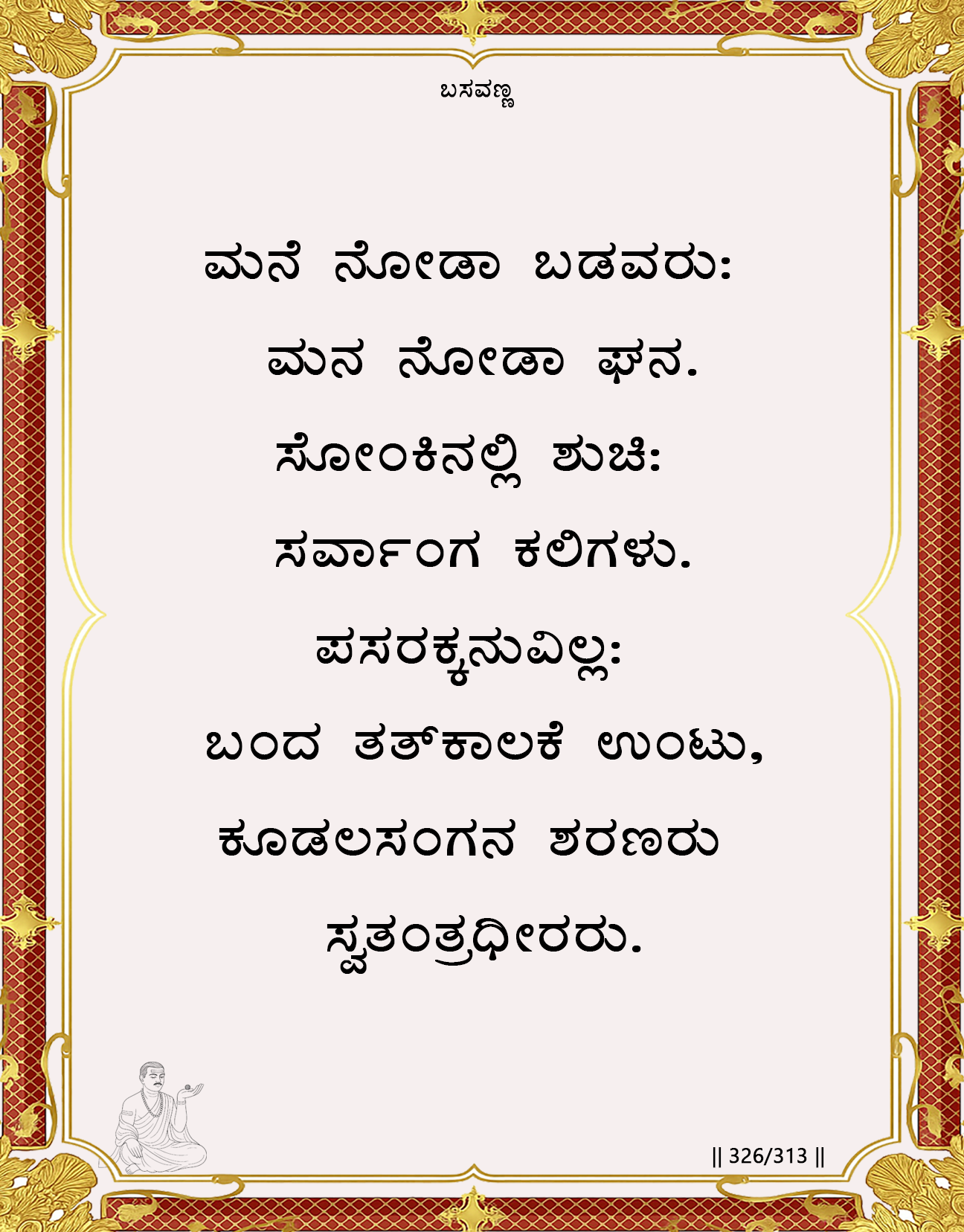
Their bodies may wear the clothing of poverty,
their homes seem bare,
their outward lives simple as dust.
But look into their minds
vast, luminous, immeasurable.
In the purity of their courage,
in the clarity of their deeds,
they stand as warriors of truth.
Without hesitation,
they arrive fully in the present moment,
free of fear, free of bargaining,
belonging to no one’s command.
Such are the companions
of Kudalasangama Deva
the Sharanas whose freedom
is their only wealth.
The Wealth of Inner Freedom In this vachana, Basavanna overturns conventional ideas of wealth and poverty. He shows that while the Sharanas may appear outwardly poor living in simple homes, wearing simple garments their inner world is immeasurably rich. Their thoughts are expansive, their minds purified, and their actions infused with fearless integrity. Basavanna describes them as warriors of purity: individuals who meet every moment with unwavering presence, free from dependence on external approval or material security. Their true currency is not gold, status, or possessions, but courage, clarity, and spiritual freedom. This teaching expresses the heart of Dasoha Dharma. Wealth is not measured by what one owns, but by the depth of one’s surrender, trust, and freedom from fear. The Sharanas embody this inverted economy they are rich because nothing binds them. For Basavanna, such beings are the true companions of Kudalasangama Deva: souls who live from the heart, whose only treasure is the freedom of divine awareness.
Spiritual Context
Core Spiritual Principle: The Economy of Consciousness (Caitanya-Artha). True value and “currency” are qualities of awareness: expansiveness, luminosity, fearlessness, and immediacy. Material wealth is a potential distraction from accumulating this inner capital.
Cosmic Reality Perspective: This is a non-dual critique of material dualism. The Shiva-Shakti dynamic is internalized: Shiva is the vast, luminous inner space (mind), and Shakti is the fearless, purifying power of action. The Sharana correctly prioritizes investment in this inner divinity, letting the external world (the body, the home) reflect that priority through simplicity, not lack.
Historical Reality (Anubhava Mantapa Context): This vachana was a socio-economic manifesto of the Lingayoga movement. It defended and celebrated the voluntary poverty of many Sharanas who left wealthy orthodox households. It redefined dignity, arguing that a person’s worth lies in their consciousness and ethical fiber, not in their caste-determined possessions. It created an alternative prestige system within the community, honoring inner attainment over outer display.
Interpretation
1. “Their bodies may wear the clothing of poverty, their homes seem bare…” This describes the principle of inversion. The external signifier (poverty) points to the opposite of the conventional meaning. Their simplicity is not deprivation but a conscious divestment (tyāga) from false currencies to highlight the true one within. The “dust” is not neglect but non-attachment.
2. “But look into their mindsvast, luminous, immeasurable.” This reveals the inner landscape of liberation. “Vast” indicates freedom from limiting identifications. “Luminous” signifies the clarity (prajñā) of self-knowledge. “Immeasurable” means their value cannot be quantified by any external scale. This is the actual treasury.
3. “Without hesitation, they arrive fully in the present moment, free of fear, free of bargaining…” This defines the functional currency of enlightenment. “Arriving fully” is the capacity for total engagement (kāyaka). “Free of fear” is security rooted in the divine refuge. “Free of bargaining” is action without ulterior motive or expectation of return (nishkāma karma). This is the spending of their inner wealth.
Practical Implications: Spiritual practice becomes the accumulation of inner capital: cultivating mental expansiveness through meditation, luminosity through self-inquiry, and fearlessness through ethical action and surrender. One audits one’s “wealth” not by bank statements but by the degree of freedom, presence, and courage in daily life.
The Cosmic Reality
Anga (Human Dimension): The Anga is the living ledger of consciousness. Its “accounts” are kept in the currency of awareness, courage, and presence. Its work is to transfer investment from external assets to internal ones, becoming “rich” in the qualities that survive bodily death.
Linga (Divine Center): Koodalasangama is the source of all true value and the ultimate asset. The Linga is the boundless expanse, the pure luminosity, the fearless being. To be a “companion of Koodalasangama” is to have one’s wealth merged with this infinite source; one’s treasury is therefore inexhaustible.
Jangama (Dynamic Interaction): The Jangama is the circulation of this spiritual currency. The “warrior of purity” spends their inner wealth fearlessly in every interaction. Their kayaka is not for wages but is itself an expenditure of divine capital into the world, enriching the collective consciousness.
Shata Sthala
Primary Sthala: Aikya. The description is of one in Aikya. Their inner wealth is the experiential richness of union itself. The “vast, luminous” mind is the mind dissolved in the cosmic mind. Their freedom from fear and bargaining is the natural state of one who knows themselves as the immortal Self, not the perishable body.
Supporting Sthala: Pranalingi. For the Pranalingi, the Linga is life itself. This vachana shows the economic consequence: if the Linga is your life, then all material supports are secondary. Your primary capital is the Linga-consciousness that animates you. You are rich because your core asset is divine.
Practical Integration
Arivu (Awareness Practices): Conduct a “Wealth Audit of Awareness.” Regularly assess: Is my mind more expansive or contracted today? Is my perception more luminous (clear) or cloudy? How much time did I spend in fearful bargaining vs. fearless presence? Invest time accordingly in practices that grow the former.
Achara (Personal Discipline): Practice conscious simplicity. Choose one area of material life to simplify, not as austerity, but as a ritual to redirect attention and value inward. Let the act be a affirmation: “My wealth is within.”
Kayaka (Sacred Action): Perform your work as the “spending” of your inner wealth. Bring expansiveness (creativity), luminosity (clarity), and fearlessness (integrity) to your tasks. Let your labor enrich the environment with these qualities, not just material output.
Dasoha (Communal Offering): Build an economy of inner wealth within community. Praise and support expressions of courage, clarity, and selfless service more than displays of material success. Create a culture where the “currency” Basavanna describes is recognized and rewarded.
Modern Application
The Performance of Wealth and Spiritual Materialism. In the age of social media and consumerism, worth is relentlessly performed through possessions, experiences, and curated personas. Even spirituality is often commodified (expensive retreats, guru franchises). This creates pervasive scarcity anxiety and a hollowing out of inner life.
Building an Inner Fort Knox. The practice of Basavayoga is to build unshakeable security in the inner treasury. It means deriving self-worth from the quality of your awareness and integrity, not your resume or feed. It involves a conscious boycott of the mental marketplace that trades in fear and status. In a gig economy, your true “portfolio” is your capacity for presence and fearlessness, which no market crash can devalue.
Essence
They measured their gold in sunlight,
their estates in sky.
Their accounts were kept in courage,
balanced in moments of unblinking grace.
While others built vaults for things that rust,
they spent their lives becoming spacious,
until the only thing they owned
was everything.
This vachana describes consciousness as a non-local field of value, decoupled from the localized material field. The Sharana’s “wealth” is a high-energy state in the consciousness fieldcharacterized by coherence (purity), amplitude (vastness), and low entropy (fearlessness). Matter (body, home) is a low-energy, localized expression. Societal error is valuing the low-energy localization over the high-energy field.
The Sharana correctly identifies with the field, making them “rich” in the fundamental currency of the universe: conscious energy. one has a giant, elaborate piggy bank full of tin coins (outer wealth, inner poverty). The other has a simple pouch, but it contains a map to a hidden gold mine (outer simplicity, inner wealth). Society praises the piggy bank. Basavanna says the mapand the skill and courage to mine the goldis the real treasure. The Sharanas are the map-holders and master miners of consciousness.
Our deepest insecurity is that we are not enough. We try to solve this by accumulating external proofs of enough-ness. Basavanna identifies this as the root of suffering and offers the radical cure: become actually enough by cultivating an inner reality so full, expansive, and fearless that the need for external validation simply ceases. The “wealth” he describes is the feeling of absolute existential security. The Sharana is not poor by circumstance but rich by choicea sovereign in the empire of their own awakened being.
Beyond its specific spiritual context, this vachana offers a transformative approach to life that transcends religious boundaries. The message speaks to our deepest human anxieties about security and survival, offering the radical antidote of trust and generosity. In an age of ecological crisis and economic inequality, this teaching provides the spiritual foundation for sustainable living: when we recognize that true security comes from belonging to the cosmic whole rather than possessing isolated parts, we naturally shift from accumulation to circulation, from anxiety to trust, from isolation to community.
The Sharana represents the fulfilled human being not the one who has the most but the one who needs the least because they are connected to the source of all. This understanding liberates us from the endless cycle of acquisition and protection that characterizes modern life, offering instead the profound peace that comes from knowing we are held by a reality that never fails those who trust it completely. Basavanna’s social-spiritual revolution the freedom of the Sharana.

Views: 7