Poetic Rendering

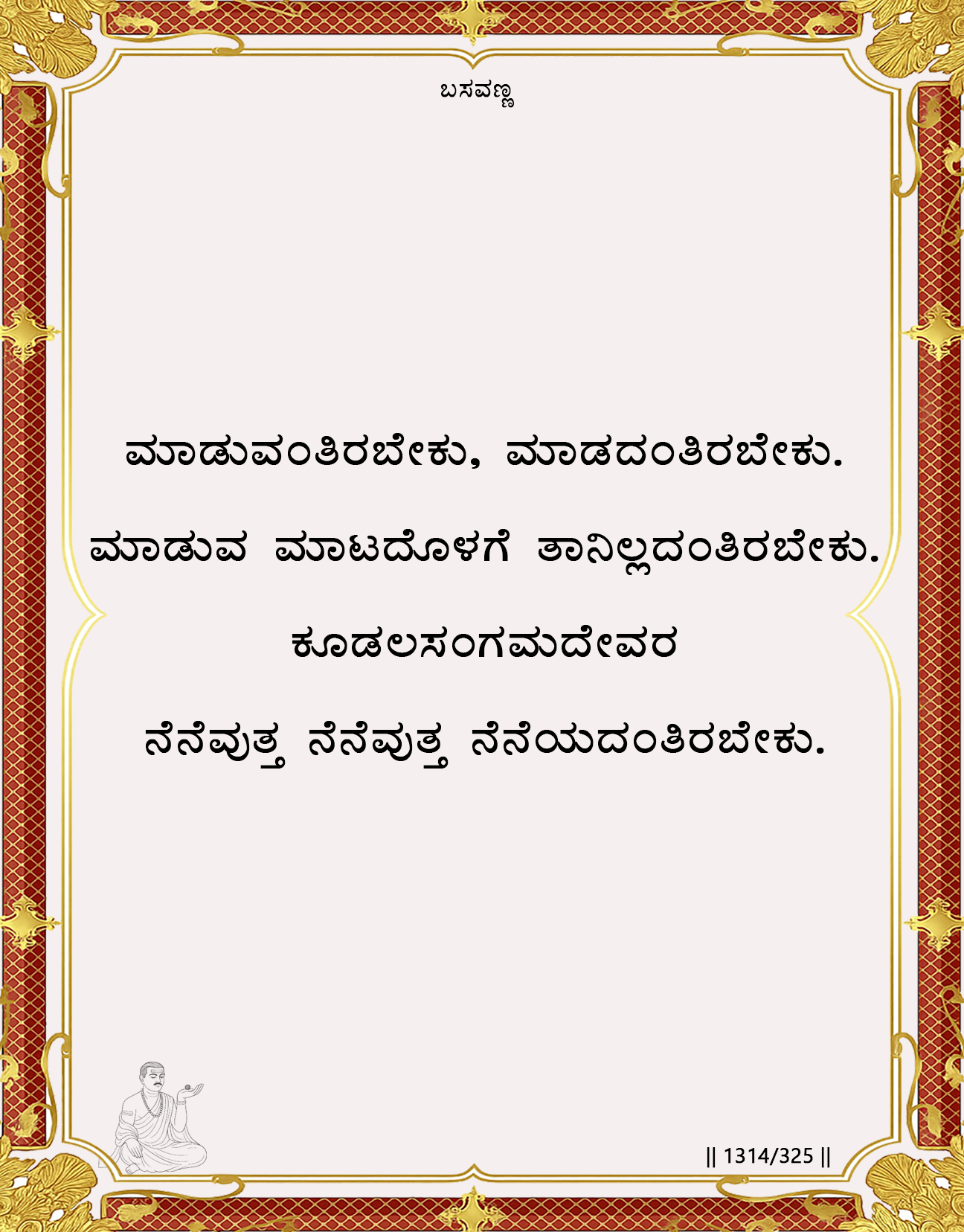
Worship when you seem to do nothing.
Worship even when your hands are full of doing.
When action dissolves into stillness,
and stillness flowers into action
let both be held as Linga-awareness.
For in the unbroken hum of being
in the rising, in the falling,
in the movement, in the pause
flows Your worship,
O Kudalasangama Deva.
It is not “doing” that worships,
nor “not doing,”
but the quiet flame of awareness
that burns in both.
Summary When Worship Becomes the Nature of Awareness In this vachana, Basavanna teaches the highest state of Lingayoga: worship that is no longer an act, but a state of consciousness. He dismantles the duality between doing and not-doing, between holding the Linga and setting it aside, between ritual and daily life. The immature seeker thinks devotion exists only in formal practice; the mature seeker discovers that awareness itself is worship. When consciousness rests naturally in the presence of the Linga both in activity and in stillness worship becomes as effortless as breathing. Basavanna here reveals sahaja-smṛti, the spontaneous, uninterrupted remembrance of the Divine. In this state, silence speaks, action prays, and each moment becomes the temple. This is not disciplined ritual but the natural radiance of a mind rooted in the Divine. Thus, the highest worship is not something we do, but something we are. This vachana stands as one of Basavanna’s most distilled expressions of non-dual awareness the culmination of his entire spiritual vision.
Spiritual Context
Core Spiritual Principle: Worship as the Ground State of Consciousness (Caitanya-Sthiti Pūjā). The most fundamental and natural state of aware being is itself the highest form of worship. It is not an activity undertaken by consciousness, but the very nature of consciousness when it is undistracted and abiding in its source.
Cosmic Reality Perspective: This is the non-dual resolution of the Shiva-Shakti dynamic into pure consciousness. Shiva is the silent, witnessing awareness (“seeming to do nothing”). Shakti is the dynamic power of manifestation (“hands full of doing”). In ordinary perception, they alternate. In the realized state described here, they are seen as one continuous spectrum of the same reality. The “quiet flame of awareness” is the light of Shiva in which the dance of Shakti is perceived, making every movement and pause an equal expression of the divine.
Historical Reality (Anubhava Mantapa Context): This vachana represents the culminating wisdom of the Lingayoga path, offered to mature practitioners in the Anubhava Mantapa. It served as the ultimate synthesis, resolving the apparent tension between the path of active kayaka (work as worship) and intense dhyāna (meditation). It declared that the community’s revolutionary engagement with the world and their deep inner devotion were not two paths, but two expressions of the same realized consciousness.
Interpretation
1. “Worship when you seem to do nothing. Worship even when your hands are full of doing.” This dismantles the temporal and modal limitations of devotion. Worship is removed from the realm of scheduled ritual and made co-extensive with time itself. The first line points to nirvikalpa samādhi (absorption without form), the second to sahaja samādhi (natural absorption amidst activity). Both are declared equally valid arenas for worship.
2. “When action dissolves into stillness, and stillness flowers into action let both be held as Linga-awareness.” This describes the dissolution of transition points. For the unawakened, there is a jarring shift between meditation and activity. Here, Basavanna speaks of a seamless continuum where the boundary dissolves. To “hold both as Linga-awareness” is to maintain the subjective feeling of being the unchanging witness (sākṣī) throughout the objective play of change.
3. “For in the unbroken hum of being… flows Your worship.” This identifies the source and substance of true worship. The “unbroken hum” (nāda) is the primal vibration of consciousness, the sound of “I Am” prior to thought. This foundational awareness, not any specific content (doing/not-doing), is itself the perpetual worship. It is the offering of existence back to itself.
Practical Implications: The seeker is released from the anxiety of “not doing enough” spiritually. Practice shifts from doing worship to being worshipful. This means cultivating a background of silent, loving awareness throughout the daya “flame” that is not disturbed by the winds of activity nor extinguished in the calm of rest. Formal meditation becomes the practice of recognizing this flame, and daily life becomes the arena of its natural expression.
The Cosmic Reality
Anga (Human Dimension): The Anga’s final role is to become the sanctuary. It is no longer a visitor to the temple of worship but the temple itself. Its work is to cease identifying as the doer or non-doer and to rest as the space (ākāśa) within which all doing and non-doing appear and are offered.
Linga (Divine Principle): Koodalasangama is revealed as the “unbroken hum of being.” The Linga is not an object of awareness but is awareness itself. It is the silent, vibrant presence that is the common denominator of all experience. The name “Koodalasangama” (Union of Confluence) is understood as this very confluence of the wave of individual awareness with the ocean of universal consciousness.
Jangama (Dynamic Flow): The Jangama is this hum in motionlife lived as a continuous, conscious offering. A true Jangama is one for whom this understanding is so embodied that their walking, talking, and resting are all seen as equal currents in the single stream of worship. They are the living demonstration that the path and the goal are one.
Shata Sthala
Primary Sthala: Aikya. This vachana is a pristine expression of Aikya. The state described transcends all stages of becoming; it is the stage of pure being. The “quiet flame” is the light of union that burns when the separation between self and divine has completely ceased.
Supporting Sthala: Sharana. The posture described is the ultimate Sharanataking refuge so totally that one’s very consciousness becomes the refuge. There is no longer a refuge-seeker and a refuge-giver; there is only refuge as the fundamental condition of existence.
Practical Integration
Arivu (Awareness Practices): Practice “Noting the Common Ground.” In meditation, notice the awareness that witnesses both thoughts and silence. In activity, notice the same awareness that witnesses both action and its results. Cultivate the recognition that this witnessing presence is constantit is the “unbroken hum.”
Achara (Personal Discipline): Let your discipline be to softly return to the hum. Whether busy or idle, whenever you remember, gently bring attention back to the simple, felt sense of being present. This is not a forceful concentration but a relaxing into the foundational awareness that is already there.
Kayaka (Sacred Action): Perform actions as expressions of this hum. Before and during work, connect with the inner silence. Let action arise from that stillness, like a melody from silence. The quality of the work will be infused with the peace of its source.
Dasoha (Communal Offering): In community, share and nurture this understanding of continuous worship. Support each other not just in doing good deeds, but in cultivating the silent, joyful awareness that makes every deed an offering. Celebrate the quality of presence in each other.
Modern Application
The Tyranny of Productivity and the Guilt of Inactivity. Modern life glorifies constant doing and pathologizes stillness, leading to burnout. Conversely, in leisure, we often feel guilty for “doing nothing.” Spiritually, this manifests as valuing intense retreats over integrated living, creating a debilitating cycle of spiritual highs and mundane lows.
Sanctifying the Continuous. The practice of Basavayoga today is to find the “unbroken hum” in the chaos of modern life. It is to discover that checking email can be as sacred as chanting if done with the same quality of present awareness. It liberates us by making every moment spiritually valid, dissolving the guilt of inactivity and the stress of overactivity into the peace of conscious being.
Essence
I used to visit God at appointed hours.
Now I have forgotten how to leave,
and He has forgotten how to be a guest.
The conversation never started,
so it never ends.
It hums in the kettle’s whistle,
in the pen’s scratch,
in the space between two thoughts.
This, I have learned, is the only liturgy:
to stay so unbearably awake
that even sleep becomes a prayer
whispered back into the ear of the Awakener.
This vachana describes consciousness as a non-local quantum field in its ground state. The “unbroken hum” is the zero-point field the foundational energy state of the universe that persists even in absolute vacuum. Individual experiences of doing and not-doing are excitations or vibrations within this field. Realization is the identification not with the excitations (the particles/waves) but with the field itself. Worship is the natural, perpetual activity of this field its sheer existence. The “quiet flame” is the field’s intrinsic luminosity, perceiving its own excitations with perfect equanimity.
Imagine the ocean. Waves (doing) rise and fall; calm (not-doing) prevails in between. The ocean is not fundamentally the waves or the calm; it is the water. The water is present in both states. Realization is identifying as the water, not as the temporary forms it takes. Worship is the water being perfectly, effortlessly itself, whether as wave or as stillness. Your essential awareness is that water.
We exhaust ourselves chasing spiritual experiences (waves) and spiritual quiet (calm), believing fulfillment lies in one state or the other. Basavanna reveals this to be a endless pursuit. Our deepest peace is found in being the capacity for all experience, not in any particular experience itself. The relentless search ends when we realize we are the sought. The “unbroken hum” is the sound of our own existence, the most intimate thing we possess, and recognizing it as divine turns the whole of life into a continuous, effortless homecoming.
This vachana is a luminous articulation of the spontaneous state of union (Sahaja Aikya). Basavanna reminds the seeker that devotion is not bound by ritual sequence it is the continuum of consciousness. Worship when you breathe, and breathe when you worship. Act without acting for He acts through all. When silence becomes God’s language, and the heart beats in His rhythm, then even the smallest gesture becomes eternal.

Views: 13