Poetic Rendering

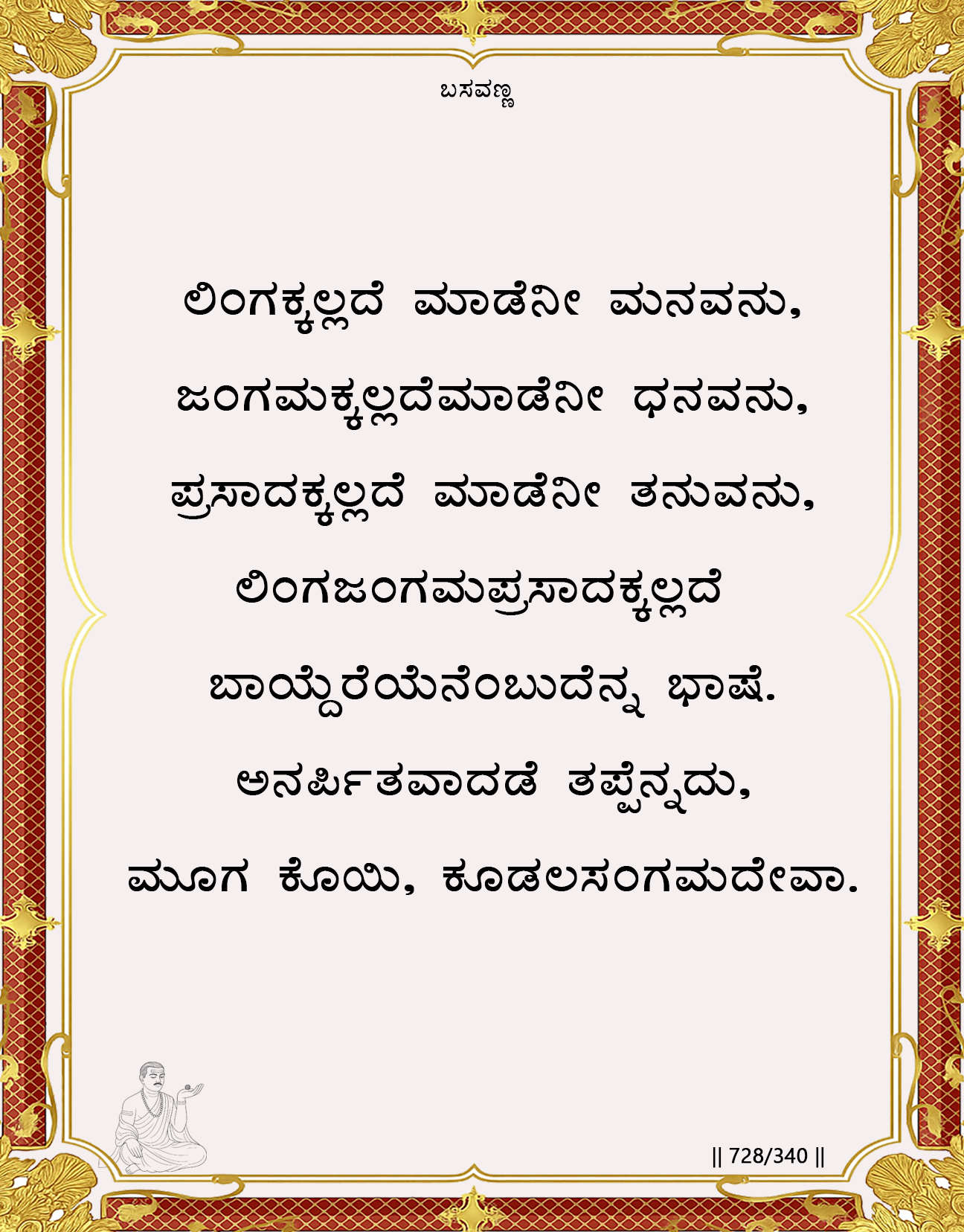
Let my mind be Yours, O Linga
a still mirror
where only Your radiance rests.
Let my wealth serve the Jangama
the moving flame of Your living truth.
Let my body be for Prasada
for work that nourishes,
for sharing that purifies,
for service that becomes sacred.
Beyond these three
mind, wealth, and body offered
let my tongue stay silent;
let it speak no word
that strays from remembrance of You.
And if ever I forget this vow,
if arrogance or distraction overtake me
then let my own speech
rise up and quiet me,
O Kudalasangama Deva.
This vachana expresses the complete alignment of human life with the divine order. Basavanna centers existence on the sacred triad: Linga (inner realization) the consecration of mind and consciousness Jangama (the realized being) the right use of wealth in service of living truth Prasada (sacred action and sharing) the consecration of the body through work and generosity Basavanna reveals that spiritual life is not an escape from the world but the transformation of every aspect of the self into an instrument of divine presence. When mind, wealth, and body are anchored in this triad, speech itself becomes holy arising not from ego, but from awareness. The teaching culminates in humility: if ever one forgets, may one’s own words awaken them again. This is the essence of living spirituality where devotion is not fragmented into rituals but becomes the breath, purpose, and expression of one’s entire being.
Spiritual Context
Core Spiritual Principle: Holistic Consecration (Samagra Arpaṇa). Liberation is not the negation of human faculties but their total redirection toward divine ends. The path is one of transference of ownership: from “my mind, my wealth, my body” to “Thine mind, Thine wealth, Thine body.”
Cosmic Reality Perspective: This is a non-dual mandala of functional unity. The vachana maps the microcosm (human being) onto the macrocosm (divine dynamics). The mind (subtlest aspect) aligns with Shiva (pure consciousness/Linga). Wealth/material energy (gross aspect) aligns with Shakti-in-motion (Jangama). The body (the field of action) aligns with the fruit of their union: grace-in-action (Prasada). This completes the circuit of divine circulation within a human life.
Historical Reality (Anubhava Mantapa Context): This was the constitutional charter for the Lingayoga community. It provided the ethical-spiritual framework for a functioning society: intellectual pursuit was for divine insight (mind to Linga), economic activity was for supporting teachers and community welfare (wealth to Jangama), and labor was for creating and sharing abundance (body to Prasada). It made spirituality the organizing principle of all social and personal life.
Interpretation
1. “Let my mind be Yours, O Lingaa still mirror where only Your radiance rests.” This consecrates the instrument of knowledge. The mind’s natural tendency is to reflect the world (saṁsāra). Here, it is repurposed to reflect only the divine source. Stillness (śānta) is not emptiness but selective receptivity to the highest truth.
2. “Let my wealth serve the Jangamathe moving flame of Your living truth.” This sanctifies the instrument of power and transaction. Wealth represents Shakti in frozen, potential form. Directing it to the Jangama (the realized teacher/community) is to invest it in the active preservation and propagation of awakening, ensuring spiritual energy circulates.
3. “Let my body be for Prasada for work that nourishes, for sharing that purifies…” This dedicates the instrument of action. The body is not for personal pleasure but for becoming a conduit of grace (prasāda). Work (kayaka) becomes the generation of grace; sharing (dasoha) becomes its distribution.
4. “Beyond these three… let my tongue stay silent; let it speak no word that strays from remembrance of You.” This establishes speech as the guardian of integrity. Speech (vāk) is the bridge between inner consecration and outer expression. It must be congruent. Silence is not absence of speech, but the refusal of speech that betrays the threefold offering.
5. “And if ever I forget… let my own speech rise up and quiet me…” This introduces the principle of autopoietic correction. The system is self-regulating. Forgetfulness generates speech that is discordant, hollow, or proud. That very speech, heard by one’s own consecrated awareness, becomes the alarm that restores remembrance and humility.
Practical Implications: Spiritual life requires a clear, recurring audit of one’s resources: Where is my attention (mind) focused? How is my money/time (wealth) being used? What is my physical energy (body) producing? Is my communication (speech) aligned?
The Cosmic Reality
Anga (Human Dimension): The Anga is the fully operational sanctuary. It is no longer a seeker building a temple; it is the temple, with each room (mind, wealth, body) dedicated to a specific sacred function. Its life is the continuous liturgy.
Linga (Divine Principle): Kudalasangama is the architect, beneficiary, and substance of the sanctuary. It is the silence that fills the mind-sanctum, the truth served by the wealth, and the grace flowing through the body-temple.
Jangama (Dynamic Interaction): The Jangama is the perfect performance of this liturgy. They are the mind perpetually mirroring the Linga, the wealth effortlessly flowing to where it serves life, the body seamlessly enacting Prasada, and the speech that is always a clear bell of remembrance.
Shata Sthala
Primary Sthala: Aikya. The total, functional surrender described is the lived reality of non-dual union (Aikya). The individual will has been harmonized with the divine will in all practical domains.
Supporting Sthala: Sharana. The act of making this vow is the ultimate expression of taking refuge (Sharana). It is the final, comprehensive surrender of all assets to the divine order.
Practical Integration
Arivu (Awareness Practices): Conduct a “Triad Audit” at day’s end. Reflect: 1) Mind: Did I dedicate my finest attention to the Divine today? 2) Wealth: Did my resources support truth, wisdom, or relief of suffering? 3) Body: Was my work done with integrity and shared generously?
Achara (Personal Discipline): Implement the “Speech Gatekeeper.” Before speaking, especially in conflict or pride, pause. Ask silently: “Does this serve the Linga (truth), the Jangama (harmony), or Prasada (healing)?” If not, practice the sacred silence the vachana prescribes.
Kayaka (Sacred Action): Explicitly dedicate your primary work as your “Body-Prasada.” Begin your workday with the intention: “This labor is my bodily offering to generate and share grace.”
Dasoha (Communal Offering): Build community systems based on this triad. Have a fund for supporting teachers and the needy (wealth to Jangama). Organize collective service projects (body to Prasada). Hold study or meditation groups (mind to Linga). Make the triad the community’s operational blueprint.
Modern Application
Extreme Fragmentation and Compartmentalization. We have a work self, a family self, a spiritual self, a consumer self. Our minds are scattered across digital fragments, our wealth often supports harmful systems, our bodies are neglected or used for vanity, and our speech is reactive and divisive. Life lacks an integrating center.
Creating an Integrated Life-Design. The practice of Shivayoga today is to use this vachana as a template to redesign one’s life. It asks: How can my career (body) be Prasada? How can my investments and spending (wealth) serve the Jangama (e.g., ethical companies, teachers, charity)? How can I curate my information diet and meditation (mind) to reflect the Linga? This framework turns life from a series of unrelated tasks into a coherent, sacred mission.
Essence
I draw a circle around my life
and inscribe it thus:
This minda clear pool for Your sky.
This goldfuel for the saint’s fire.
These handstools for the feast of grace.
And let my voice be only
the wind in that circle’s trees,
speaking of nothing
but the weather of Your presence.
And if a word should fall
like a stone in the pool,
let the ripples of its wrongness
reach the shore of my own hearing,
and there, let it teach me silence.
This vachana describes the establishment of a sovereign spiritual entity operating under divine jurisdiction. The human being is reconstituted as a principality where the divine (Linga) is the monarch, the constitution is the triad (Linga-Jangama-Prasada), and the citizen-faculties (mind, wealth, body) swear fealty. Speech is the diplomatic corps, authorized only to communicate the kingdom’s principles. The “self-correcting” clause is the kingdom’s internal judiciary built-in mechanism to adjudicate and correct treasonous acts (forgetful speech). This is the transition from a chaotic, contested territory of competing desires to a peaceful, efficiently governed state wholly aligned with a higher sovereignty.
Imagine a modern corporation. A dysfunctional one has departments (mind/R&D, wealth/Finance, body/Operations) working at cross-purposes, with PR (speech) spinning stories. Basavanna’s vachana is the moment of a visionary turnaround. The new CEO (the awakened self) restructures the entire company with a single mission: to express a core sacred value. R&D (mind) focuses only on innovations aligned with the mission. Finance (wealth) only funds projects that further it. Operations (body) only manufactures products that embody it. PR (speech) only communicates this truth. Any statement that contradicts the mission is immediately flagged by the company’s own ethics office (self-awareness) and corrected. The company becomes purpose-driven, integrated, and authentic.
Our suffering stems from inner civil war parts of us want different, contradictory things. We are exhausted from managing this internal conflict. This vachana offers the peace treaty: a unifying, non-negotiable purpose for our entire being that transcends petty desires. The consecration is not a loss of freedom, but the end of internal conflict. The mind finds peace in reflection, not chase. Wealth finds purpose in circulation, not hoarding. The body finds dignity in service, not indulgence. Speech finds power in truth, not manipulation. In this integration, we no longer “have” a spiritual life; we are a spiritual life, breathing the singular Breath of Being.

Views: 11