Poetic Rendering

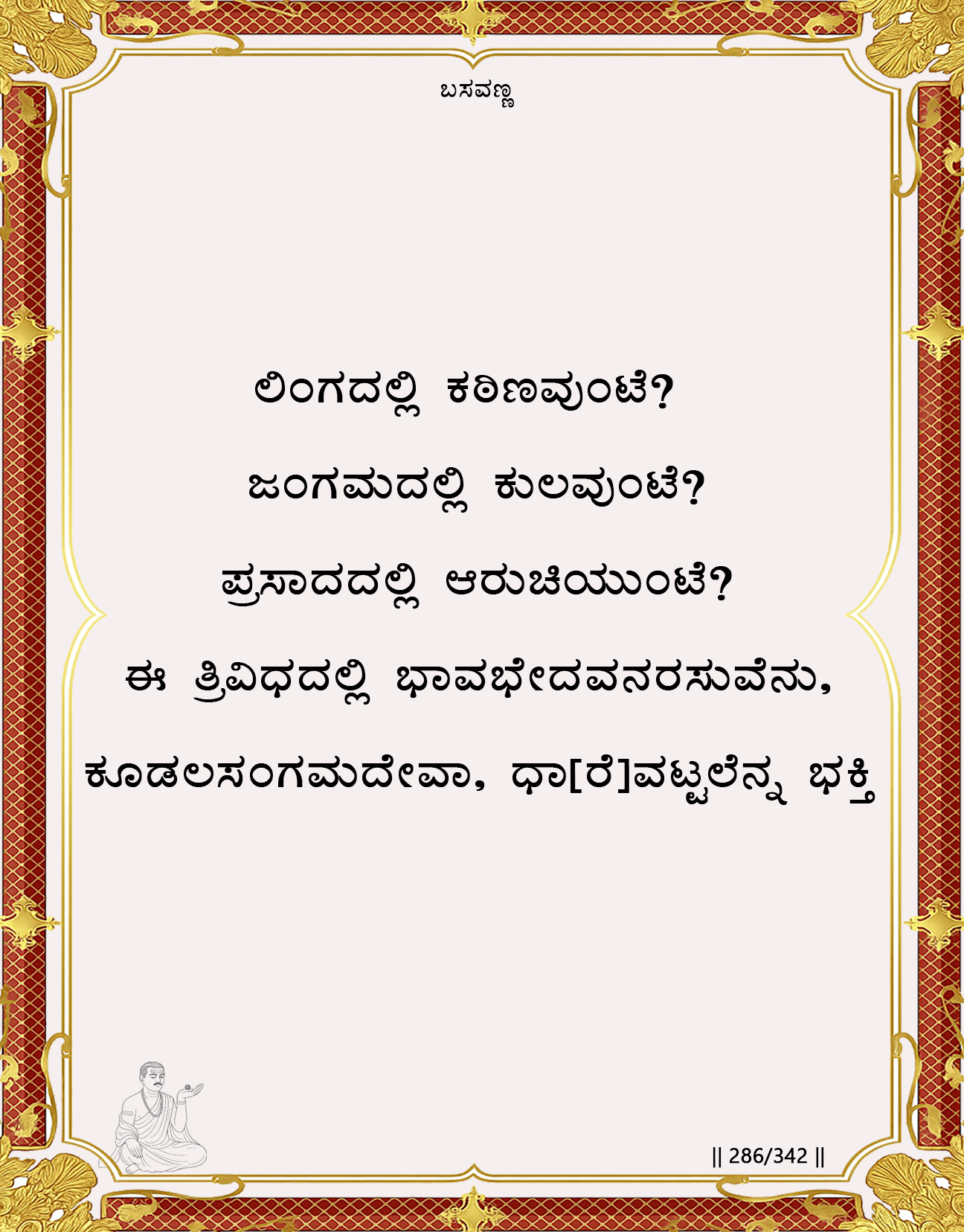
Is there pride in the Linga
the boundless, deathless One?
Is there caste or creed in the Jangama
the living form of the same Divine?
Is there bitterness in Prasada
the sharing that springs from grace
and knows no division?
In this holy threefold unity
I shall see no separation,
no wall of name or birth or belief.
My devotion, O Kudalasangama,
flows like the jaladhara-pātre
a vessel whose steady stream
pours only You,
and nothing else.
In this vachana, Basavanna affirms the indivisible unity of the three pillars of his spiritual path:
1. Linga the transcendent, all-pervading Divine which contains no pride, hierarchy, or distinction. 2. Jangama the living embodiment of that Divine in whom there can be no caste, sect, or social division.
3. Prasada the sacred sharing of one’s resources, labor, and experience, which is by nature sweet, impartial, and universal.
Basavanna insists that any division among these three whether by pride, status, caste, or ego is a violation of the very foundation of devotion. He likens his bhakti to the jaladhara-pātre (also called the gālantika):a vessel with a small opening at the bottom that offers a continuous, unbroken stream of water to the Linga. This image expresses humility, constancy, and purity devotion that flows without interruption, without judgement, without discrimination. For Basavanna, the Divine unity is not a concept but a lived truth: To divide is to fall; to remain whole is to worship.
Spiritual Context
Core Spiritual Principle: The Inherent Purity of the Sacred Triad (Traya Śuddhi). Linga, Jangama, and Prasada are not just concepts but fundamental realities that are, by their nature, free from human corruptions of ego, hierarchy, and conditionality. To impose such divisions upon them is a fundamental error of perception and a corruption of devotion.
Cosmic Reality Perspective: This is a non-dual declaration of the intrinsic sanctity of existence. In Shiva-Shakti terms: Shiva (Linga) is pure consciousness, without the contaminant of separate identity (ahaṅkāra). Shakti as dynamic expression (Jangama) is pure energy, without the limitations of constructed form (upādhi). Their harmonious interplay naturally yields grace (Prasada) that is universally sweet and nourishing. Division is a mental overlay, not a feature of reality.
Historical Reality (Anubhava Mantapa Context): This vachana was the constitutional guarantee against corruption within the Lingayoga community. It preemptively declared that the movement’s core symbolsthe personal Linga, the wandering teacher (Jangama), and the communal meal (Prasada)were immune to and must be protected from the societal poisons of caste pride, sectarianism, and conditional charity. It was a theological immunization against hierarchical drift.
Interpretation
1. “Is there pride in the Linga?” Pride (abhimāna) requires a subject-object dichotomy. The Linga, as the non-dual substrate of all, is the very ground of being prior to such division. The question is rhetorical, exposing the absurdity of projecting human ego onto the absolute.
2. “Is there caste or creed in the Jangama?” Caste (jāti) and creed (mata) are mental classifications. The Jangama, as the Divine in human motion, operates from a consciousness that has shattered all such conceptual cages. To see a Jangama through these lenses is to miss the reality for the costume.
3. “Is there bitterness in Prasada?” Bitterness (kaṣāya) arises from attachment, expectation, or resentment. True Prasada is grace materializedit is the unconditional fruit of divine generosity. Its nature is sweetness (mādhurya), the taste of selfless giving and receiving.
4. “In this holy threefold unity I shall see no separation…” This is the vow of integrated perception. The devotee commits to seeing the triad as a single, flowing process: Source (Linga) -> Expression (Jangama) -> Nourishment (Prasada). Any “wall” is an illusion maintained by ignorance.
5. “My devotion… flows like the jaladhara-pātre…” The jaladhara-pātre (a vessel with a small, steady outlet) symbolizes devotion as a law of nature. It is constant, humble (the stream is thin), targeted (only to the Divine), and pure (nothing else mixed in). It represents the ideal state of the human vessel.
Practical Implications: Every act of reverence, every encounter with a teacher, every instance of giving or receiving must be consciously purified of mental divisions. Devotion is not a sporadic ritual but a continuous, undifferentiated flow of aligned awareness.
The Cosmic Reality
Anga (Human Dimension): The Anga is the vessel in need of calibration. Its task is to drill the single, correct opening (the heart) and align it perfectly so that its contents (life-energy) flow uninterruptedly toward the Divine, without being diverted by the sediments of pride, prejudice, or possessiveness.
Linga (Divine Principle): Kudalasangama is the ocean and the gravitational pull. It is the source of all water (grace) and the force that draws the stream downward. Its nature is absolute inclusivity; it receives all streams without discrimination.
Jangama (Dynamic Interaction): The Jangama is the river that demonstrates the law of flow. They show that a human life can be a perfect conduit no dams of caste, no diversions of creed, no pollution of bitterness carrying the water from source to field (the world) efficiently and sweetly.
Shata Sthala
Primary Sthala: Aikya. The perception of non-separation in the sacred triad is the functional definition of the Aikya stage. The devotee no longer relates to Linga, Jangama, and Prasada as separate entities but experiences them as facets of one reality.
Supporting Sthala: Sharana. The attitude of the jaladhara-pātre constant, reliant, single-pointed offering is the essence of taking refuge (Sharana). It is the practical stance that leads to the realization of Aikya.
Practical Integration
Arivu (Awareness Practices): Practice the “Triadic Gaze.” When you see your Ishtalinga (Linga), when you meet a respected elder or teacher (Jangama), and when you give or receive food or help (Prasada), consciously affirm: “This is one sacred movement. I see no division here.”
Achara (Personal Discipline): Create a “Jaladhara Ritual.” Use a water vessel with a small opening to water a plant or offer water to the Linga. As you watch the steady, unbroken stream, internalize the quality of your devotion: constant, patient, and directed.
Kayaka (Sacred Action): In your workplace or home, perform tasks as an offering of Prasada. Before starting, set the intention: “This work is part of the sacred stream. May no bitterness of resentment, no pride of ownership, and no caste-like hierarchy enter into it.
Dasoha (Communal Offering): In community gatherings, ensure that the sharing of food (Prasada) is done in a manner that explicitly honors the triad: blessed as an offering to the Linga, served with the reverence due a Jangama, and distributed to all without the slightest discrimination.
Modern Application
The Fragmentation of the Sacred and the Commodification of Spirituality. We compartmentalize spirituality (Linga) to private belief, valorize spiritual teachers (Jangama) as celebrities creating fan hierarchies, and turn generosity (Prasada) into transactional charity or virtue-signaling. The natural unity is shattered.
Weaving the Sacred Back into the Fabric of Life. The practice of Basavayoga today is to repair this fragmentation. It means treating your daily work as Prasada directly offered to the Linga through the medium of serving the Jangama (the divine in others). It means following teachers not for their personality but for the undistorted stream of truth they carry. It restores spirituality as a continuous, integrated flow, not a set of isolated transactions.
Essence
You ask: Does the sky boast of its blueness?
Does the river choose which banks to grace?
Does the harvest’s grain remember
which field was high or low?
I have seen the source, the flow, the gift
are one water, one cycle, one breath.
So I make my heart a simple pot
with a single, steadfast leak:
a thin, silver thread of remembrance
that never says “this, not that,”
wearing down the rock of separation
until only the ocean’s song remains.
This vachana describes a topological invariant in the field of consciousness. The properties of being division-less, label-less, and condition-less are invariant characteristics of the fundamental triad (Linga, Jangama, Prasada). Just as in mathematics a circle remains a circle regardless of rotation or translation, these spiritual realities retain their essential purity regardless of the human mind’s projections. The jaladhara-pātre represents a system in a limit cycle a stable, rhythmic oscillation (the steady drip) that maintains its form far from equilibrium, symbolizing a soul in sustained devotion, dynamically stable against perturbations of ego and society.
Imagine a pure mountain spring (Linga). The water that flows from it (Jangama) is inherently pure. The cup you drink from it (Prasada) is inherently refreshing. Now, if someone says, “This water is only for Brahmins,” or “This cup is bitter,” the error is not in the spring, the water, or the cupit’s in the person’s imposed story. Basavanna says: be like a simple channel (the jaladhara) that just carries the water from spring to mouth without adding any story, color, or filter. Your job is to not contaminate the stream with your own mental divisions.
Our minds are categorization engines; we survive by labeling and separating. But in the realm of spirit, this survival tool becomes a prison. We create “holy” and “profane,” “pure” and “impure,” “us” and “them,” and then worship our own categories instead of the reality they obscure. This vachana calls for a cognitive ceasefire. It invites us to experience realityin its divine source, its human expression, and its gracious exchangedirectly, without the interpretive noise of social and egoic conditioning. The peace we seek is found not in better categories, but in the “steady stream” of perception that washes them all away, leaving only the taste of the sacred.
A Sacred Framework Uniting the Cosmic, Human, and Natural Dimensions of Basavanna’s Vision Where Oneness Is the Pulse of Existence.

Views: 13